Reporter Spent 18 Months Hunting the True Identity of Bitcoin's Satoshi Nakamoto
After 18 months in bitcoin's cryptographic archives, reporter John Carreyrou confronts why Satoshi's identity matters now: 1.1 million dormant coins worth billions and rising legal chaos.
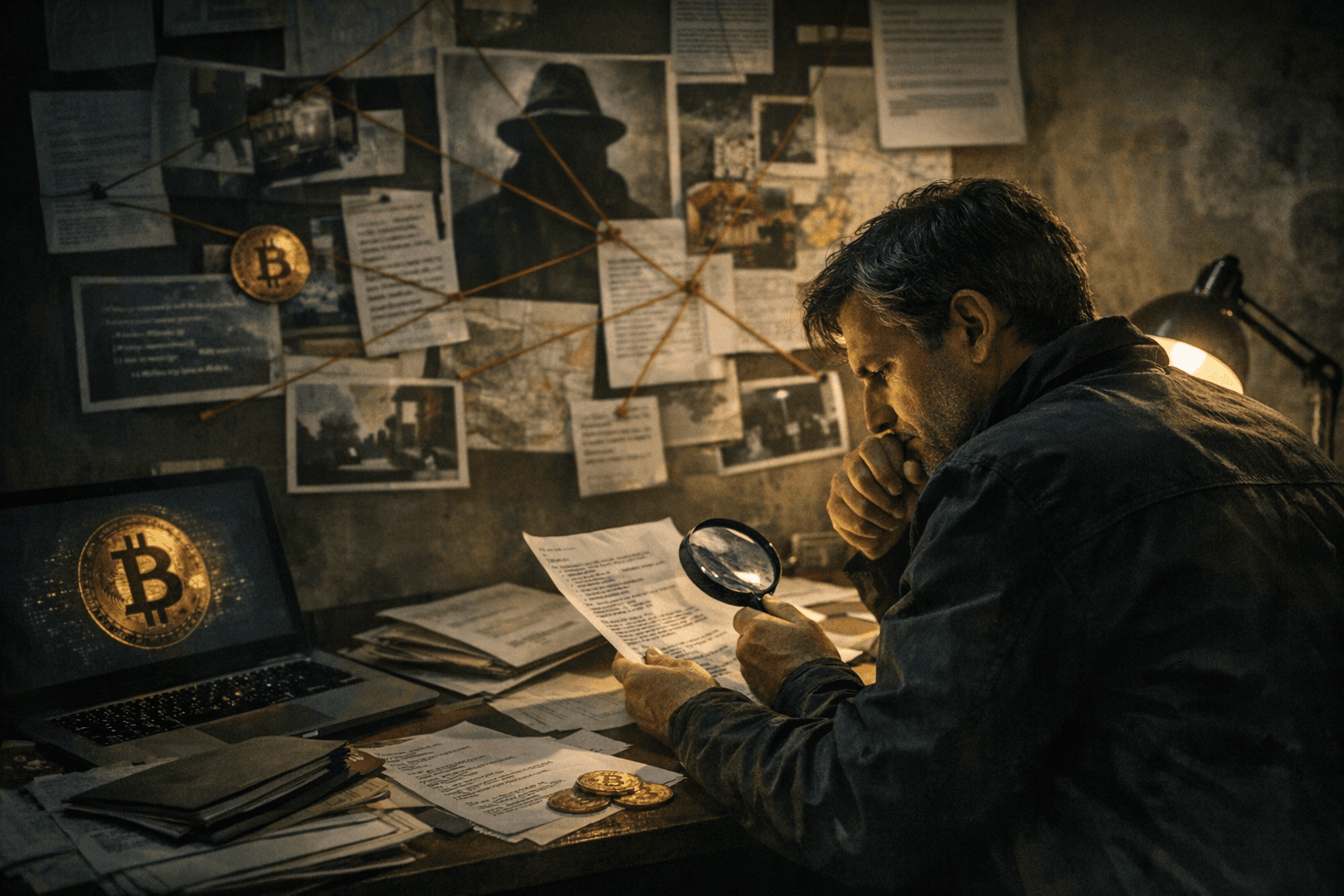
The wallet has not moved since 2010. Inside it sit an estimated 1.1 million bitcoins, worth approximately $77.9 billion as of February 2026, controlled by an unknown person or group operating under the pseudonym Satoshi Nakamoto. Identifying that person is no longer an academic exercise. It sits at the center of fraud prosecutions, quantum computing emergency planning, and a succession of courtroom dramas that have exposed just how badly the uncertainty can be exploited.
Investigative reporter John Carreyrou spent 18 months working through the archives of online cryptography communities, the cypherpunk mailing lists and early Bitcoin forums where Nakamoto surfaced in late 2008 and then, by 2011, vanished. The evidentiary landscape he encountered was rich in linguistic fingerprints and chronological clues, but thin on anything that could withstand a legal standard of proof.
The fundamental problem has not changed since Bitcoin's genesis block was mined in January 2009: the only conclusive proof of authorship would be a message cryptographically signed with the private keys attached to Satoshi's earliest Bitcoin addresses. No one has produced it. Stylometric analysis of the 3,076-word Bitcoin whitepaper, which contains a telling mix of British spellings like "favour" alongside American constructions like "characterized," has pointed investigators toward the cypherpunk community in the United Kingdom. Researchers applying AI-driven language modeling in 2025 compared Nakamoto's grammar and syntax patterns against dozens of candidates. The results narrowed the field but did not close it.
The candidates who have attracted the most sustained scrutiny include cryptographer Nick Szabo, Hashcash inventor Adam Back, and the late cypherpunk Len Sassaman, who died in 2011. A 2024 HBO documentary, "Money Electric: The Bitcoin Mystery," pointed to Canadian developer Peter Todd; Todd denied it and cryptographers widely dismissed the claim as lacking on-chain proof. The most spectacular failure of identification belonged to Australian computer scientist Craig Wright, who publicly claimed to be Satoshi starting in 2016. In March 2024, the High Court of England and Wales ruled that Wright was not Nakamoto, finding that documents he submitted as evidence were forgeries and that he had, in the court's words, "lied to the court extensively and repeatedly." In December 2024, Wright was sentenced to one year in prison, suspended for two years, for contempt of court.
The legal wreckage of the Wright case illustrates the danger the identity vacuum creates. A 58-year-old British businessman named Stephen Mollah has separately faced a private fraud prosecution for allegedly impersonating Satoshi Nakamoto to deceive investors, a scheme that would have been far harder to execute if Nakamoto's true identity were publicly established.
The stakes have sharpened further on the security front. Quantum computers powerful enough to break Bitcoin's public-key cryptography could expose roughly 7 million coins, including the approximately 1 million attributed to Nakamoto, a pool worth an estimated $440 billion at current valuations. Whether those coins could be frozen or migrated without a verified owner remains an open policy question that the Bitcoin community cannot answer while Satoshi's identity stays sealed.
The Wikipedia record on Nakamoto reflects what Carreyrou's archive reporting confirms: the wallet has been untouched since 2010, and the person behind it gave enough false biographical signals, including a claimed Japanese residence, to suggest the anonymity was deliberate and carefully maintained. What would force an answer now is not journalism alone. It is a wallet that finally moves, a court order that compels cryptographic disclosure, or archival verification robust enough to survive cross-examination, none of which has materialized in 17 years.
This article was produced by Prism’s automated news system from verified source data, official records, and press releases, then run through automated quality and moderation checks before publishing. The system is built and supervised by the people who set the standards it runs under. Read our full AI policy.
Did this article answer your question?