Republican Clay Fuller Wins Georgia Special Election for State House Seat
Fuller won Georgia's 14th Congressional District 56-43, but Harris's 25-point Democratic overperformance in Trump's reddest Georgia district is the number Republicans will be studying all summer.
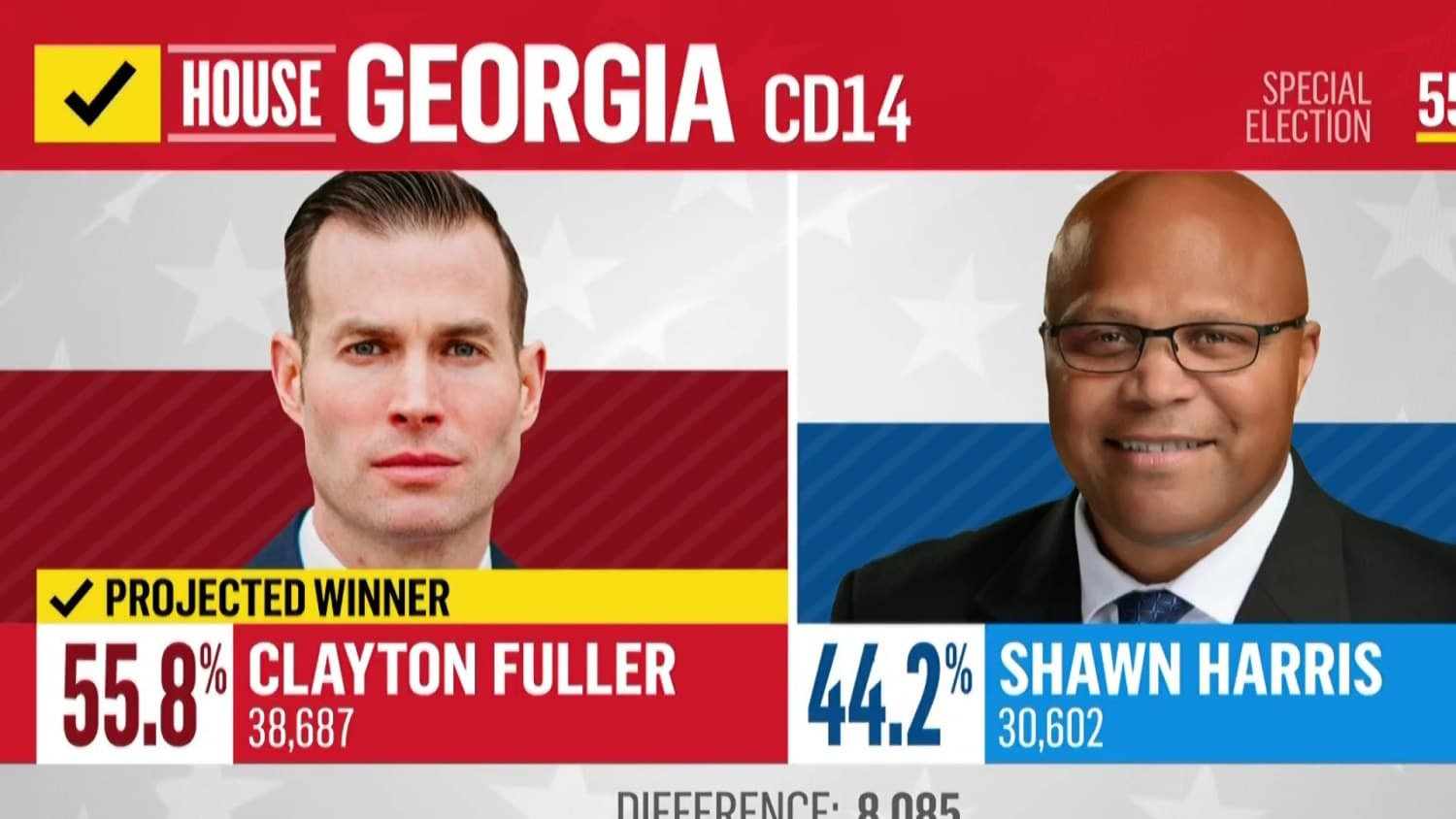
Clay Fuller won Georgia's 14th Congressional District special election runoff Tuesday night, defeating Democrat Shawn Harris 56% to 43% to claim the seat Marjorie Taylor Greene vacated in January. The Associated Press called the race after 8 p.m. But the margin, not the outcome, became the night's defining story.
Republicans avoided an upset by electing the Trump-endorsed Fuller, a local district attorney, to fill Greene's former seat in the northwestern 14th Congressional District. Yet the final spread of roughly 12 points was a dramatic compression of the district's historical Republican advantage. Harris lost by 11.8 points but pulled off the largest Democratic overperformance in a House special election since Trump took office, outperforming the Democratic 2024 presidential results by 25 points. In a district where Trump carried 68% of the vote just 18 months ago, that gap is the kind of number that reshapes midterm strategy.
Harris's best performances came in Cobb and Paulding counties, the two most populous in the district and the ones closest to metro Atlanta. Those suburban gains tracked a pattern Democratic strategists have been watching for months: the party's erosion of Republican margins in exurban and suburban communities outpacing any movement in more rural corners of the district. In deeply rural Chattooga County, Democrats received about 26% of the vote in the March 10 first round; on Tuesday that rose to roughly 30%, a slight improvement but not enough to seriously threaten Fuller's advantage in the district's smaller, more conservative precincts.
The early-vote mechanics shaped how the night read in real time. All 10 counties in the district tend to release absentee results in the first vote update, and four counties including Paulding and Cobb also include early in-person votes. Since 2020, Democrats have been more likely to cast votes early or by mail, meaning Harris held early leads before Election Day totals from rural precincts erased them, a pattern Republicans will need to account for as they model November turnout.
The fundraising imbalance was stark. Harris raised nearly $6.5 million to Fuller's $1.2 million, yet the money didn't close the gap enough to flip the seat. Democrats invested more than $1.5 million to defend the Trump +37 seat, drawing national surrogates including Pete Buttigieg and Senator Raphael Warnock for Harris's closing stretch.

Fuller is a former White House fellow in the first Trump administration and a lieutenant colonel in the Georgia Air National Guard. Harris, a retired Army brigadier general and cattle farmer, ran as a self-described "dirt-road Democrat" and notably improved on his own prior performances: he modestly improved his vote share in nine of the district's 10 counties compared to 2024, when he received just 35% against Greene herself.
House Republicans currently hold a 217-214 majority; once Fuller is sworn in, they will be able to afford only two defections on party-line votes. That reality gives Fuller's seat immediate legislative weight, but it also hands Democrats a recruiting tool: if Harris can post a 43% performance in Georgia's reddest congressional district, the party's operatives will argue that virtually no seat in the state should be written off ahead of November.
Both Fuller and Harris are already seeking their parties' nominations for a full two-year term in the May 19 primary. The seat is up again in 210 days, and both campaigns begin that sprint having just told Georgia, and the country, exactly how much the political terrain has shifted under their feet.
Sources:
Know something we missed? Have a correction or additional information?
Submit a Tip