Resourceful Miniatures demonstrates prepping, basecoats, layering and glazing on a Beholder miniature
Resourceful Miniatures published a beginner-friendly Beholder tutorial demonstrating prepping, basecoats, layering and glazing, useful for painters tackling complex organic minis.

Resourceful Miniatures premiered a new tutorial video titled "Painting a Beholder - D&D’s Most Iconic Monster" on Feb 3, 2026, laying out a full process walkthrough that matters to painters at every level. The video focuses on preparation, basecoats, layering and glazing, four core skills that determine whether a multi-limbed sculpt reads clearly on the tabletop.
The creator opens with preparation, showing why cleaning mold lines, controlling flash and getting a consistent primer coat are worth the time. Good prep makes subsequent basecoats go on smoothly and prevents glaze and wash pooling in small recesses. For a Beholder miniature, where eye-stalks and the central eye present many tight angles, that groundwork changes how clean highlights and color transitions look at gaming distance.
Basecoats are treated as the structural stage rather than a finished pass. The video demonstrates blocking in dominant colors to establish silhouette and value. Layering then builds midtones and edge highlights in manageable steps, allowing painters to refine contrast without resorting to aggressive drybrushing that can obscure sculpt detail. Glazing is presented as the finishing tool for unifying transitions and nudging color temperature - thin, controlled layers of pigment that alter hue and smooth out gradations without covering underlying work.
Practical takeaways are front and center. Resourceful Miniatures emphasizes thinning paints to glazing consistency, managing brush moisture, and pacing layers to let previous work cure. Those techniques reduce common problems such as streaking on organic surfaces and inconsistent gloss in eye-socket areas. The approach is explicitly beginner-friendly: the sequence from prep to glaze provides a repeatable workflow that novices can practice on spare minis before attempting a display piece.
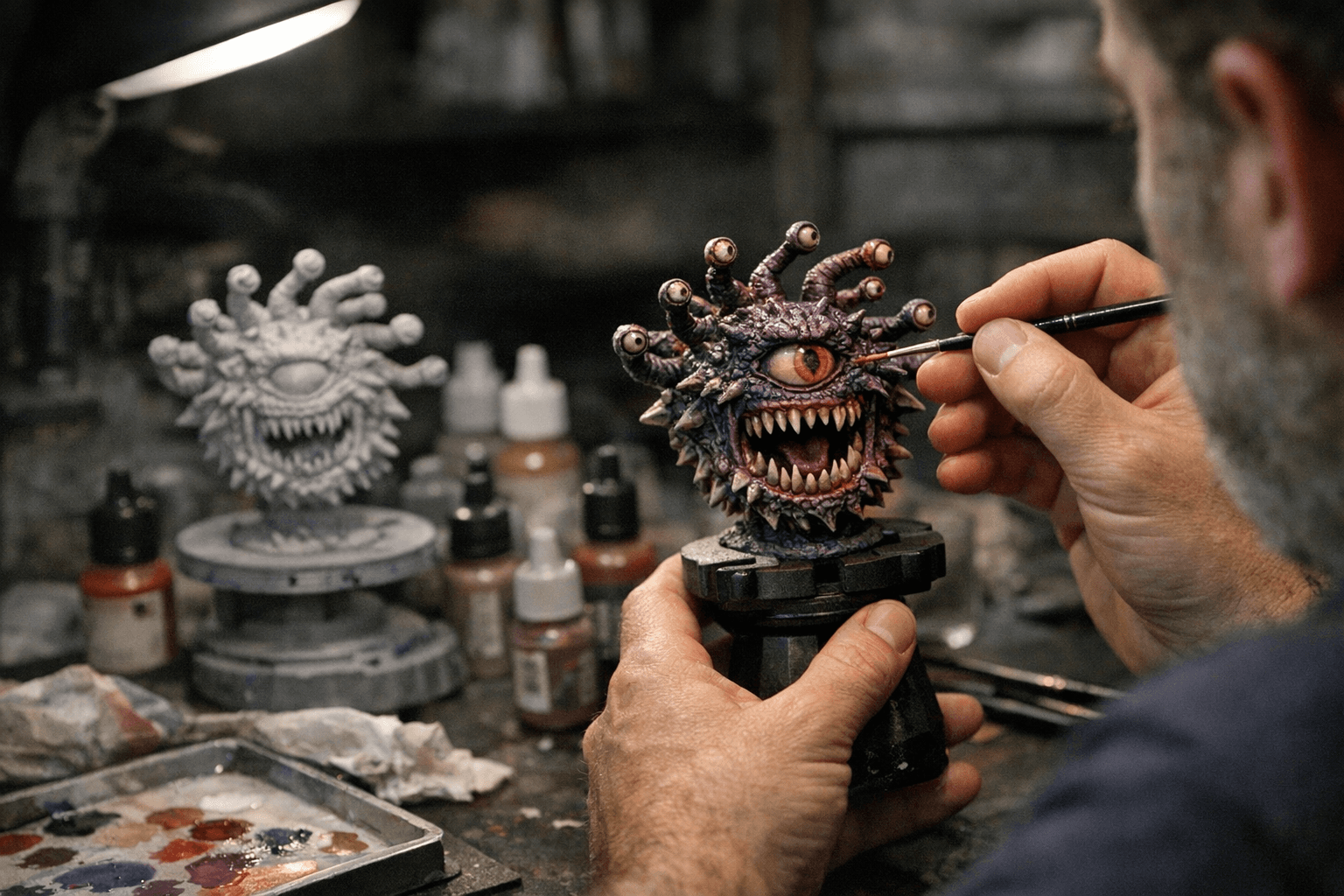
Community relevance is immediate. Beholders are a rite of passage in D&D painting circles because their anatomy forces mastery of small-scale transitions and focal points. A clear, watchable template for handling those issues helps local gaming groups and online paint-and-tell threads, raising the overall baseline for table-ready minis.
For readers ready to try this method, start by applying the same four-stage workflow to an inexpensive test miniature: clean and prime, block basecolors, build layers, then apply thin glazes to harmonize. Share before-and-after photos with your group to compare glazing approaches and brush control. Resourceful Miniatures’ tutorial reduces the intimidation factor and gives painters a practical path from messy basecoats to a coherent, eye-catching Beholder on the tabletop.
Know something we missed? Have a correction or additional information?
Submit a Tip