Retired Teachers Return as National Shortage Leaves Thousands of Classrooms Empty
At least 411,549 U.S. teaching slots were unfilled or undercertified in 2025, pushing districts to recruit retirees just to keep classrooms open.

Schools are not bringing retired teachers back because they are nostalgic for the past. They are doing it because the staffing model is breaking under national pressure, with classrooms that would otherwise sit empty or be covered by long-term substitutes.
The scale of the shortage is now hard to dismiss as a few hard-to-fill jobs. The Learning Policy Institute said at least 411,549 teaching positions nationwide were either unfilled or staffed by teachers not fully certified for their assignments in 2025, about 1 in 8 teaching positions. It also counted 45,582 unfilled teacher positions across 31 states plus Washington, D.C., a sign that the problem reaches well beyond one region or one subject.
The National Center for Education Statistics found that 74% of public schools had trouble filling one or more vacant teaching jobs before the start of the 2024-25 school year. The toughest openings were in general elementary teaching, special education and English language arts. Those are not peripheral roles. They are core positions, the ones districts need most to keep class schedules intact and students moving through the next school year without disruption.
That is why retired educators have become part of the emergency response. Districts are recruiting them because they already know the curriculum, the classrooms and the daily demands of school life. But their return solves only the immediate problem of coverage. It does not reverse the deeper forces driving shortages: fewer people entering teaching and high turnover among current teachers.
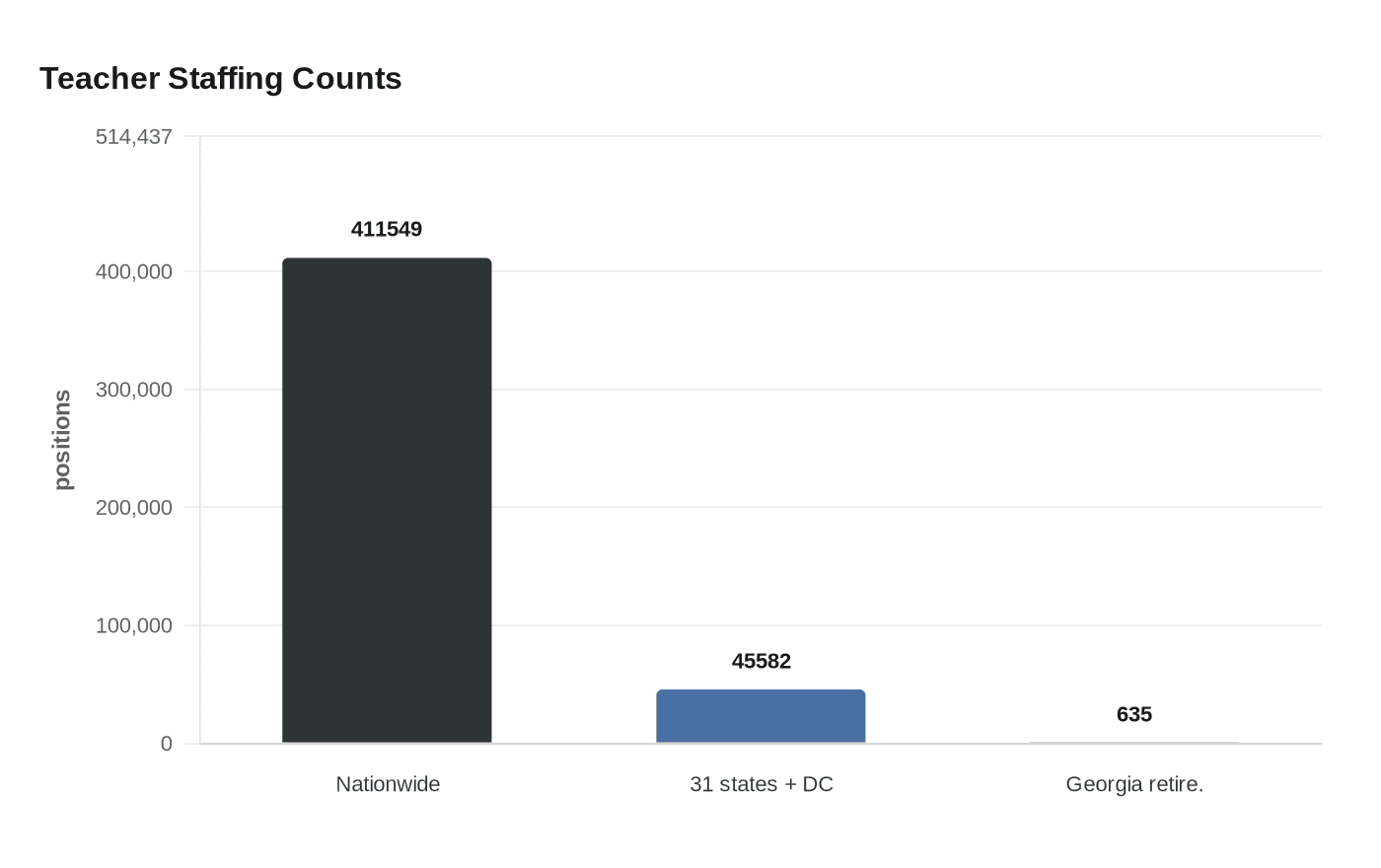
Georgia shows both the promise and the limit of the approach. A state audit found that since HB 385 took effect, school systems employed 635 full-time retired teachers, generating about $11.1 million in contributions to the Georgia Teachers Retirement System. Even so, the audit said the law had only a minimal effect overall, and the retirees accounted for less than 1% of the state’s teacher workforce.
Georgia lawmakers kept looking for ways to make return-to-work easier. Senate Bill 150, considered in 2025, would have allowed retired teachers with 25 years of service to come back 60 days after retirement. An older rule had required a one-year wait after 30 years of service and applied only in limited high-demand subjects. Other states have followed with their own changes. Tennessee passed a 2025 law to let retirees in hard-to-fill positions return while keeping most retirement benefits. Louisiana enacted a similar measure. Missouri also changed its rules to encourage retirees to return, while noting an earnings exemption amount of $21,240.
The pattern points to a national system under strain. Retirees can buy time for districts facing immediate vacancies, but they cannot by themselves solve the shortage that is already shaping staffing, class size and course availability for the year ahead.
This article was produced by Prism’s automated news system from verified source data, official records, and press releases, then run through automated quality and moderation checks before publishing. The system is built and supervised by the people who set the standards it runs under. Read our full AI policy.
Did this article answer your question?

