Rio's altinha turns World Cup warm-up into street sport ritual
Rio’s altinha is a warm-up drill turned beach ritual, side hustle and claim on public space. In Rio, the game matters almost as much as kickoff.

How altinha turns a warm-up into neighborhood life
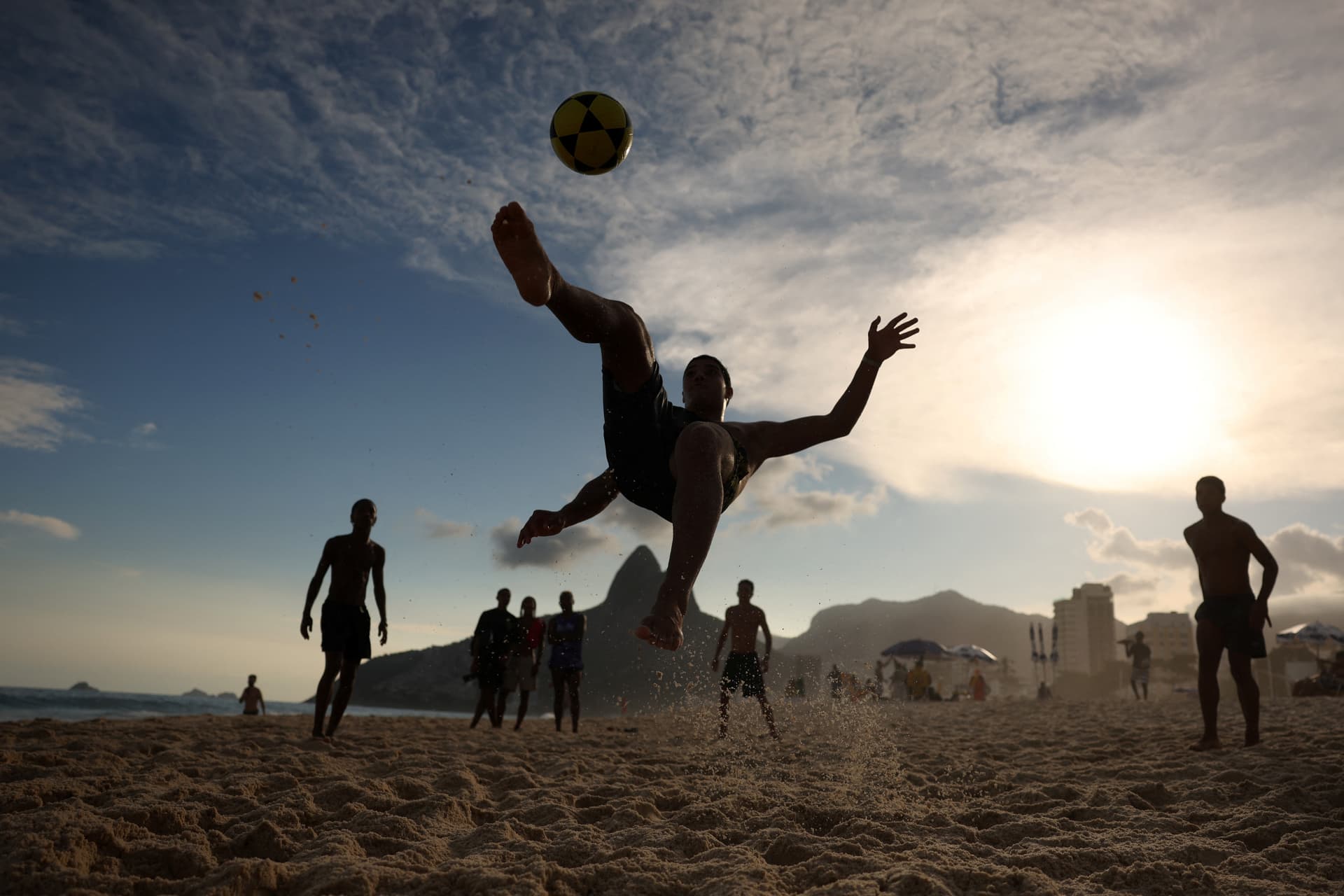
In Rio de Janeiro, the pre-match circle drill is not just a way to get loose. It is a beach ritual, a neighborhood habit and, for some players, a way to make a living. Long before stadium lights come on, altinha already fills the city’s beaches and courts with a rhythm that blends athletic control, social belonging and local pride.
Altinha is simple in concept and difficult in execution. At least two people keep a soccer ball airborne without using their hands or arms, trading touches until the ball moves in a smooth, synchronized flow. What makes it different from a routine training exercise is the style attached to it: the best exchanges prize rhythm, collective harmony and a kind of effortless grace that makes the action look casual even when the skill level is high.
Born on the beach, shaped by the city
Local history places altinha in Ipanema in the 1960s, where beach players and neighborhood courts helped turn a training drill into a social pastime. As beach soccer flourished, the game spread through Rio’s shoreline culture and then took on a life of its own. By the 1980s, it was no longer just a way to sharpen touch for another sport. It had become a distinct game, defined as much by flair and timing as by competition.
That evolution matters because altinha reflects how sport often grows in places that are not built for formal competition. It emerged in public space, among people who were improvising with what they had, and it still carries that informal, communal character. In Rio, the beach is not just scenery. It is a social field where sport, conversation and identity overlap.

Why players keep coming back
For many who play, the attraction is not only technical. It is emotional, and it is social. Patrick Emanuel, 21, describes the feeling as wonderful because the game distracts players from their problems. That sense of release helps explain why altinha endures even when it offers no trophy, no official league and no guaranteed career path.
Filmmaker Cecilia Lang points to another part of its appeal: the goal is for the ball to move so naturally that the mind is no longer there. That description captures the game’s meditative quality. Altinha asks for total attention, but it rewards players by making that attention feel weightless, almost communal, as if the group is thinking with one body.
A sport tied to public space and social rules
Altinha’s place in Rio is also shaped by the city itself. One Rio heritage source says beachside play is permitted only after 5 p.m. under city rules, which means the game is not simply a matter of talent or taste. It is also a negotiation with public space, timing and access, a reminder that even informal culture is bounded by regulation.
The city recognized altinha as Patrimônio Cultural Imaterial in January 2020, giving official standing to a practice that had long been lived before it was protected on paper. That recognition acknowledges more than entertainment. It affirms that the game is part of Rio’s cultural memory and that beach sport can be a form of heritage, not just recreation.
From pastime to profession
Altinha has also become part of the informal economy of global sport, where social media, identity and income often converge. Artur Marques shows how that shift works in practice. He did not become a traditional soccer player, but he built a career by filming and sharing altinha online, and now makes his living from it.
His online persona, Arthurzin, has drawn a large following on TikTok and YouTube, where altinha is presented not only as a sport but as a lifestyle and entertainment niche. That matters because it turns local skill into digital value. The game still depends on the beach, the ball and the circle, but the audience can now extend far beyond Rio, and the income can come from attention as much as from play.
When culture becomes policy
The move from street habit to public institution has now reached the legislature. On February 12, 2025, Brazilian senator Romário introduced PL 434/2025 to recognize altinha and altinho as an official sport and promote it. The bill advanced later in 2025 and was remitted to the Câmara dos Deputados, showing that the game has entered the policy arena as well as the cultural one.

That push reflects a broader truth about informal sports in Brazil. What begins as neighborhood practice can become a matter of heritage protection, political recognition and economic opportunity. In altinha’s case, the path from Ipanema sand to Senate debate shows how deeply a local game can cut into national identity.
Why the World Cup frame matters
The World Cup warm-up lens gives the story added weight because it connects Rio’s beach culture to the global stage. In the city, the same circle movement seen in pre-match preparations has long lived as an independent ritual, not a borrowed one. That overlap makes football culture in Brazil feel expansive: it is not confined to the formal stadium, but spread across beaches, courts and social media.
Even the national team’s preparation continues to draw attention beyond the shoreline. Reuters Connect reported on March 16, 2026, that Neymar was left out of a Brazil squad for World Cup warm-ups, a reminder that tournament preparation remains a major national sports storyline. Against that backdrop, altinha reads as more than a warm-up. It is a public language for skill, a source of income for some players and a shared ritual that helps explain why sport in Rio belongs as much to the streets as to the scoreboard.
Altinha endures because it offers all three at once: movement, belonging and possibility. In Rio, that is not a side note to the World Cup atmosphere. It is part of the event’s real economy and its real meaning.
This article was produced by Prism’s automated news system from verified source data, official records, and press releases, then run through automated quality and moderation checks before publishing. The system is built and supervised by the people who set the standards it runs under. Read our full AI policy.
Did this article answer your question?