Romania's government falls, deepening debt and currency fears
Romania’s coalition collapsed by a wide margin, sending the leu to a record low and raising fresh pressure on debt, reform and EU funds.

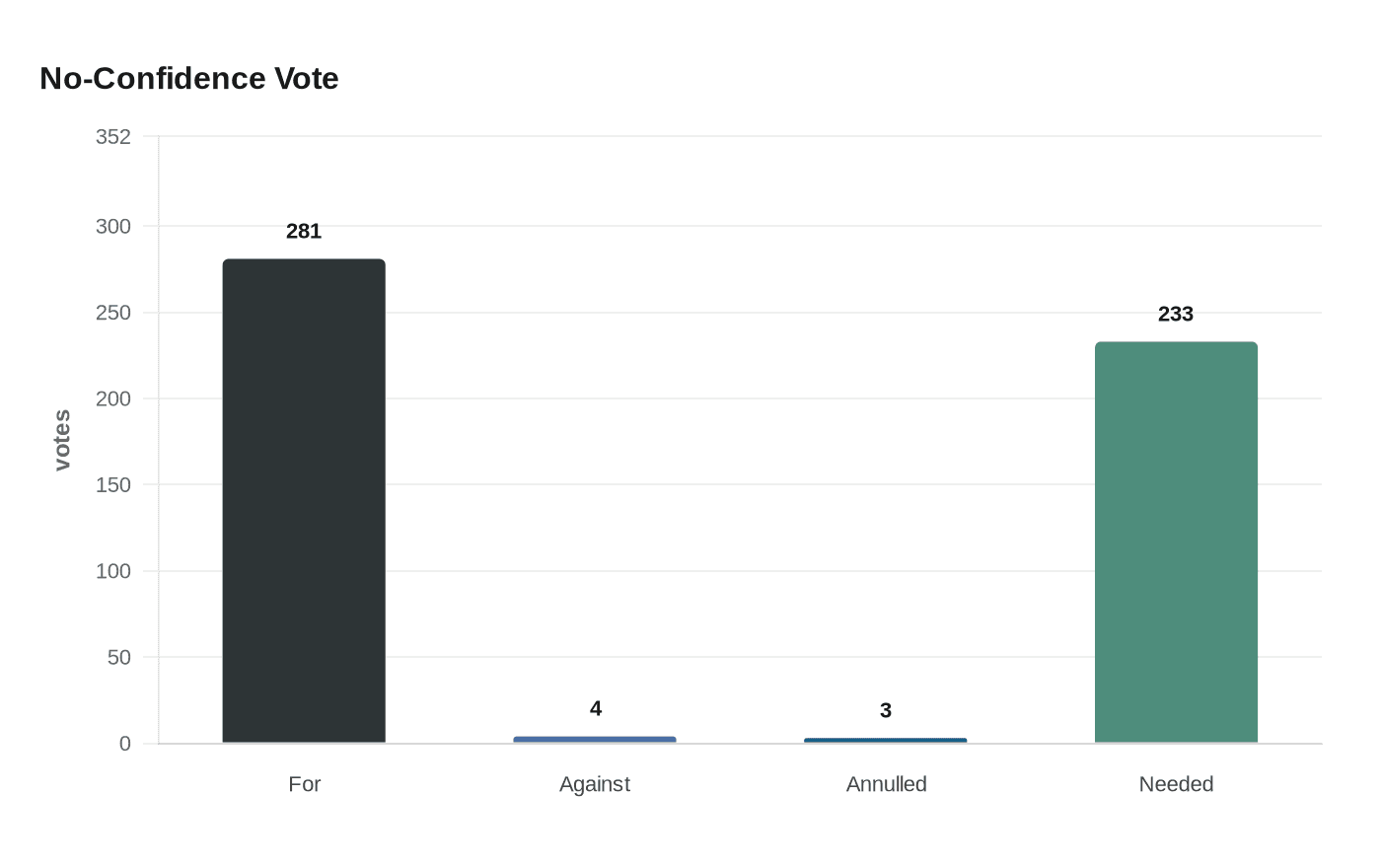
Romania’s pro-EU government collapsed in a decisive no-confidence vote, opening a period of political uncertainty that immediately rattled the currency and sharpened fears over debt, fiscal discipline and EU financing. Lawmakers removed Prime Minister Ilie Bolojan’s cabinet by 281 votes in favor, 4 against and 3 annulled, far above the 233 needed.
The defeat ended a coalition that had held together for about 10 months, since its formation in June 2025 by the PSD, PNL, USR and UDMR. The motion was initiated by MPs from PSD, AUR and PACE-Întâi România and formally presented by AUR Senate leader Petrișor Peiu. PSD, the largest party in parliament, withdrew support after repeated clashes over austerity measures, helping bring down a government that had been sold as a corrective to Romania’s worsening budget crisis.

Bolojan defended his record in Parliament, saying he had inherited a 9.3% of GDP budget deficit and had chosen to do what was necessary rather than what was popular. The European Commission has projected that deficit to ease to 8.4% of GDP in 2025 and 6.2% in 2026, but that path now depends on a new government being formed quickly enough to keep reforms on track. Romania also faces pressure tied to EU recovery money, with an August 2026 deadline looming for eligible project completion.
President Nicușor Dan moved to contain the damage, saying he would begin informal consultations with political parties to form a new government and ruling out early elections. He said Romania would have a pro-Western government within a reasonable timeframe and argued there was consensus among pro-Western parties on OECD accession, the 2026 budget target, and the SAFE and PNRR timetables, including May 31 and August 31 deadlines tied to those programs. Until a new executive is installed, the government will continue in a caretaker capacity with limited powers.
Markets reacted at once. The leu fell to a record low of 5.218 per euro on May 5, a sign investors were already pricing in a longer stretch of instability. The political fallout has broader stakes for the European Union and NATO, because Romania sits on the alliance’s eastern flank and has become a key test case for whether fiscal consolidation can survive coalition collapse. Valérie Hayer called the PSD-far-right alliance that toppled the cabinet “an irresponsible act at a critical moment,” while Ciarán Cuffe called it a “European warning sign.” Siegfried Mureșan said building parliamentary majorities with parties attacking the EU is “profoundly anti-European.”
This article was produced by Prism’s automated news system from verified source data, official records, and press releases, then run through automated quality and moderation checks before publishing. The system is built and supervised by the people who set the standards it runs under. Read our full AI policy.
Did this article answer your question?