San Diego County sells desalinated water to drought-hit Western states
San Diego County is turning desalinated seawater into a paid drought hedge, with 21-year deals already carrying tens of thousands of acre-feet and millions in upfront cash.
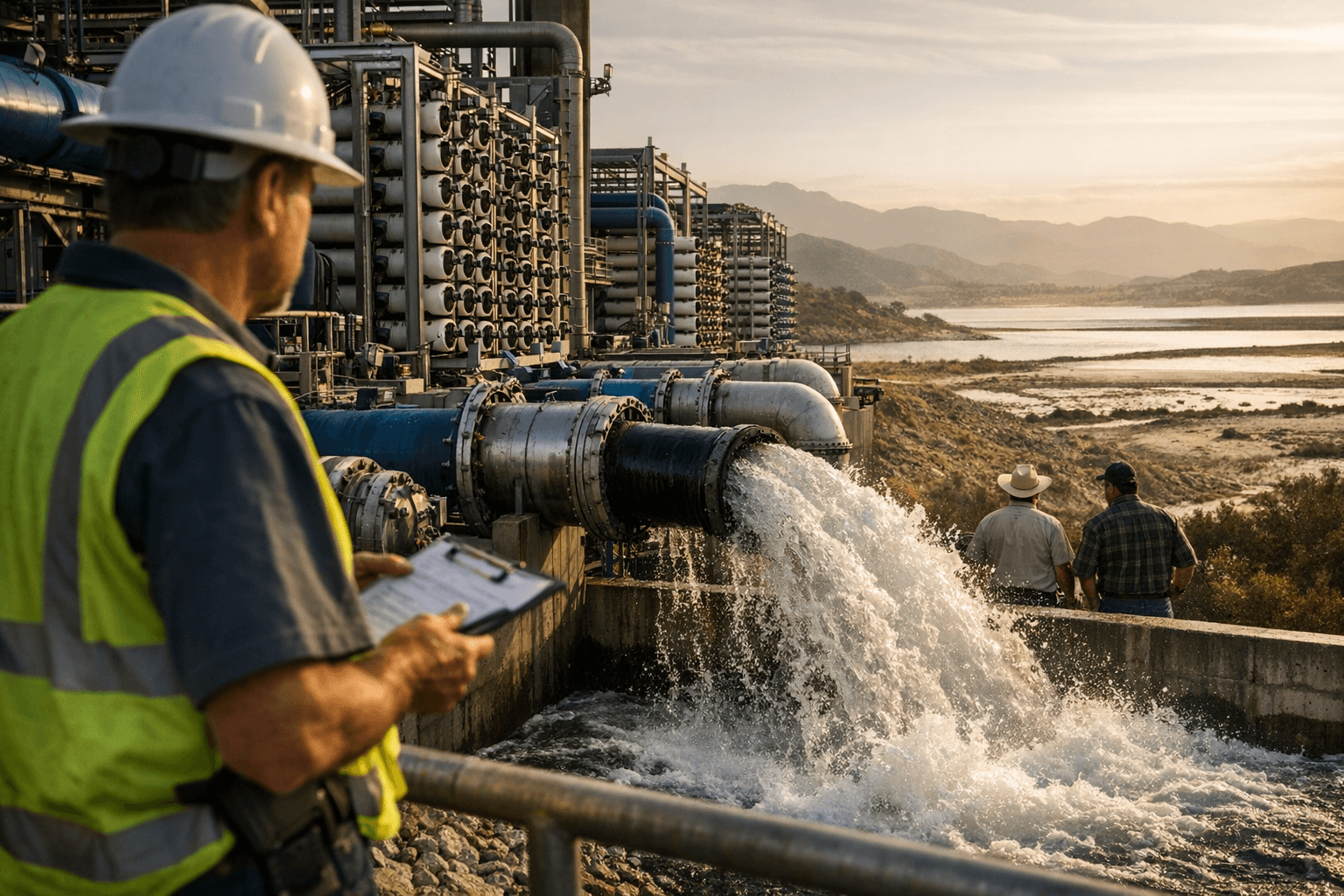
San Diego County is trying to do something that once would have seemed improbable: turn a drought-proof desalinated supply into a revenue stream for other Western water agencies. The San Diego County Water Authority has already signed or approved two long-term sales that could move 20,000 acre-feet a year to Riverside County, while also testing whether expensive local supply can travel far enough, fast enough and cheaply enough to become a real hedge against Western drought.
The clearest signal came on March 19, 2026, when the Water Authority and Western Municipal Water District announced a 21-year agreement calling for at least 10,000 acre-feet a year. Western also agreed to pre-purchase about 30,000 acre-feet for future delivery, a nearly $40 million investment. The Water Authority said the arrangement should produce about $13.5 million a year and roughly $100 million over the first five years after upfront payments are counted. Days later, the board approved a similar 21-year deal with Eastern Municipal Water District, also for 10,000 acre-feet annually. Eastern’s contract includes a $19 million pre-purchase of 30,000 acre-feet and is expected to generate $74 million in new revenue over the first five years.
Those deals rest on a bigger bet made over decades in San Diego County. The Claude “Bud” Lewis Carlsbad Desalination Plant began commercial operations in 2015 and has since produced more than 124 billion gallons of drinking water, according to the Water Authority. The agency says the plant, part of a $1 billion project that includes a 10-mile pipeline and distribution upgrades, helped build a portfolio that can meet regional demand through 2050, even in multiple dry years. In 2020, about two-thirds of San Diego’s water supplies came from the Colorado River, underscoring how dependent the region still is on a stressed interstate system.
That dependence is also why San Diego’s water sales carry broader political weight. The Water Authority says its service area supports a $267 billion economy and 3.3 million residents, and it has framed recent transfers as a way to ease pressure on local ratepayers. In 2023 and 2024, the agency said it saved San Diego County ratepayers $40 million through transfers that helped raise Lake Mead, the key reservoir for the Colorado River system serving about 40 million people and 30 Tribal Nations across seven Western states and Mexico.
The infrastructure and legal questions remain enormous. In February 2026, the Water Authority approved an agreement to explore an interstate transfer and exchange pilot program with the U.S. Bureau of Reclamation, the Metropolitan Water District of Southern California, and agencies in Nevada and Arizona. A 2025 scientific study said the Carlsbad plant was operating in compliance with regulations and permits, a finding that matters because desalination has long faced criticism over energy use and coastal impacts. San Diego is now betting that those costs, once sunk, can be leveraged into a wider Western market where water scarcity itself becomes tradable.
This article was produced by Prism’s automated news system from verified source data, official records, and press releases, then run through automated quality and moderation checks before publishing. The system is built and supervised by the people who set the standards it runs under. Read our full AI policy.
Did this article answer your question?

