San Francisco Launches Downtown Financing District to Fund Office-to-Housing Conversions
Mayor Daniel Lurie signed a Downtown Revitalization Financing District on Feb. 12, 2026 to redirect property tax growth toward office-to-housing conversions downtown.
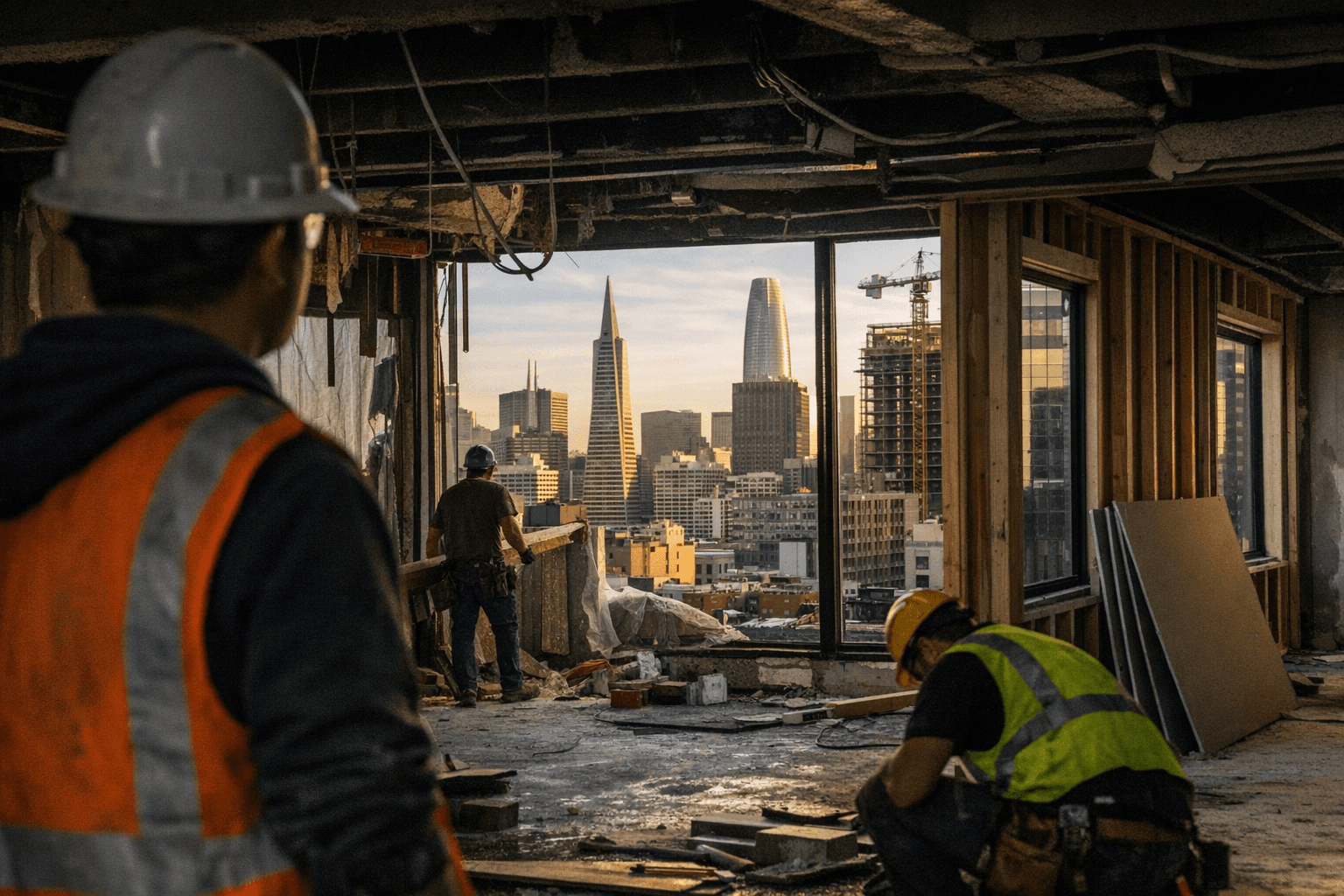
Mayor Daniel Lurie signed legislation on February 12, 2026 establishing a Downtown Revitalization Financing District to redirect property tax increments toward incentives and public investments that make office-to-residential conversions financially viable in the Financial District, Union Square, parts of the Market Corridor, and SoMa. The administration framed the district as part of its Heart of the City plan to transform downtown into a 24/7 neighborhood; Lurie said, “Through our Heart of the City plan, our administration is accelerating downtown's recovery by activating our public spaces, prioritizing safe and clean streets, and creating a downtown where people live, work, play, and learn.”
The district is enabled by state law AB 2488, which took effect January 1, 2025, and is structured as a tax increment financing district that will redirect increases in property tax revenue toward annual incentive payments for eligible conversion projects. SPUR and city documents specify that projects can receive annual payments for up to 30 years, payments are capped at the city’s share of the increment, and eligible projects must opt in by December 31, 2032. Governance will be handled by a separate District Board of Directors, according to SPUR materials.
Geographically the district covers San Francisco’s urban core and a SPUR inventory identifies 1,300 parcels with eligible commercial buildings; within that universe SPUR flags 49 likely candidate buildings, while RealDeal cites “about 50 buildings” that could convert. SPUR’s candidate criteria include buildings built before 1990, building class B or C, at least 20,000 square feet of rentable area, and vacancy rates above 50 percent. City estimates vary on yield: SPUR projects those candidate properties could yield 4,400 units housing about 10,000 residents downtown, while RealDeal reports city documents estimating potential for up to 7,000 new homes.
Fiscal projections for the district also differ across sources. SPUR reports up to $15.2 million of annual property tax increment could be generated and disbursed, while RealDeal cites city documents saying the district “could put more than $1.2 billion of redirected property tax increases into these projects over the next 30 years.” A source inside the Office of Economic and Workforce Development told RealDeal that “the typical project could receive about $100,000 per unit in incentives.” The city has layered the district on prior reforms including the September 2023 Housing Fee Reform Plan, the March 2024 transfer tax waiver for up to 5 million square feet of conversions, and pending Board File 240927 for inclusionary housing and impact fee waivers.
Developers and advisory partners have pushed for the program as a complement to place-based investments. Marc Babsin, president of the Emerald Fund, said, “With the finalization and inauguration of the downtown revitalization financing district today, San Francisco joins the ranks of major cities around the country, from New York to Boston to Chicago, that have recognized the power of property tax relief to enable the revitalization of downtown districts through office-to-residential conversions.” M-fhc commentary and HR&A analysis cite targeted uses of captured increments for streetscape upgrades, pedestrian infrastructure, utility modernization, and public safety, and HR&A noted its participation in SPUR/ULI 2023 and HUD-linked 2025 studies, adding, “We’re excited to see San Francisco continue making strides towards creating a resilient, vibrant downtown with opportunities for workers, residents, and visitors.”
Key operational questions remain as the district moves from legislation to implementation: SPUR noted formation began in April with the district expected to begin accepting applications in 2026, but the city has not yet published a parcel map, application portal, or the District Board membership and oversight rules. City officials, OEWD, and the Board of Supervisors will need to clarify the application start date in 2026, reconcile the $15.2 million annual versus $1.2 billion 30-year fiscal estimates, explain how district payments stack with existing waivers, and disclose how increments will be split between developer incentives and public works.
Know something we missed? Have a correction or additional information?
Submit a Tip