Satellite imagery shows crater damage near Iran’s Eagle 44 tunnel entrances
Crater marks at Eagle 44’s tunnel mouths suggest Iran’s underground air base may have been hardened, but not immune, in the 2025 war.
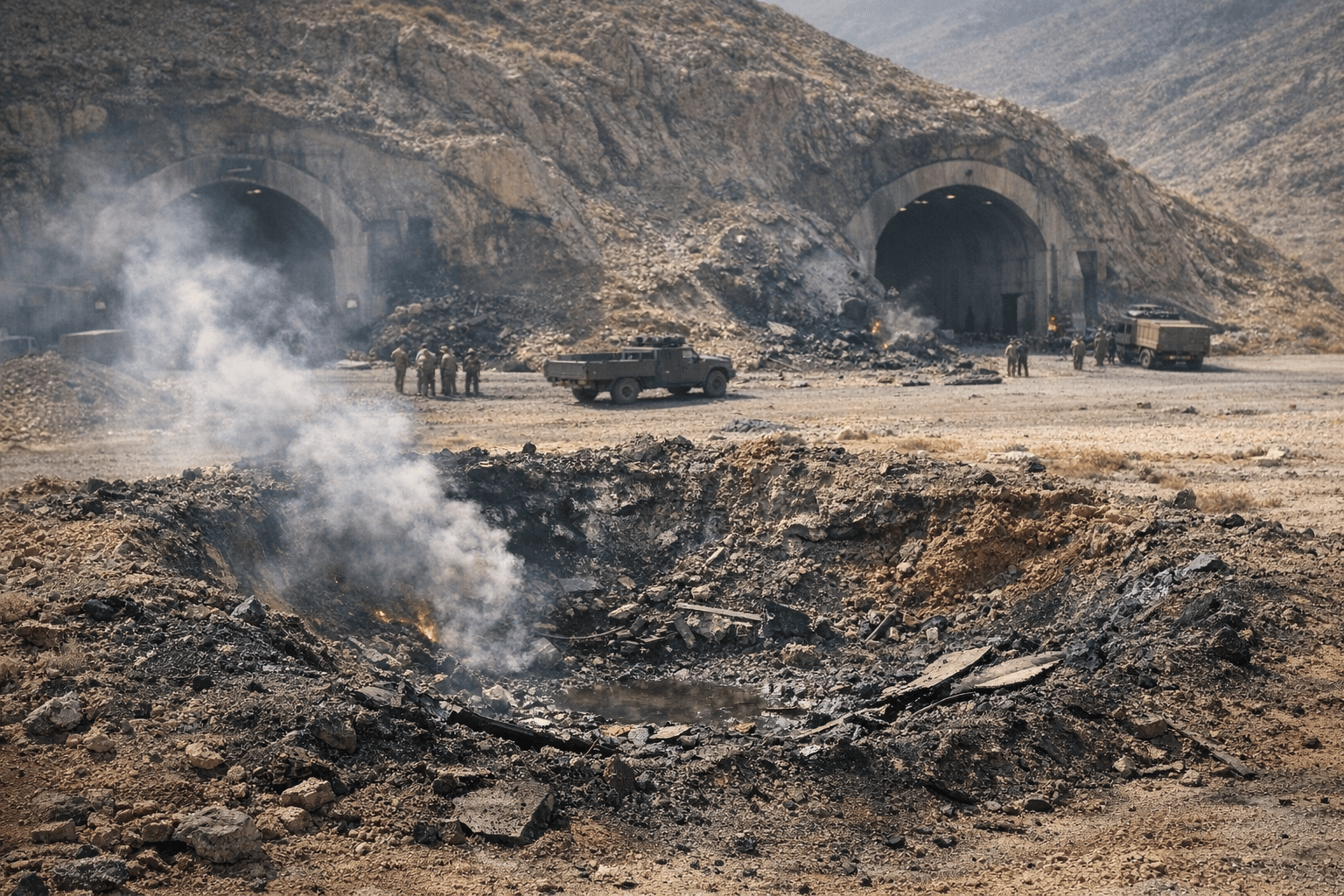
Satellite imagery showed impact craters at and near the tunnel entrances to aircraft shelters at Iran’s remote Eagle 44 base, a narrow but telling sign that hardened construction does not make a military site invulnerable. The damage points to the exposed parts of the complex, where access, ventilation, maintenance and emergency response can be disrupted even if the deeper underground spaces remain intact.
Iran unveiled Eagle 44, also known as Oghab 44, on February 7, 2023 as its first underground air base for fighter jets and bombers. State media said the site sat hundreds of meters under mountains and was built to withstand US bunker-busting bombs. Iranian officials said it could host fighter jets, bombers and drones, and the unveiling came just before Iran’s Air Force Day and the 44th anniversary of the 1979 Islamic Revolution. Mohammad Bagheri, then chief of staff of Iran’s armed forces, cast the base as a warning to Iran’s enemies, saying any base used to attack Iran would face severe retaliation, along with Israel.
The imagery now offers a more practical measure of that deterrent message. Historical satellite analysis showed activity at the site beginning in August 2013, with excavation visible by early 2014. By the time of the 2023 unveiling, five tunnel entrances could be seen. Commercial imagery analysis that year also found aircraft mock-ups at the base, including one resembling a Russian Su-35, suggesting the complex was built with newer aircraft in mind. Analysts have long said the underground tunnel system could shelter aircraft, fuel and maintenance functions, but also noted vulnerabilities in ventilation and firefighting, the kinds of weak points that become critical when a base is hit.
The craters matter even more in the context of the June 2025 Israel-Iran war, which began when Israel struck Iranian military and nuclear targets on June 13, 2025. Iran responded with ballistic missiles, and later assessments said Israeli strikes aimed to degrade Tehran’s retaliatory capacity by damaging missile launchers, air defenses and other military infrastructure. Eagle 44 fits squarely into Iran’s long-running passive defense strategy, built around tunnels, hidden missile sites and other hardened assets. The latest imagery suggests that strategy can preserve some combat capability, but it does not erase the vulnerability of the entrances, support systems and access routes that keep an underground base usable.
This article was produced by Prism’s automated news system from verified source data, official records, and press releases, then run through automated quality and moderation checks before publishing. The system is built and supervised by the people who set the standards it runs under. Read our full AI policy.
Did this article answer your question?