Schneider Electric uses AI to speed manufacturing, not cut jobs
Schneider Electric is showing how AI can speed factory work without automatic layoffs. The test is whether managers pair it with retraining, redeployment, and clear labor safeguards.
The practical question for workers
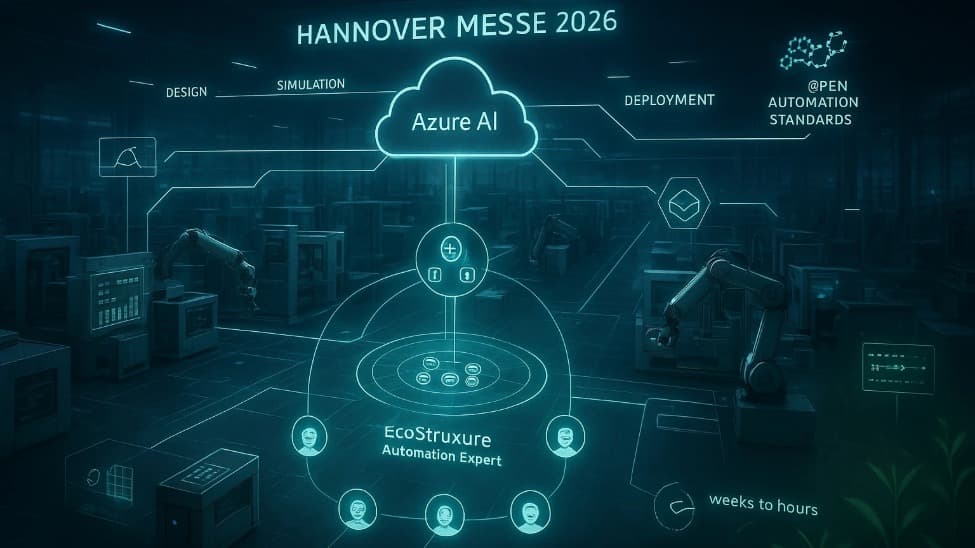
AI in manufacturing becomes far more credible when it is used to remove friction rather than people. Schneider Electric’s latest industrial copilot, powered by Microsoft Azure AI, is built around that idea: engineering teams say it can cut up to 50% of the time spent on control configuration and documentation, and production line changes that once took weeks can now be finished in hours.

That matters because the biggest worker fear around AI is not abstract. It is whether new software will be used to squeeze payroll. Schneider’s pitch, unveiled at Hannover Messe on April 16, 2026, is different: use AI to accelerate plant changes, reduce admin work, and help factories cope with volatile demand without treating headcount cuts as the default outcome.

How the system is set up
Schneider Electric built the copilot around EcoStruxure Automation Expert, its open, software-defined automation platform. The company says the platform is designed to run across on-premises, edge, and hybrid environments, and to support a single workflow from design and engineering through build, commissioning, and operations.
That architecture is important. AI tools tend to create real value when they are connected to the daily mechanics of production, not bolted on as a demo. By tying the copilot to the full industrial workflow, Schneider is trying to move AI from a narrow assistant for one department into a tool that can standardize how plants are configured, documented, and updated across sites.
Why manufacturing managers are interested
The company’s case rests on a simple operational truth: manufacturers are dealing with more product variability, more supply-chain instability, and more pressure to modernize safely. In that environment, the bottleneck is often not labor in the abstract but the speed at which engineering and operations can absorb change.
If a line change used to take weeks and now takes hours, a factory can respond faster to new orders, smaller batch sizes, and disruption. That can raise productivity without reducing employment if management uses the gains to increase throughput, shorten downtime, and handle more complexity with the same team. In other words, the question is not whether AI saves time, but what leaders do with the time it saves.
The scale behind the experiment
Schneider Electric is not a startup testing an experiment on a single line. The French multinational reported 2024 revenue of €38.153 billion, adjusted EBITA of €7.083 billion, net income of €4.269 billion, and free cash flow of €4.216 billion. It also said it ended 2024 with more than 160,000 employees worldwide, while independent workforce trackers put 2025 headcount at roughly 159,844 to 162,970.
That scale makes its AI strategy economically meaningful. The company said its 2024 results were helped by strong momentum in Energy Management, while Industrial Automation returned to growth in the fourth quarter after being down 4% organic for the full year. A company that large can spread an industrial AI model across many plants and many functions, which means the decision to automate work is also a decision about how to manage a very large workforce.
What the broader market says about adoption
Schneider’s own market research suggests the industrial AI race is still early. The company has said only about 13% of consumer-packaged-goods manufacturers have embedded AI today. Its 2026 industrial AI survey found that manufacturers expect rising production inefficiencies and cost pressures by 2030, but also identified three major barriers to adoption: data quality, legacy automation, and change management.
Those blockers are revealing. They show that the main constraint is often organizational, not technological. Factories do not struggle only because the software is immature. They also struggle because data is messy, old equipment is hard to integrate, and managers have to persuade operators, engineers, and supervisors to trust a new workflow.
What has to happen for AI to avoid layoffs
Schneider’s example suggests a practical playbook for “AI without layoffs” that is more managerial than magical:
- Start with work that is repetitive, technical, and time-consuming, such as control configuration and documentation, where AI can remove friction without eliminating the need for human judgment.
- Use AI to shorten changeovers and improve responsiveness, so productivity gains show up as more output, less downtime, and better service rather than an automatic payroll reduction.
- Invest in retraining so engineers and plant staff can work with the new tools, interpret outputs, and handle exceptions that AI cannot safely resolve on its own.
- Put labor safeguards in place, such as redeployment commitments and vacancy absorption, so efficiency gains can be translated into growth, not immediate cuts.
The point is not that every company will choose that path. It is that this path only works when leadership treats AI as a workflow redesign project. If managers simply layer software on top of old habits, the result is usually confusion. If they redesign jobs, retrain staff, and give workers a stake in the productivity gains, AI can become a tool for scale instead of a trigger for downsizing.
Why Schneider matters beyond one company
Schneider is also positioning itself on both sides of the AI economy. It has a strategic collaboration with Microsoft on industrial AI, and separately with Nvidia on AI-factory infrastructure. The two companies are advancing research and development for power, cooling, controls, and high-density rack systems needed for the next generation of AI factories.
That puts Schneider in a rare position. It is not only using AI in its own manufacturing operations, but also helping supply the infrastructure that makes the wider AI boom possible. For workers, that dual role matters because it shows where industrial value is shifting: toward companies that can connect software, electricity, controls, and physical production in the same system.
The broader lesson is straightforward. AI raises productivity without cutting jobs when it is aimed at bottlenecks, backed by clean data and modern controls, and managed with retraining and redeployment rather than reflexive headcount reduction. Schneider Electric is making that case with hard numbers, and in a manufacturing economy under pressure, those numbers are hard to ignore.
This article was produced by Prism’s automated news system from verified source data, official records, and press releases, then run through automated quality and moderation checks before publishing. The system is built and supervised by the people who set the standards it runs under. Read our full AI policy.
Did this article answer your question?