Scotland Sets Its Own Course on Income Tax and Social Security
Scotland's income tax divergence from the rest of the UK now puts 322,000 children on a weekly payment worth 13 times what England offers, reshaping the May 2026 Holyrood election.
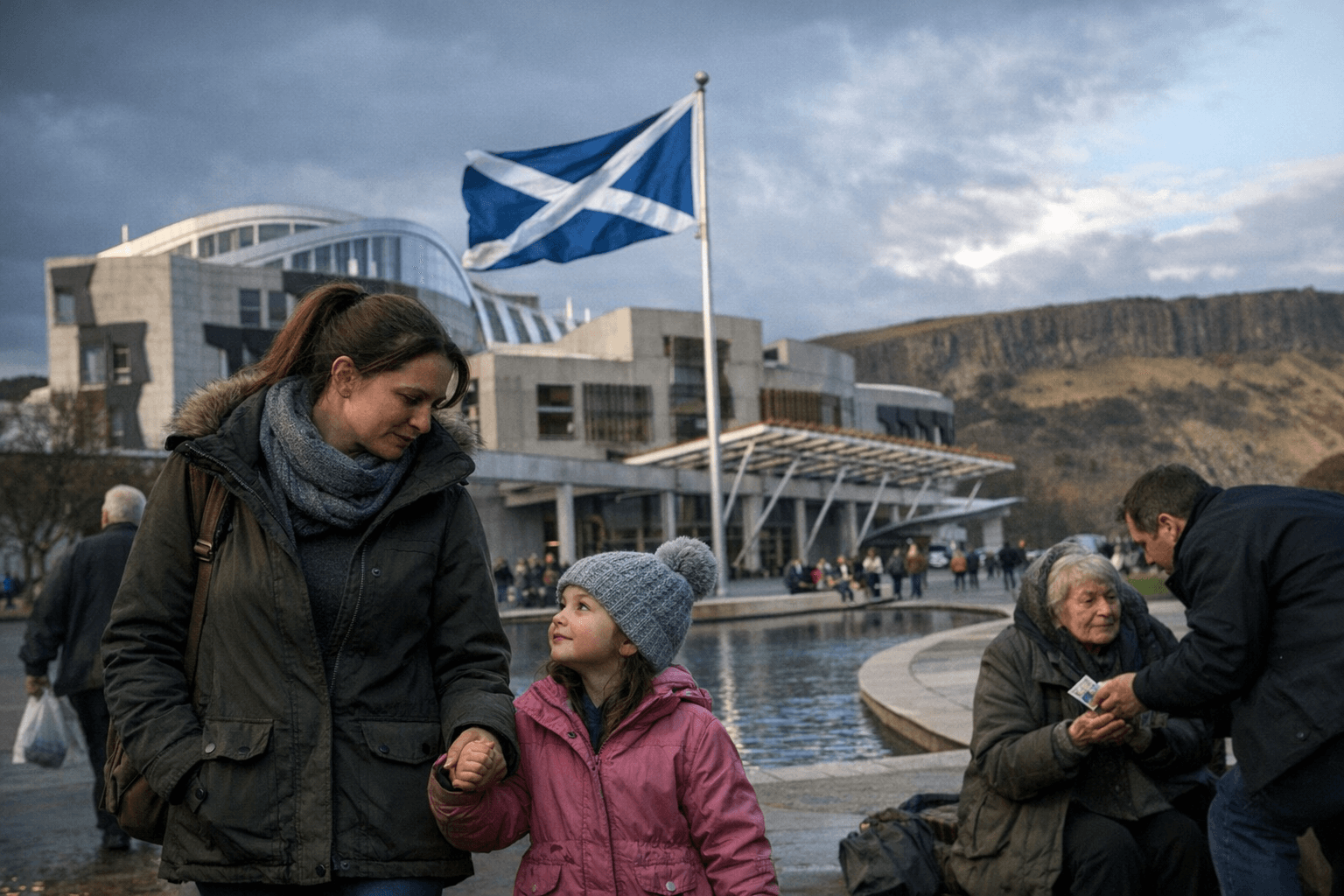
The question confronting Scottish voters on 7 May 2026 is not simply which party should govern Holyrood; it is whether Scotland's experiment in running a more progressive tax-and-welfare state than the rest of the United Kingdom is actually working. Since the Scotland Act 2016 gave the Scottish Parliament full control over income tax rates and bands, the divergence has widened with each budget cycle. The shift began in earnest in 2017 and has sharpened further under the SNP-led government, producing a six-band income tax system unlike anything operating elsewhere in Britain.
The arithmetic of that system cuts differently depending on where a household sits in the income distribution. The Institute for Fiscal Studies projects that 55 percent of income taxpayers in Scotland, those earning up to £33,500 a year, will be better off than equivalent earners in the rest of the UK. But the tax advantage amounts to no more than £40 per year, or 77p per week. The Chartered Institute of Taxation calculates that Scottish taxpayers earning more than £30,318 pay more income tax than a counterpart in the rest of the UK with the same earnings. For a nurse or teacher sitting just above that threshold, the crossover is marginal in pounds terms. For a business owner or senior manager earning above £43,663, the gap is more consequential: Scotland's higher rate of 42 percent kicks in at that level, compared with England's 40 percent rate which does not apply until earnings reach £50,270.
The social security side of the ledger tells a sharper story for lower-income families. The Scottish Child Payment provides families with £27.15 a week for every eligible child under 16, rising to £28.20 from April 2026, and more than 322,000 children were benefiting as of September 2025. By a child's 16th birthday, the payment and other Social Security Scotland family support could be worth around £25,000, compared with less than £2,000 in England and Wales, where support ends at age four. The Scottish Government estimates the payment will keep 40,000 children out of relative poverty in 2025-26.
Funding that generosity carries a price. The Scottish Fiscal Commission forecasts that income tax will raise just under £20.5 billion in Scotland in 2025-26. Scotland is spending roughly £1.7 billion more on social security above what its Block Grant Adjustment from Westminster covers. The IFS has said Scotland's tax and benefit system is more progressive than the rest of the UK's, but also unnecessarily complex and distortionary. The Fraser of Allander Institute has calculated that the number of higher rate taxpayers in Scotland will reach 550,000 if the next government freezes the threshold, with around 130,000 of those facing a marginal rate of 53 percent because of the misalignment between Scottish and UK rates.
The SNP's approach of cutting poverty with a more generous welfare state funded by taxation is shared to varying degrees by Labour, the Scottish Greens, and the Liberal Democrats. The Conservatives and Reform UK, by contrast, prioritise cutting taxes and benefits, arguing that economic growth will improve lives. The Tory manifesto proposes tightening eligibility for Adult Disability Payment, particularly for those claiming on mental health grounds, and describes Scotland's benefits bill as "bloated." Reform UK has pledged to cut Scottish income tax below rest-of-UK rates, funded by closing public bodies. The Scottish Conservatives claim that if the SNP and Labour continue to freeze income tax thresholds as planned, it will cost the average full-time worker £1,800 over the course of the next parliament.
YouGov polling found that Scotland is the only nation or region of Great Britain where a majority favours tax increases over spending cuts, with 54 percent of Scots saying taxes overall should be higher. Yet the same polling shows only 29 to 31 percent of Scots believe the Scottish Government is handling taxation well. The model Scotland has built commands majority sympathy in principle; persuading voters it has been executed well is the harder task the campaign has yet to resolve.
This article was produced by Prism’s automated news system from verified source data, official records, and press releases, then run through automated quality and moderation checks before publishing. The system is built and supervised by the people who set the standards it runs under. Read our full AI policy.
Did this article answer your question?

