Scott Conant returns to family-style Italian cooking at home
Scott Conant’s restaurant prestige now circles back to the family kitchen, where Neapolitan memory and simple Italian dishes define his authority.

Scott Conant’s most persuasive calling card may no longer be the polished dining room. It is the family kitchen, where sausage and peppers, pasta with clams, gnocchi, and other straightforward Italian dishes carry the weight of memory, inheritance, and craft.
That shift fits a larger culinary moment. As fine dining has leaned hard into spectacle, lifestyle branding, and ever more elaborate tasting menus, chefs with real pedigree are finding that authority can come from something quieter: the ability to cook like home still matters. In Conant’s case, the appeal is especially strong because his version of simplicity is not casual or trend-driven. It is tied to a two-time James Beard Award-winning career, a century of Italian-American foodways, and a personal story that has stayed visible across restaurants, television, and home cooking.
Roots in Waterbury
Conant was born in Waterbury, Connecticut, in 1971, and he has long described his mother’s side of the family as Italian. A CBS News profile said he grew up in Waterbury and first learned to love food from his family, with his maternal grandfather serving as a central influence. The image is vivid and durable: afternoons in the garden, evenings at the table, and authentic Neapolitan cooking passed down as a living part of family life.
That early education helped define the chef he became. He began taking cooking classes at age 11, a sign of unusual focus for a child, and later attended the Culinary Institute of America after technical culinary training. Before the fame, before the branded restaurants, there was a methodical apprenticeship in which family memory and formal technique reinforced one another.
From culinary school to Manhattan recognition
Conant’s rise accelerated in New York City, where the intensity of the restaurant scene rewarded both skill and point of view. His Manhattan restaurant L’Impero opened in Tudor City in 2002 and quickly established him as a serious Italian chef with a modern voice. The following year, L’Impero won the James Beard Foundation’s Best New Restaurant award, a milestone that helped confirm his place among the city’s leading culinary figures.
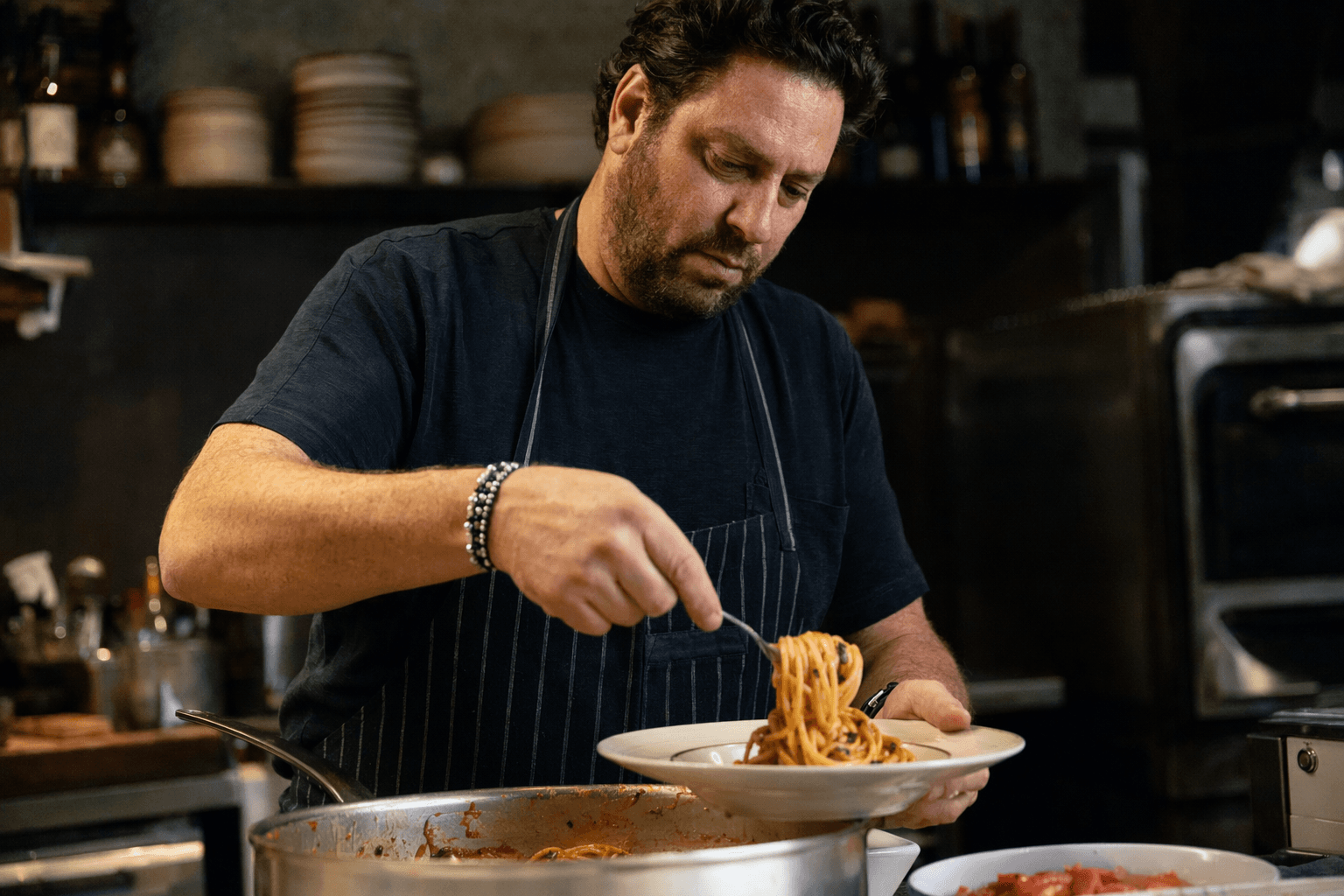
That arc matters because it explains why his current return to home-style cooking does not read as a retreat. It reads as a continuation. Conant built his reputation by translating Italian traditions into restaurant form, and the prestige of L’Impero gave him the platform to do it at scale. Even now, his career still carries that same balance of precision and inheritance.
Scarpetta and the value of savoring more
The name Scarpetta captures that philosophy in a single phrase. It comes from the Italian expression “fare la scarpetta,” meaning to savor a meal to the very last bite. For a restaurant brand, the phrase is more than clever packaging. It signals abundance, satisfaction, and a distinctly Italian understanding that the final smear of sauce or last piece of bread can be as meaningful as the first course.
That idea has helped shape the identity of Scarpetta Restaurants and the broader public image of Conant as a chef who bridges high-end dining and deeply familiar food. His restaurants are not built around austerity or performative minimalism. They are built around the pleasures of Italian cooking that is soulful, convivial, and meant to be remembered. Conant’s official profile describes a career spanning more than 34 years, and that length of time has given him the kind of credibility that can survive shifts in taste.
The home kitchen as the new point of authority
The recent emphasis on family recipes makes that credibility feel newly relevant. TODAY has featured Conant making dishes such as his mom’s sausage and peppers and pasta with clams, bringing him back to the kind of food that first formed his palate. In those appearances, the emphasis is not on spectacle. It is on repetition, tradition, and the confidence to make a dish that feels unmistakably personal.
CBS Weekender has also highlighted this return to roots, showing how Conant has reconnected with the food culture that shaped him. The program’s coverage, along with earlier CBS News reporting, underscores that his identity has always been grounded in family, not just restaurants. He is a chef who can command a dining room, but he is equally compelling when he is talking through heirloom recipes, garden vegetables, and the Neapolitan dishes that linked generations in his family.
Why this shift resonates now
Conant’s renewed focus on home-style Italian cooking reflects a broader reordering of culinary authority. In a market saturated with chef-driven concepts, consumers increasingly respond to chefs who can connect technique to autobiography. A dish becomes more compelling when it is not just executed well, but anchored in a credible story about where it came from and why it matters.
That is where Conant has an advantage. His food is not an abstract exercise in nostalgia. It is tied to Waterbury, to his mother’s family, to his grandfather’s garden, and to a career that moved from culinary school to Manhattan recognition without losing its roots. When he makes traditional Italian dishes now, he is not reinventing himself so much as revealing what was always there.
The result is a useful reminder about where culinary power now lives. Prestige still matters, but it is no longer enough on its own. The chefs who endure are often the ones who can turn restaurant excellence into something intimate, then bring that intimacy back to the table at home. Conant’s career shows that the most durable form of sophistication may be the one that still knows how to make a simple Italian meal feel deeply personal.
This article was produced by Prism’s automated news system from verified source data, official records, and press releases, then run through automated quality and moderation checks before publishing. The system is built and supervised by the people who set the standards it runs under. Read our full AI policy.
Did this article answer your question?