Senate Republicans rush to embrace Paxton after brutal Texas primary
Paxton’s narrow first-round race turned into a rout, and Senate Republicans quickly pivoted from intraparty bloodletting to damage control.
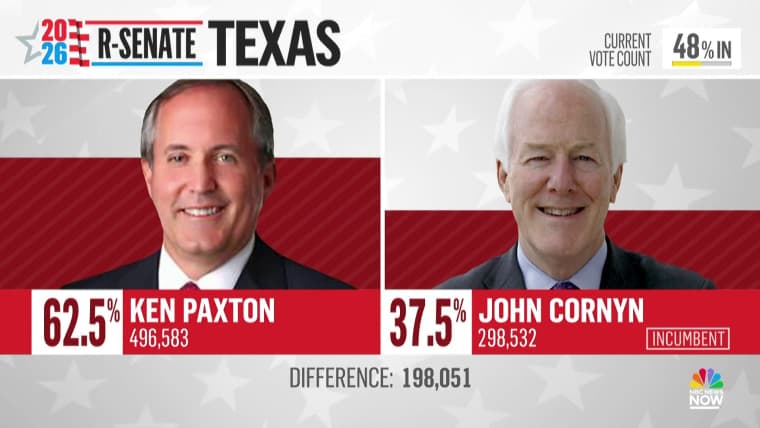
Senate Republicans moved quickly to close ranks around Ken Paxton after his bruising Texas runoff victory over John Cornyn, a rapid reversal that showed how fast personal and ideological warfare gives way when Senate control and donor money are on the line. U.S. Senate Republican leadership is now signaling that the path to protecting the majority runs through Texas, not through settling scores from a $130 million primary fight.
Paxton defeated Cornyn in the Republican runoff on May 26, 2026, after the March 3 primary forced both men into a second round because neither cleared a majority. Cornyn had led the first vote, 42.0% to 40.5%, but Paxton surged back to finish him off in a race that Axios described as a 28-point rout and the widest primary defeat for a sitting U.S. senator in nearly 50 years. The scale of the loss instantly reshaped the political math inside the GOP.
The scramble to unify behind Paxton accelerated after Donald Trump endorsed him on May 19, 2026, over Cornyn. Senate Majority Leader John Thune then backed Paxton after the runoff, a clear sign that Republican leaders want the party to stop relitigating the primary and start treating the Texas race as a general-election operation. NBC News projected that Paxton will face Democratic state Rep. James Talarico in November.

For Cornyn, the defeat is a stark break with a long Senate career. He was first elected in 2002, won reelection multiple times, and became the first Republican senator from Texas to lose his party’s nomination for reelection. That history only sharpens the meaning of the result: a once-safe incumbent was beaten in a state where Republicans have not lost a statewide race in more than three decades.
That is why the détente matters beyond Texas. Republicans are trying to contain the fallout from an expensive intraparty war while presenting Paxton as the party’s next standard-bearer. Democrats, meanwhile, are likely to use the hard-fought runoff as evidence that Texas can be forced into a real contest. The race now tests not only Trump’s influence inside the GOP, but also whether Republican unity can be rebuilt fast enough to preserve a seat that could still shape Senate control.
This article was produced by Prism’s automated news system from verified source data, official records, and press releases, then run through automated quality and moderation checks before publishing. The system is built and supervised by the people who set the standards it runs under. Read our full AI policy.
Did this article answer your question?

