Senegal-France World Cup rematch highlights football’s migration era
France-Senegal still carries the memory of 2002, but the 2026 rematch exposes a larger truth: migration now shapes who teams are, and who gets to belong.

Senegal’s shock win over France in 2002 still hangs over this rivalry, but the rematch in East Rutherford shows the fixture has grown into something larger than a sporting grudge. France and Senegal now meet at the point where colonial history, migration, and modern national identity collide, with African talent helping define the tournament even as questions about belonging and representation grow sharper.
A rivalry forged in empire and migration
The France-Senegal relationship has always carried the afterlife of empire. One country’s team has long drawn from the other’s people, families, and football pathways, and the World Cup now makes that connection impossible to ignore. In 2026, of 1,248 players at the tournament, 292 were born outside the country they represent, nearly a quarter of the field. That is a dramatic shift from 2006, when the share of foreign-born players was below 9 percent.
Senegal’s own squad reflects the same reality from another angle. Ten members of its 2026 World Cup team were born in France, a reminder that migration is not a side story in international football but one of its main engines. The team sheet tells a story of movement across borders, of families making lives in Europe, and of eligibility rules that allow those paths to become national-team assets.
That is why France can both benefit from African talent and face scrutiny over what that means for national identity. The French team’s strength has increasingly been built through a system in which players developed in one place, or born in another, arrive carrying multiple affiliations. For some, that is a sign of football’s openness. For others, it raises harder questions about who is recognized as fully French, and on what terms.
The 2002 upset that still defines the fixture
The modern history of this matchup begins in Seoul on May 31, 2002, when Senegal stunned the reigning world champions 1-0 in the opening match of the World Cup. Papa Bouba Diop scored the winner after 30 minutes, and the result immediately became one of the tournament’s defining shocks. FIFA has continued to recall it as an iconic moment, and BBC Sport described it as Senegal’s sensational World Cup debut.
The consequences were far-reaching. France exited the tournament in the group stage without scoring a goal, a humiliating collapse for a champion side. Senegal, by contrast, went on to reach the quarterfinals, announcing itself on the world stage in a way that still shapes how the country is viewed in football.
That result matters because it gave this rivalry a memory that survives beyond one generation of players. Every France-Senegal meeting is now haunted by Seoul, not only because of the scoreline, but because the upset inverted the expected hierarchy. It was a match that exposed how football could reorder the assumptions of power, even when the political and historical imbalance between the two nations remained intact.
The 2026 rematch and the new geography of the game
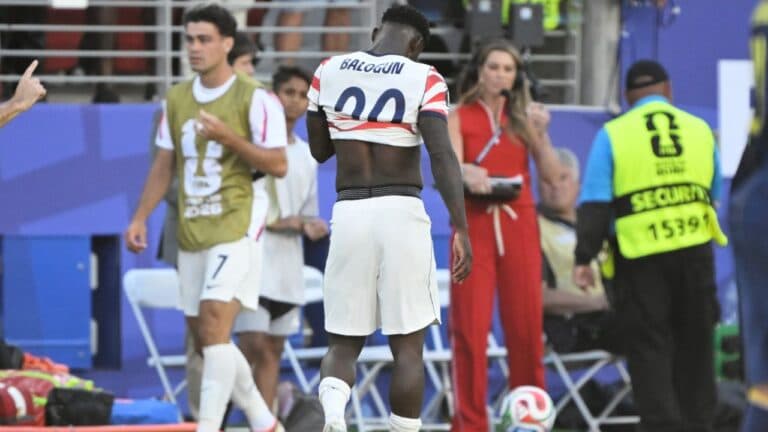
The 2026 rematch took place on June 16 at New York/New Jersey Stadium in East Rutherford, with FIFA framing it as a Group I showdown. France’s official lineup featured Maignan, Koundé, Saliba, Upamecano, T. Hernandez, Tchouaméni, Rabiot, O. Dembélé, Olise, D. Doué, and captain Mbappé. Senegal lined up with Édouard Mendy, Kalidou Koulibaly, Sadio Mané, and Nicolas Jackson among its starters.
Those names matter because they reflect how international football now works at elite level. France’s squad is built around a deep talent pool that often draws from backgrounds far beyond the Hexagon, while Senegal brings together leaders whose careers have unfolded across Africa and Europe. The result is a contest between two teams that are both, in different ways, products of transnational football.
The scale of that shift is hard to miss. Analysts have described the 2026 tournament as a “diaspora World Cup,” and the numbers support the label. Foreign-born and foreign-developed players are playing a larger role than ever, changing how national sides are assembled and how supporters read them. The traditional idea of a team as the pure expression of one nation has given way to something more layered, and often more contested.
Diaspora, access, and the politics of support
Senegal coach Pape Thiaw pushed that reality into the open before the France match by urging the Senegalese diaspora in the United States to turn out in support. His appeal carried an obvious practical edge: many home-based supporters could not travel. Visa restrictions and travel barriers made attendance difficult for fans based in Senegal, turning the U.S. diaspora into a crucial part of the match-day atmosphere.
That detail reveals another layer of the tournament’s migration story. The same cross-border flows that strengthen squads can also shape the stands, with expatriate communities becoming the most mobile and visible source of support. In a World Cup hosted in the United States, Senegal’s fan presence is not only a matter of passion but of access, paperwork, and geography.
For France, too, the match sits inside a debate about representation that extends beyond the pitch. The country’s success has been tied to players whose backgrounds reflect France’s postcolonial and immigrant reality, while critics continue to ask how fully those players are embraced when the national conversation turns tense. Senegal-France is therefore not just a football fixture. It is a test case for how modern nations narrate themselves when their teams no longer fit old ideas of origin.
The rematch in East Rutherford showed that the old empire is still present, but in a changed form. The power dynamic is no longer simply France looking outward at Senegal; it is a shared football world in which movement, identity, and talent circulate constantly, and where the line between home and abroad has become far harder to draw.
This article was produced by Prism’s automated news system from verified source data, official records, and press releases, then run through automated quality and moderation checks before publishing. The system is built and supervised by the people who set the standards it runs under. Read our full AI policy.
Did this article answer your question?