SEO Agencies Face Mass Failure as AI Disrupts Traffic and Services
Jake Ward, co-founder of Contact.so, warns that most SEO agencies won't survive 2026 as AI guts organic traffic and renders traditional ranking metrics worthless.
Jake Ward built his SEO agency from scratch in 2019 and scaled it to generate over $20 million annually for clients before the rules of the game fundamentally changed. Now the 26-year-old co-founder of Contact.so is warning that most of his peers in the agency world won't make it through 2026, and the numbers behind that prediction are hard to argue with.
The structural threat is not theoretical. AI Overviews now appear in 68% of all search results, up 31 percentage points since early 2024. Zero-click results have become the default outcome for millions of queries that once reliably delivered visitors to client websites. A separate industry analysis found that 62% of brands are effectively invisible to generative AI models despite investing heavily in traditional SEO. Agencies that built their entire value proposition around organic traffic volume and keyword rankings are selling a product that increasingly has nowhere to deliver.
Ward's diagnosis centers on three compounding failures: AI tools automating services that agencies once charged premium fees for, the collapse of referral traffic from AI-mediated search experiences, and an industry-wide refusal to adapt quickly enough. The agencies most at risk are those still reporting keyword positions and domain authority as headline metrics to clients, measures that Search Engine Land analysts have called "actively misleading" in the current environment.
The survival pivot Ward advocates starts with abandoning traffic as the primary KPI entirely. Conversion-weighted visibility, SERP real estate ownership, AI platform mentions, and direct revenue contribution are the metrics that connect SEO work to outcomes clients actually care about. SERP share, which measures the proportion of visible positions across a topic cluster rather than individual keyword ranks, offers agencies a more defensible number to defend in quarterly reviews as AI Overviews compress traditional organic listings.

On the service side, agencies have a 90-day window to restructure around demand capture rather than demand creation. That means folding conversion rate optimization into core retainers rather than treating it as an upsell, building first-party data collection into every content strategy so clients retain audience value regardless of what Google or any LLM does next, and pricing around customer lifetime value improvements rather than traffic lifts. Retention economics give agencies a story to tell even when click-through rates from search continue to fall.
Ward's own background underscores both the opportunity and the fragility of the current moment. His experiments with AI-generated content at scale, including a widely discussed campaign that redirected millions of impressions toward a target site, demonstrated how quickly AI can both create and destroy traffic positions. The underlying lesson is that traffic itself is no longer a durable asset. What survives algorithm shifts, AI Overviews, and the continuing migration of search intent toward chatbots is the infrastructure that converts and retains visitors once they arrive.
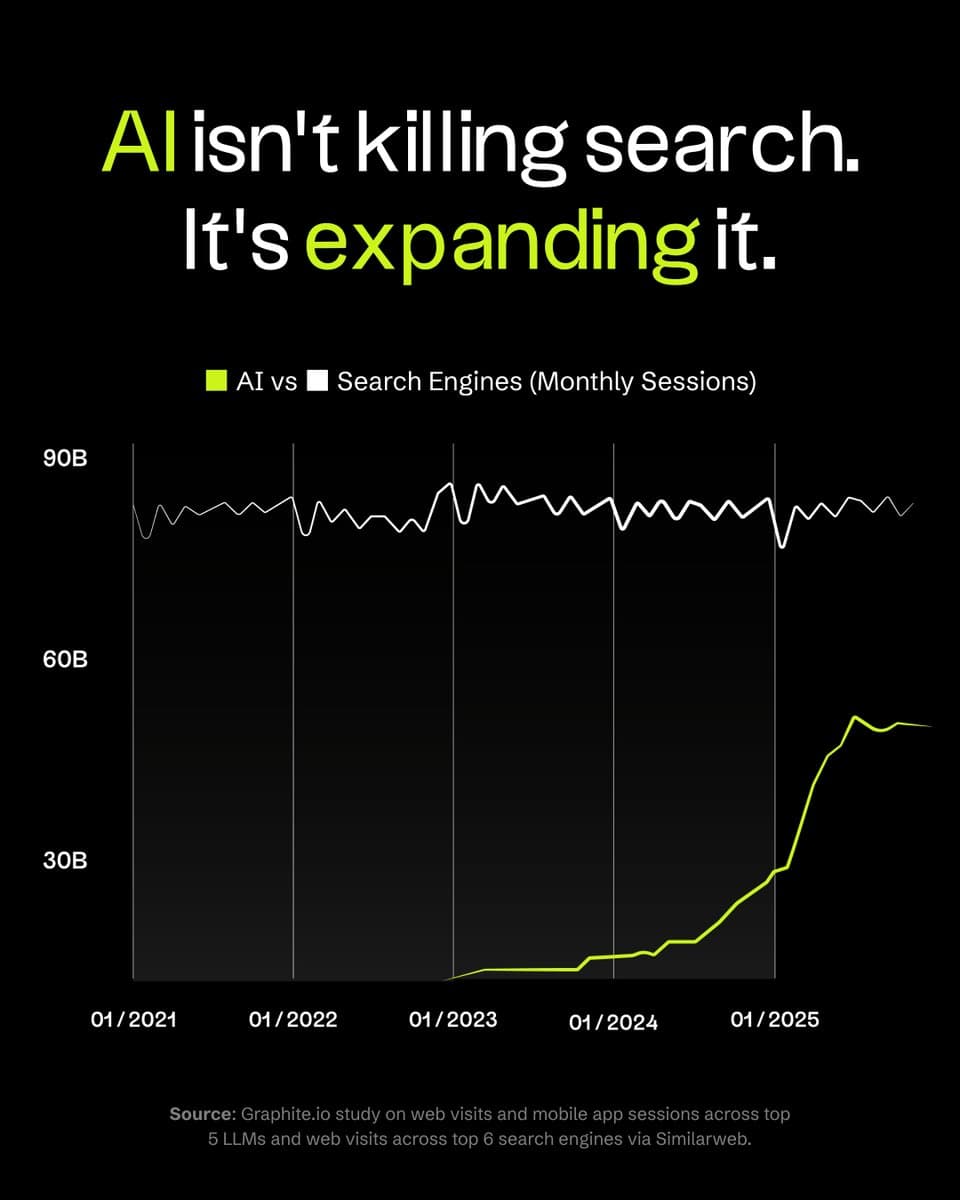
Total search volume, combining traditional engines and LLM-based tools, has grown 26% globally since last year. The audience is still there. The agencies that reframe their role as revenue architects rather than traffic generators are the ones positioned to capture it.
Sources:
Know something we missed? Have a correction or additional information?
Submit a Tip