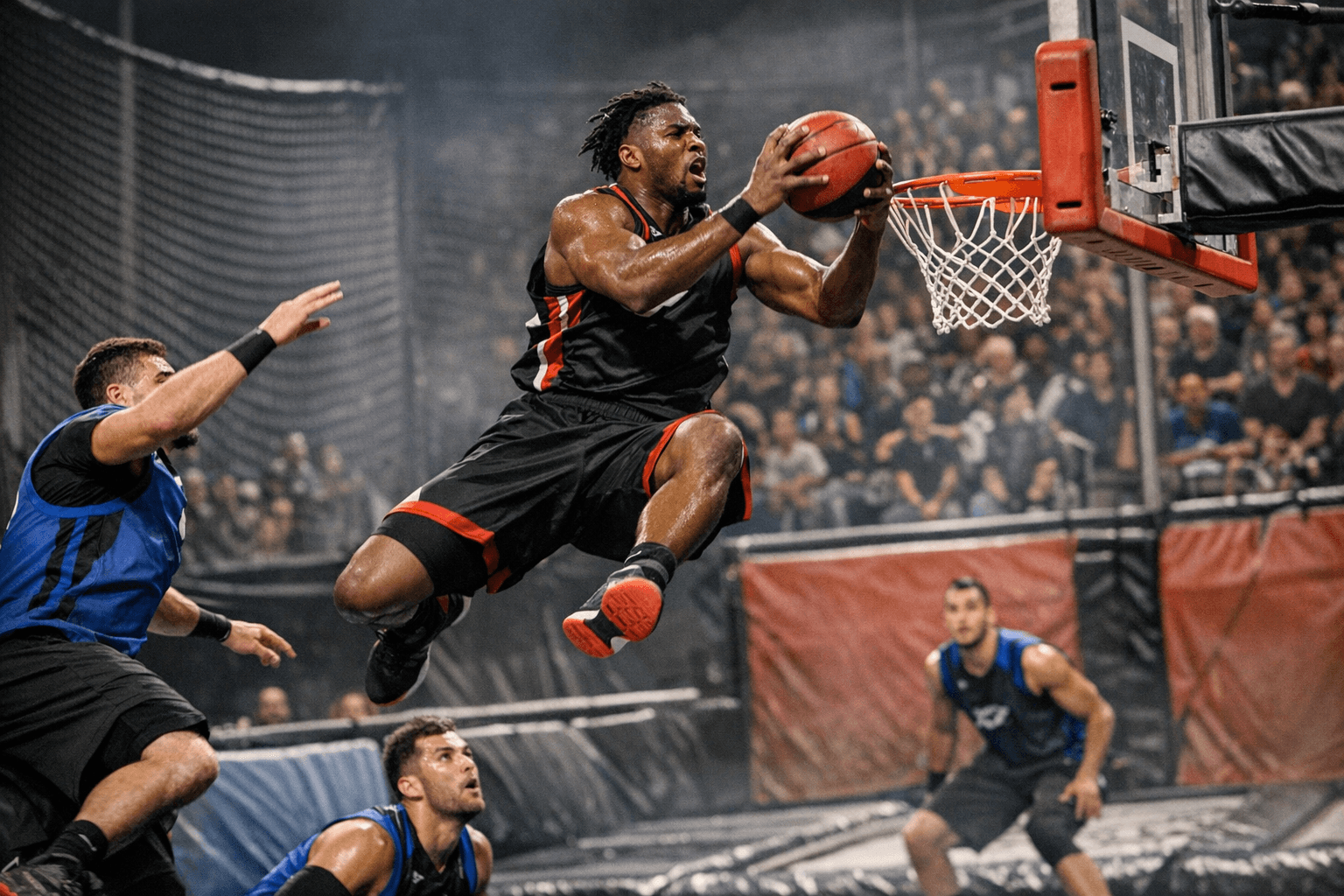
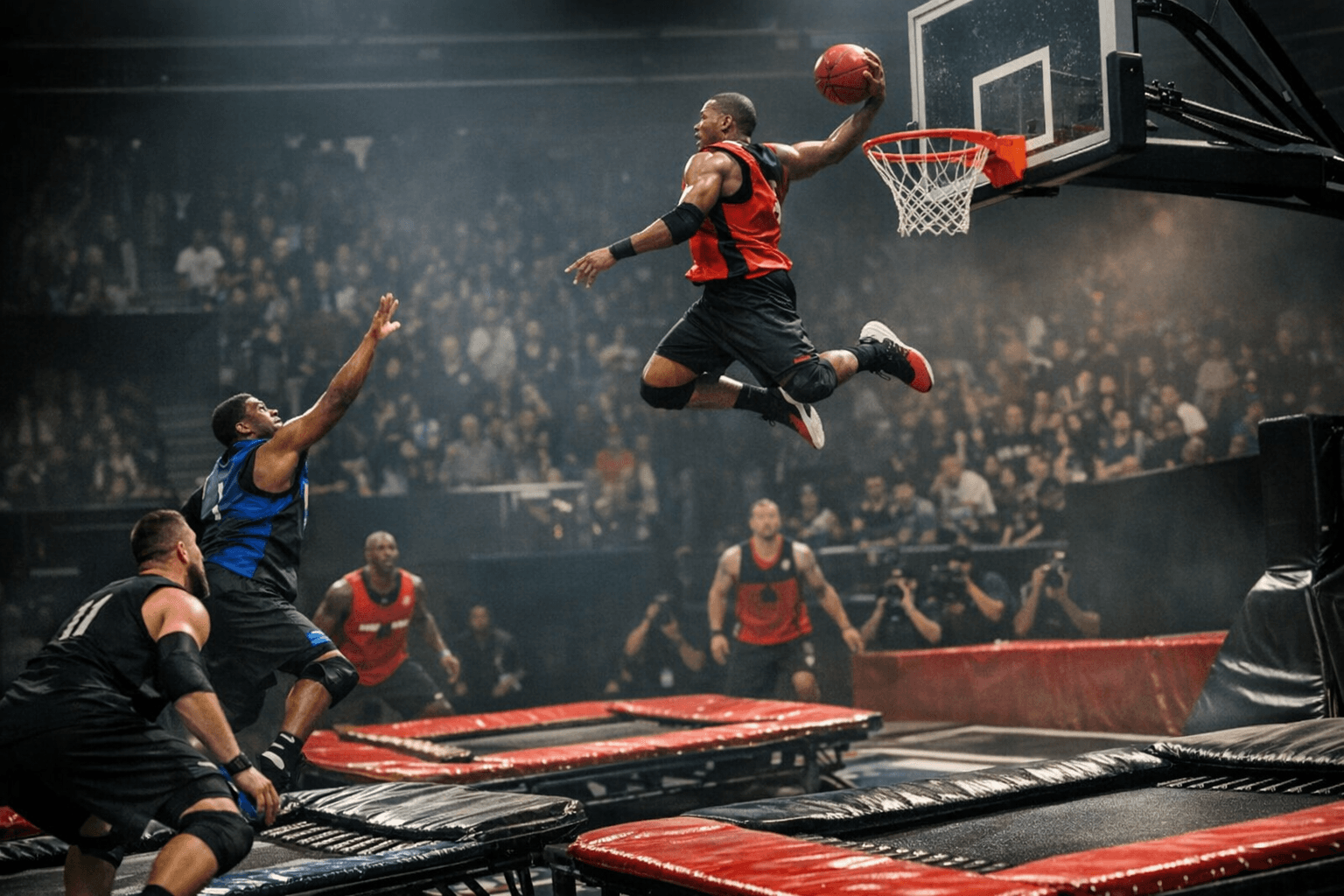
SlamBall Rules, Court Layout and Protective Gear Fans Need to Know
Short, high-flying 20-minute games built for highlights, know the 26.5 ft four-point arc, the 96×64 court with four springbeds per end, and the mandatory protective kit that keeps players flying safer.
1. Why the relaunch matters to fans
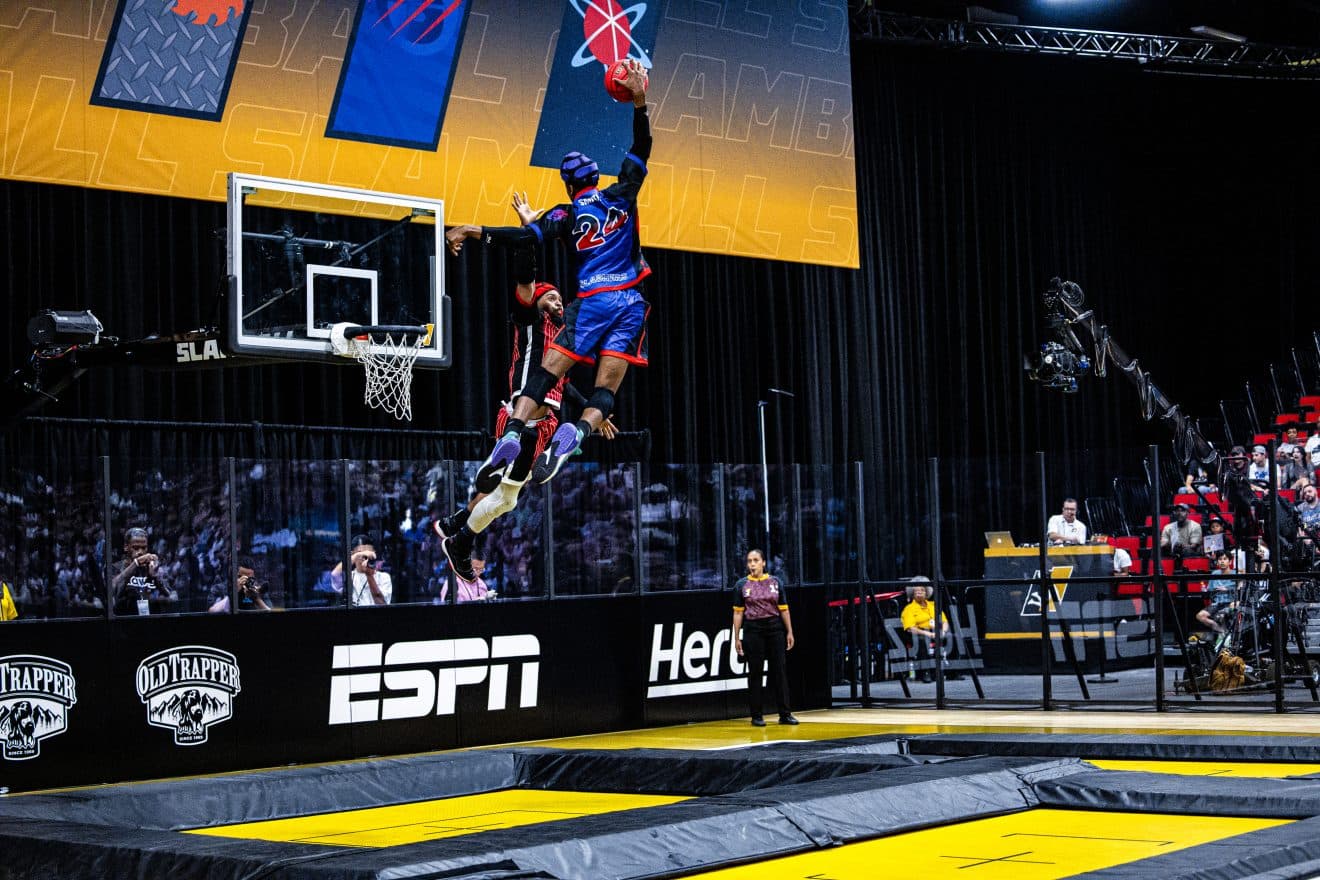
SlamBall’s comeback repackages competition for the streaming era: games are just 20 minutes of timed play, a shot clock of 20 seconds keeps possessions rapid, and a four-point arc at 26.5 feet creates instant highlight potential. That short-form, high-value scoring format is designed for social clips and real-time engagement, which explains why the league emphasizes spectacle without abandoning structured rules.
2. What SlamBall is, the quick definition
“Imagine basketball, but with trampolines strategically placed to allow for incredible dunks and aerial manoeuvres.” SlamBall is 4-on-4 full-contact basketball played on a spring-loaded floor with four trampolines at each end, plexiglass boards instead of out-of-bounds lines, and live, hockey-style substitutions. Mikegolub sums the product: “SlamBall’s resurgence reflects a growing appetite for sports that marry spectacle with structure,” a shorthand for why fans who like highlights and depth should pay attention.
3. Court footprint and fixed features
The playing surface is 96 feet long by 64 feet wide, slightly larger than a regulation basketball court, encased by an eight-foot-high plexiglass wall (four feet in team box sections). Rims sit at a standard 10 feet, and there’s 8 feet of playable floor behind the springbeds so action can occur behind the baskets. Pads and a padded dome surround the trampolines to limit dangerous impacts and keep the ball and players in continuous motion.
4. Springbeds and scoring bed layout
Each end contains four springbeds built into the floor: three standard beds measuring 7 by 14 feet and a larger scoring bed at 10 by 14 feet positioned directly under the rim. The scoring bed is the primary launchpad for thunderous dunks and controlled aerial plays; the triad of standard beds creates lanes for approach, takeoff, and lateral movement. That geometry drives both spectacle (big dunks) and strategy (angle of attack, spacing).
5. Official ball specifications
The League requires the official SlamBall ball with strict tolerances: weight 20–22 ounces, circumference 28–30 inches, and inflation between 7.5 and 9 psi. While some descriptions call it “a standard basketball” for fans, the League’s numeric limits govern what is permitted in competition, a detail that matters for consistency across broadcasts and equipment checks.
6. Mandatory protective gear and approved equipment rules
Players must wear League-authorized protective gear at all times; permitted items include elbow pads, knee pads, padded undergarments and elective padded helmets. Slamball Australia supplements that list with mouthguards and ankle support as typical safety items, but the League explicitly forbids any non-authorized equipment. The combination of mandatory padding and an encasing dome shows the league’s dual priorities: preserve aerial spectacle while minimizing catastrophic collisions.
7. Teams, rosters, and live substitutions
Teams play four-on-four with seven-player rosters (seven active per team), enabling rapid tactical changes and specialist roles. Substitutions are hockey-like and can occur during live play, but the exiting player must be within five feet of his own team box before a new player steps onto the court, a rule that enforces safe and orderly line changes. Coaches use that live-sub model to keep the tempo relentless and rotate players for short-burst high-impact plays.
8. Game starts: the throw down (faceoff)
Each half begins with a throw down: “The official slams the ball down and the ball bounces high above the players, who try to get position to secure it below. The ball must reach its apex uninterrupted.” That inverted tip-off is both a spectacle and a tactical moment; positioning under the apex often determines early possession tilts and sets the tone for short quarters.
9. Game timing, shot clock and timeout rules
Regulation SlamBall games consist of four five-minute quarters (20 minutes total) with a 20-second shot clock that resets to 12 seconds on offensive rebounds. The clock runs in nearly all situations outside Faceoffs and timeouts, but in the final minute the clock reverts to stop-time on all calls. Each team is allotted one timeout, usable only in the fourth quarter, a structural choice that preserves game flow and heightens late-game drama.

10. Scoring breakdown and the 26.5-foot arc
Current scoring rewards both aerial and perimeter skill: dunks through the rim with force are three points; shots behind the arc at 26.5 feet are four points; many interior shots inside the arc are three points, and trampoline jump shots or layups are valued at two points. Mason Gordon explained the arc placement: “At 26 and a half feet, the arc is farther back than it was in SlamBall 1.0, and farther than the NBA line... right between 26 feet, from where most pros can shoot, and 27 feet, from where only the top shooters in the world can shoot.” Coaches like Ken Carter emphasize the tactical shift: “My team shoots the three and the four. Everybody on my team can shoot the ball.”
11. Fouls, goaltending, and penalty resolution
SlamBall is full contact, body checking is allowed, and has distinct foul-resolution methods: instead of typical free throws, many fouls are settled with one-on-one penalty shots. Defenders may legally goaltend on shots taken from trampolines, a departure from basketball norms that changes defensive strategy around aerial plays. Detailed movement restrictions in the trampoline area exist and are cataloged in the League rulebook; those specifics determine what counts as a dangerous or illegal approach.
12. Athlete profile and roster composition
Across team rosters cited in coverage, 56 players combine a mix of backgrounds: 34 with college basketball pedigrees, 12 with college football experience, and five who ran track; the average SlamBall player stands about 6-foot-4 and is roughly 26 years old. That blend of jump ability, contact experience, and speed explains why teams deploy hybrid lineups, players who can finish above the rim, sustain contact, and space out to chase four-point shots.
13. Safety design and the tradeoffs of spectacle
The court’s padded perimeters, dome, and mandatory protective gear reflect a deliberate safety architecture: pads around trampolines, an eight-foot plexiglass wall, and a League mandate on authorized equipment. As Mikegolub notes, the sport’s aerial freedom “comes the need for a complex rulebook designed to maintain fairness, reduce dangerous collisions, and guide player behavior.” That balancing act shapes recruiting (favoring multi-sport athletes who can land safely) and the league’s medical policies.
14. Broadcast, cultural impact and business implications
Short, 20-minute games with built-in highlight mechanics (dunks, four-point shots, throw downs) are native to social-video distribution and attractive to streaming partners looking for snackable live events. The product’s history, Mason Gordon’s SpikeTV seasons in 2002–03 and now a fifth iteration, positions SlamBall as a nostalgia-tinged entrant retooled for modern attention economics. Expect teams and coaches to pivot tactics to generate clips: perimeter specialists will be as commercially valuable as slam artists.
15. What to watch for on game day
Tune into throw downs (faceoffs), live substitutions, high-value perimeter attempts from beyond 26.5 feet, goaltending plays on trampoline shots, and show-stopping dunks off the 10×14 scoring bed, those moments drive both scoreboard swings and viral moments. Production teams will likely build graphics for arc distance, trampoline usage, and player swap windows to help casual viewers follow fast action.
16. Verification points and where to check official rules
For play-by-play nuance, the exact mapping of every shot-location to point value, full movement restrictions in trampoline areas, and the League’s definitive authorized-equipment list, consult the official SlamBall rulebook. The rulebook also clarifies whether items like mouthguards and ankle supports are mandatory versus recommended and confirms any season-to-season arc or scoring adjustments.
17. Final takeaway for fans
SlamBall packages athletic spectacle into a tightly governed game: 96×64 feet of spring-loaded theater, precise equipment tolerances, mandatory padding, and scoring innovations that push perimeter skill and highlight value. The result is a sport explicitly designed for fans who want abbreviated, intense contests that translate into clips, conversation, and a new kind of live-sports social currency.
Know something we missed? Have a correction or additional information?
Submit a Tip