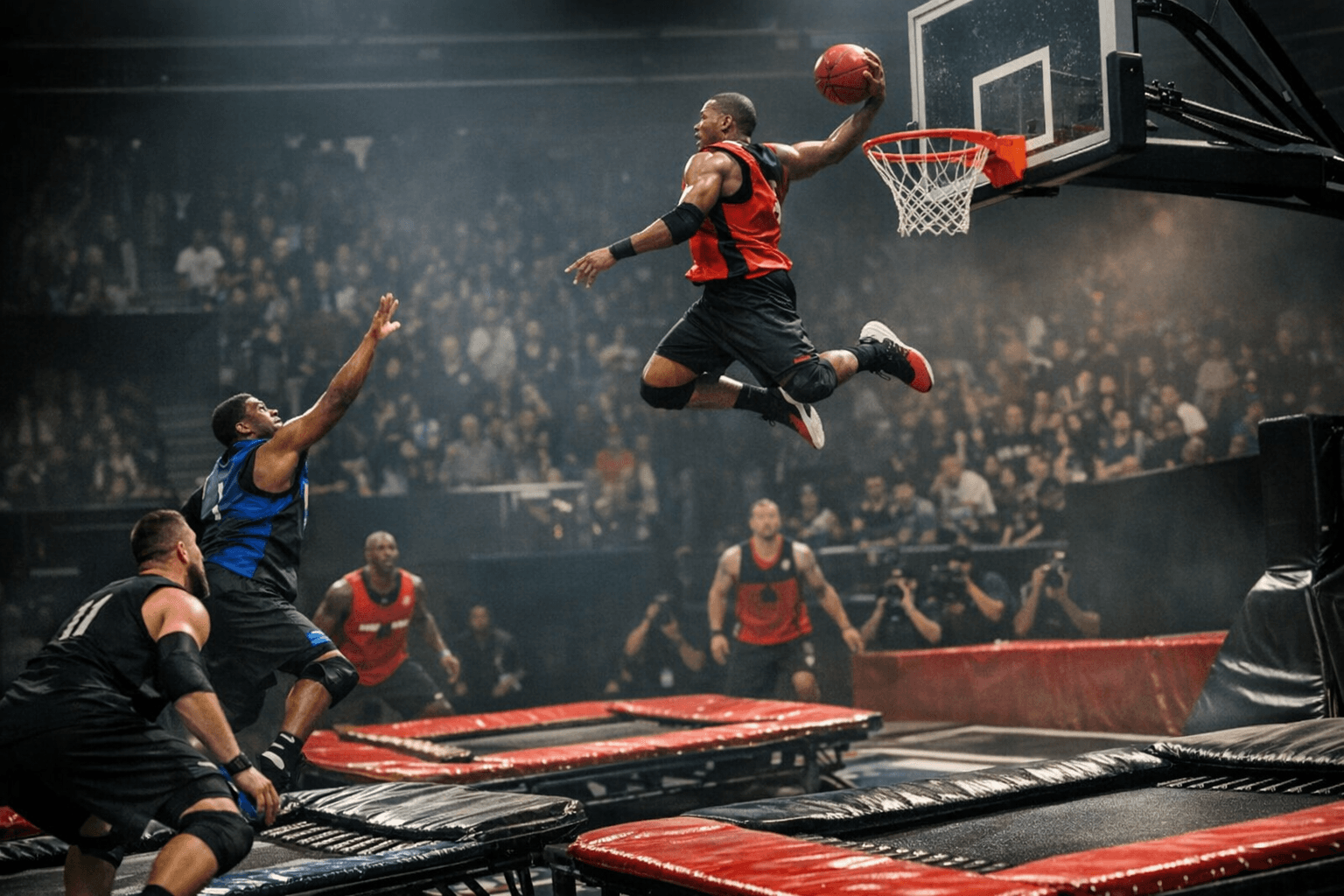
SlamBall: Trampoline-fueled, full-contact hybrid of basketball, football, hockey, gymnastics
SlamBall returned to national TV in 2023 with an ESPN-backed Series 6 staged in Las Vegas, spotlighting a high-flying, full-contact hybrid that aims to translate short-form highlights into mainstream viewership.
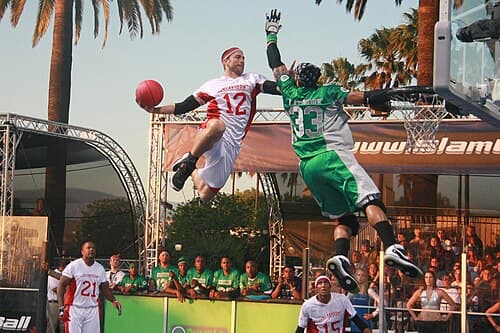
SlamBall re-emerged as a national spectacle with a 2023 Series 6 season staged in Las Vegas and all games broadcast on ESPN, a signal that the trampoline-powered, full-contact sport is chasing mainstream traction. The revival combines nimble production strategies with venue upgrades and a rule set designed to fuel highlight reels for younger audiences.
Sportico summed the on-court product succinctly: “SlamBall is essentially 4-on-4 basketball played on a spring-loaded floor with four trampolines inside the arc. It’s full contact, body checking is allowed, and fast-paced, with on the fly substitutions and hockey-like plexiglass boards surrounding the court instead of out-of-bounds lines.” That theatrical mix allows players to “jump on and fly up to 20 feet in the air to deliver a slam dunk,” and the court measures 96 feet long by 64 feet wide, slightly larger than a regulation basketball court. Each side features four trampolines in front of the net, a paint-area springbed that reshapes timing, spacing, and finish attempts.
Rules are compact and spectacle-oriented: four 5-minute quarters, 4-on-4 rosters on court, dunks worth 3 points, jump shots worth 2, a conventional 3-point line and the reported introduction of a 4-point shot in recent play. Fouls are settled by a one-on-one face-off rather than traditional free throws, goaltending is permitted on trampoline shots, and substitutions happen on the fly in hockey-style line changes. Positions are named for function: handler, gunner, stopper.
The talent pool skews young and athletic. Sportico reported 56 rostered players across the league mix backgrounds: 34 with college basketball experience, 12 from college football, and five who ran track. Average height sits at 6-foot-4 and average age at 26, a profile that favors explosive leapers comfortable with contact and aerial finishing.
The league’s timeline is patchwork: Mason Gordon invented the concept around 1999 and the professional league is listed as founded in 2000, with televised runs on SpikeTV in 2002 and 2003 and multiple later restarts. Wikipedia’s league table records several first-season and cessation years culminating in the 2023 revival. The team Mob is listed as the most decorated franchise with three titles.

Business strategy is explicit: Gordon has positioned Las Vegas as a staging ground, noting that “Vegas is rapidly becoming sports town USA.” He argues the format plays to modern viewing habits: “Gordon envisions that short games will keep audiences interested in the core product, particularly since younger demographics consume legacy sports increasingly through highlight clips and social media.” The league is investing in infrastructure too, tearing down and rebuilding a practice court at Cox Pavilion to match the spectacle environment.
Culturally, SlamBall has long inhabited pop-culture fringes, from a Back to the Future Part II databank mention to a 2002 public demonstration, “Athlete LaMonica Garrett demonstrates the new team action sport 'Slamball' at a live exhibition at Nick on Sunset on July 30, 2002 in Los Angeles”, that helped seed early curiosity. The sport’s return under ESPN brings commercial opportunities but also renewed scrutiny around safety, scheduling, and sustainable roster economics.
For fans and industry watchers, the Las Vegas run is a test: can a hybrid built for highlight clips convert short attention into consistent viewership, sponsorship, and growth? The answer will shape whether SlamBall becomes a permanent fixture in the sports calendar or remains a high-flying niche spectacle.
Know something we missed? Have a correction or additional information?
Submit a Tip