Slots & Daggers blends slot machines and roguelike strategy on Steam
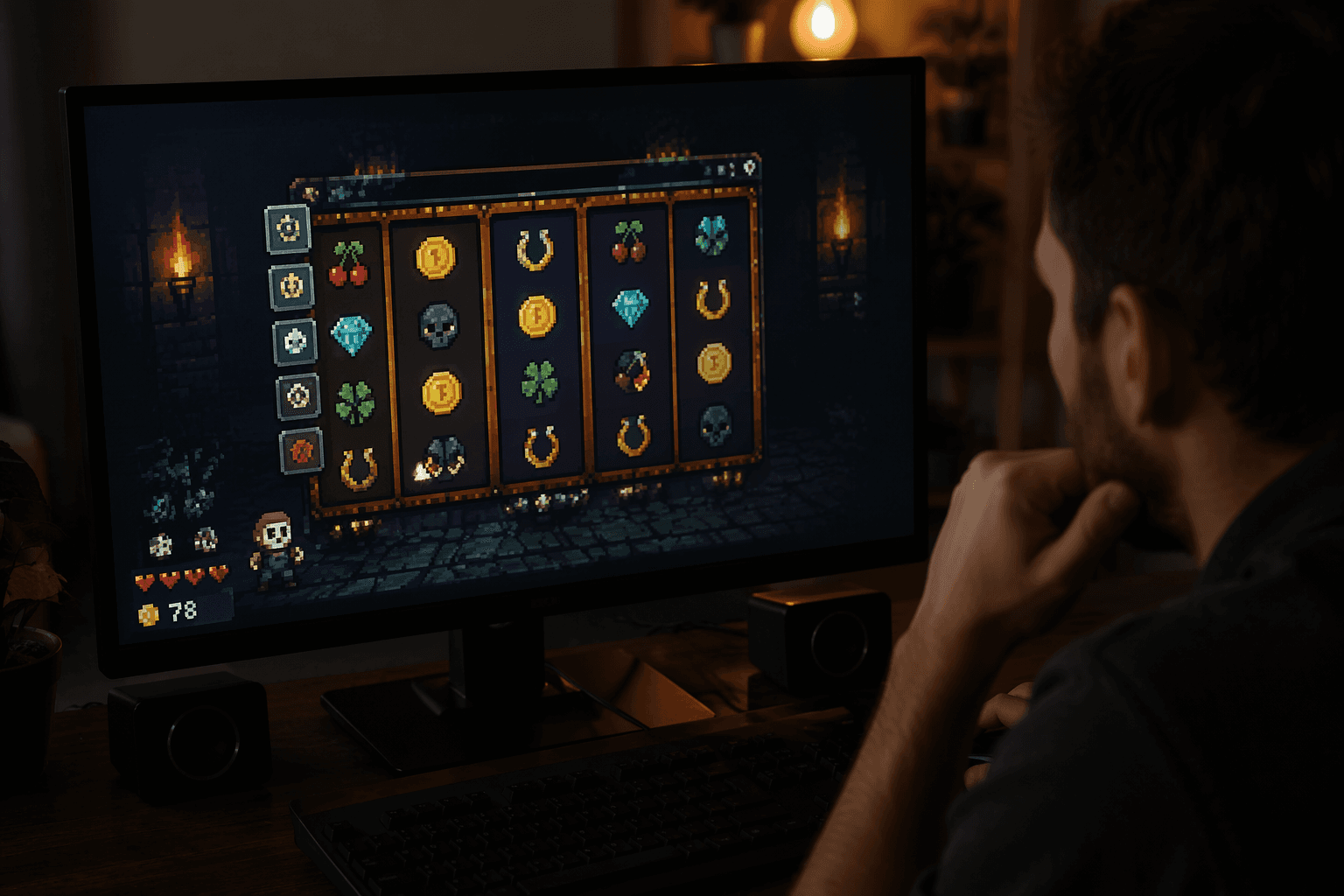
Slots & Daggers turns a slot machine into a compact roguelike, and its short, dense design is resonating with players tired of oversized games.
Why this compact roguelike is landing now
Slots & Daggers succeeds because it feels built for players who want tension, strategy, and a clean finish instead of a 60-hour commitment. Steam describes it as “a retro mini-roguelike inside a slot machine,” and that pitch matches a broader shift in taste: short, mechanically dense games are increasingly appealing when bigger releases demand more time than many players can give.
That compactness is not an accident. Steam lists the campaign at about 4 to 8 hours, prices it at $7.99, and adds an “Egg arena” high-score mode for players who want to keep pushing after the main run. The result is a game that feels economical in the best sense, with enough structure to reward experimentation and enough restraint to avoid wearing out its welcome.
How the game works
The core idea is simple to explain and surprisingly rich in play. Slots & Daggers mixes deckbuilding roguelike logic with slot machine mechanics, creating a loop where luck and planning keep colliding. Each run feeds into steady meta-progression, so even failed attempts can move the player forward and make the next try more viable.
That blend is what makes the game more than a novelty. Instead of treating the slot machine as a gimmick, Friedemann uses it as the engine of the entire strategy layer. The appeal comes from reading risk, chasing combinations, and deciding when to lean into chance, which gives the game a fast-moving rhythm that fits its small scale.
A small project with a clear identity
The game is a solo project by Berlin-based developer Friedemann and was published by Future Friends Games. He said he had been making indie games for almost 10 years and previously co-founded GrizzlyGames, which helps explain why the design feels disciplined rather than overstuffed. There is a long development instinct behind what looks, at first glance, like a playful experiment.
Friedemann has also said that Summerhouse sold 350,000-plus units, giving him a proven track record with compact indie design. For Slots & Daggers, he framed the project as a deliberately small experiment in luck-and-strategy design, a sharp contrast to the sprawling ambitions that can bog down much of the games market. That restraint is part of the game’s identity and part of its commercial appeal.
From palette cleanser to finished release
Slots & Daggers began as a palette cleanser after Friedemann got stuck on another project, and he originally expected to make it in about six weeks. That origin matters because it helps explain the game’s focus: it was not designed to become an endless system or a prestige-scale production, but a clean, contained idea built around one strong hook.
His inspiration came from gambling and casino-style mechanics, along with the notion that indie games are “thinly disguised slot machines.” That line captures why the game feels so immediate. It does not hide its dependence on chance, but uses that relationship to create a tight strategic loop that remains readable even as the runs escalate.
Why the length works
The game’s 4 to 8 hour campaign is one of its biggest strengths, not a compromise. In a market where players are often asked to keep up with massive releases, the brevity here feels intentional and respectful. It offers enough content to feel substantial, but not so much that every session becomes a long-term obligation.
That design choice also speaks to changing player habits. A growing share of the audience seems drawn to games that can be learned quickly, completed cleanly, and replayed without a large emotional or time investment. Slots & Daggers fits that pattern neatly, with a structure that rewards repeated runs while still giving the player a clear endpoint.
What to expect on Steam
Steam lists the game at $7.99, which places it firmly in impulse-buy territory for players curious about a strange but promising idea. The store page also describes it as “small, focused, and made with care,” language that reflects how the game presents itself: compact, polished, and built around a single strong concept rather than a long feature list.

That presentation appears to be working. Steam’s store pages show recent user reviews trending very positive, and the game’s framing as a miniature roguelike has made it easy to understand at a glance. For a project this small, clarity is a major advantage, because the pitch communicates the experience before anyone even clicks play.
How the release has widened its reach
Slots & Daggers launched on October 24, 2025 on Steam, then expanded to PlayStation 5, Nintendo Switch, and Xbox Play Anywhere on May 15, 2026. That console rollout matters because it gives the game a second life beyond PC and places its compact format in front of players who may be especially receptive to shorter sessions.
Steam also announced a 30% daily deal for the game from May 15 to May 29, 2026, which further increased its visibility. The timing is telling: a low-priced, tightly scoped roguelike was able to travel well across platforms and into promotion because its value proposition is easy to understand and hard to confuse with anything else.
Why Slots & Daggers matters beyond one release
The larger signal here is not just that a slot-machine roguelike found an audience. It is that players continue to reward games that know exactly what they are and do not overextend themselves in pursuit of scale. Slots & Daggers shows how a focused idea, a modest price, and a short campaign can feel more inviting than bloated alternatives.
That is where the game sits in the current market: as proof that compact experiences still have room to grow, especially when they are mechanically sharp and emotionally legible. In that sense, its success is not a curiosity, but a reminder that plenty of players are looking for games they can finish, revisit, and actually fit into their lives.
This article was produced by Prism’s automated news system from verified source data, official records, and press releases, then run through automated quality and moderation checks before publishing. The system is built and supervised by the people who set the standards it runs under. Read our full AI policy.
Did this article answer your question?