Social Media Giants Face Big Tobacco Reckoning as Trial Begins in Los Angeles
A Los Angeles jury found Meta and YouTube negligent and awarded $6 million to Kaley, a 20-year-old who started using Instagram at age 9 — the first-ever social media addiction verdict in U.S. history.
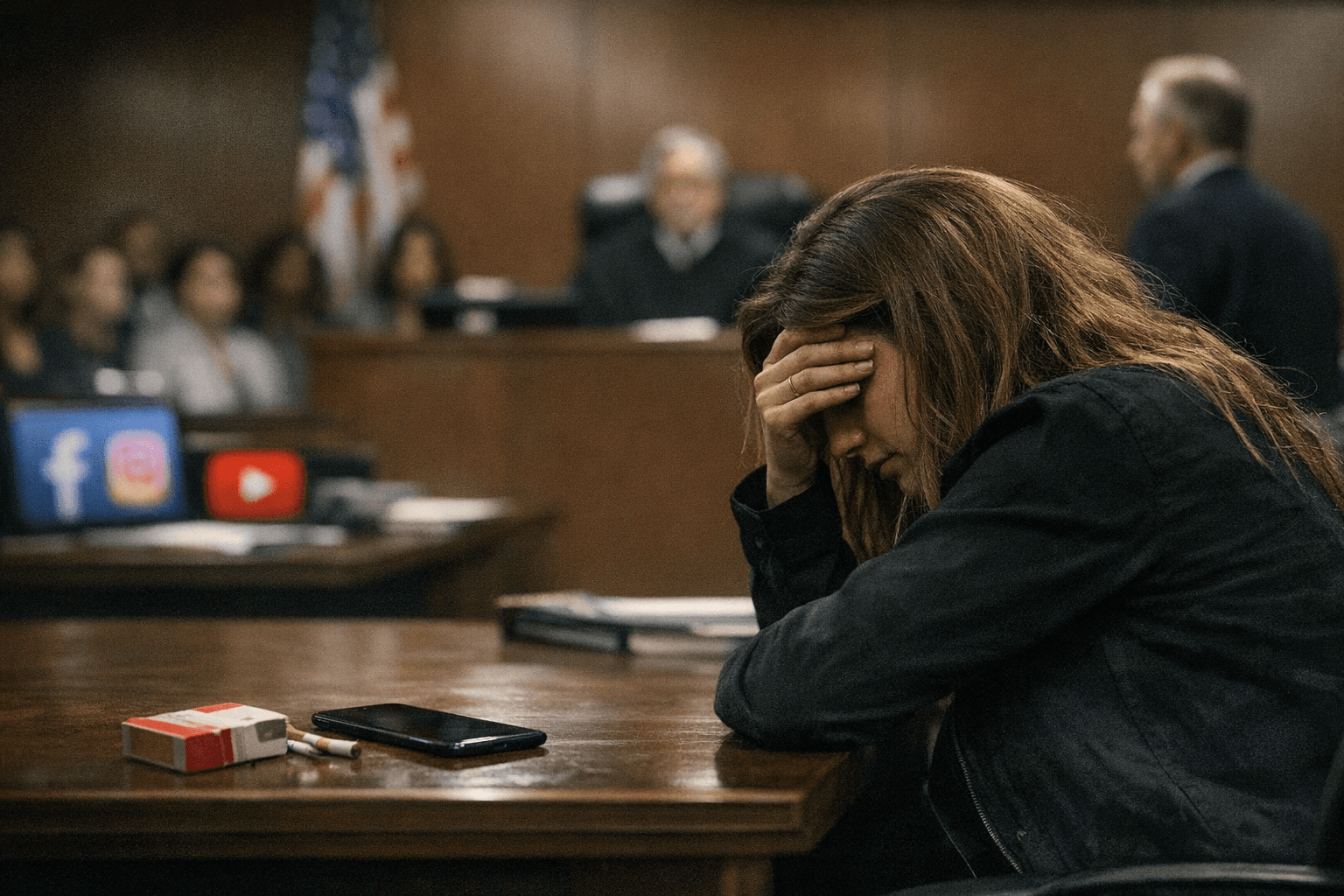
Kaley started watching YouTube at age 6. By age 9, she had an Instagram account. By the time she was a teenager, she told a Los Angeles jury, she was on social media "all day long," and the compulsive use had left her struggling with depression, anxiety, and body dysmorphia. On Wednesday, that jury handed her a landmark victory that advocates are already comparing to the tobacco industry's courtroom reckoning of the 1990s.
A California jury found that Meta and Google were to blame for the depression and anxiety of a woman who compulsively used social media as a small child, awarding her $6 million in a rare verdict holding Silicon Valley accountable for its role in fueling a youth mental health crisis. Jurors found Meta 70% responsible for the harm caused to her, with YouTube responsible for the remaining 30%.
Meta's apps, including Instagram, and Google's YouTube, the jury concluded, were deliberately built to be addictive, and the companies' executives knew this and failed to protect their youngest users. The legal team showed the jury internal documents from Meta in which CEO Mark Zuckerberg and other executives described the company's efforts to attract and keep kids on its platforms. One document said: "If we wanna win big with teens, we must bring them in as tweens." Another internal memo showed that 11-year-olds were four times as likely to keep coming back to Instagram compared with competing apps, despite the platform requiring users to be at least 13 years old.
Lawyers took a different legal approach by focusing on how tech companies built their platforms, arguing that features like infinite scroll, constant notifications, autoplaying videos, and beauty filters made apps like Instagram and YouTube equivalent to a "digital casino" that young people found too irresistible to put down. The lawsuit's language was direct: "Borrowing heavily from the behavioral and neurobiological techniques used by slot machines and exploited by the cigarette industry, defendants deliberately embedded in their products an array of design features aimed at maximizing youth engagement to drive advertising revenue."
TikTok and Snap were originally part of the case but settled with the plaintiff before the trial began, leaving Meta and Google to face the jury alone. The jury deliberated for more than eight days after a seven-week trial in Los Angeles Superior Court. One juror, who did not feel comfortable sharing her full name, said outside the courtroom that Mark Zuckerberg's testimony, and how he "changed it back and forth," did not "sit well" with the jury.
It was the second verdict against Meta in as many days. A separate jury in New Mexico found Meta liable for failing to protect children from online predators and sexual exploitation on Facebook and Instagram, ordering the company to pay $375 million in civil penalties.
Matt Bergman, founding attorney of the Social Media Victims Law Center, said the jury's decision "establishes a framework for how similar cases across the country will be evaluated and demonstrates that juries are willing to hold technology companies accountable when the evidence shows foreseeable harm."
The trial is a test case, known as a bellwether, tied to about 2,000 other pending lawsuits brought by parents and school districts arguing that social media giants should be considered manufacturers of defective products for hooking a generation of young people to social media feeds. According to Ethics and Public Policy Center fellow Clare Morell, Meta, TikTok, Snap, and YouTube face more than 3,000 lawsuits in California alone, along with more than 2,000 additional cases in federal court. A federal trial is set to begin this summer in the Northern District of California involving similar, consolidated claims by school districts and parents nationwide.
Both companies vowed to appeal. Meta said it "respectfully disagrees with the verdict," adding that "teen mental health is profoundly complex and cannot be linked to a single app" and that it remains "confident in our record of protecting teens online." Google said it disagreed with the verdict and planned to appeal, adding that "this case misunderstands YouTube, which is a responsibly built streaming platform, not a social media site."
The congressional backdrop makes the courtroom victories all the more significant. Congress has not passed a child online safety law since 1998, nearly a decade before social media existed, leaving parents and state governments to pursue accountability through litigation. More than 40 state attorneys general have filed lawsuits against Meta, claiming it is harming young people and contributing to the youth mental health crisis by deliberately designing features on Instagram and Facebook that addict children to its platforms. In January, French lawmakers approved a bill banning social media for children under 15. Australia has already passed a social media ban for minors under 16.
Peter Ormerod, an associate professor of law at Villanova University, called the verdict "a momentous development" but noted it is just "one step in a much longer saga," adding: "I don't think it is an unequivocal victory and I think there's a long way to go before you see something akin to the master settlement that this is often analogized to in the tobacco and opioid litigation."
The litigation has drawn comparisons to the legal crusade in the 1990s against Big Tobacco, which forced the industry to stop targeting minors with advertising. While exactly how the litigation may upend the social media landscape is uncertain, the lawyers involved in the cases against the tech giants view the Los Angeles verdict as a promising early sign that the dam is breaking in favor of industry-wide changes.
This article was produced by Prism’s automated news system from verified source data, official records, and press releases, then run through automated quality and moderation checks before publishing. The system is built and supervised by the people who set the standards it runs under. Read our full AI policy.
Did this article answer your question?