Sotheby’s to auction giant South Dakota T. rex for up to $30 million
A South Dakota T. rex nicknamed Gus went to auction with a $19 million opening bid and a $30 million estimate, renewing fears that science may lose access.

Sotheby’s put a giant Tyrannosaurus rex from Harding County, South Dakota, on the auction block with bidding starting at $19 million and an estimate of $20 million to $30 million, the highest range yet assigned to a dinosaur fossil. If Gus reaches the top of that estimate, it would push the market for spectacular fossils even further into territory once reserved for major works of art and old master paintings.
The specimen was found on land owned by cattle rancher Gary “Gus” Licking, and it took three summer field seasons, from 2021 through 2023, before the fossil spent three more years in the lab being cleaned and assembled. Sotheby’s said the skeleton contains 183 fossil bone elements, making up about 63 percent of a T. rex’s total bone count and as much as 80 percent of its bone mass. It measures about 38 feet long and 12.5 feet tall, with a skull 54 inches long.
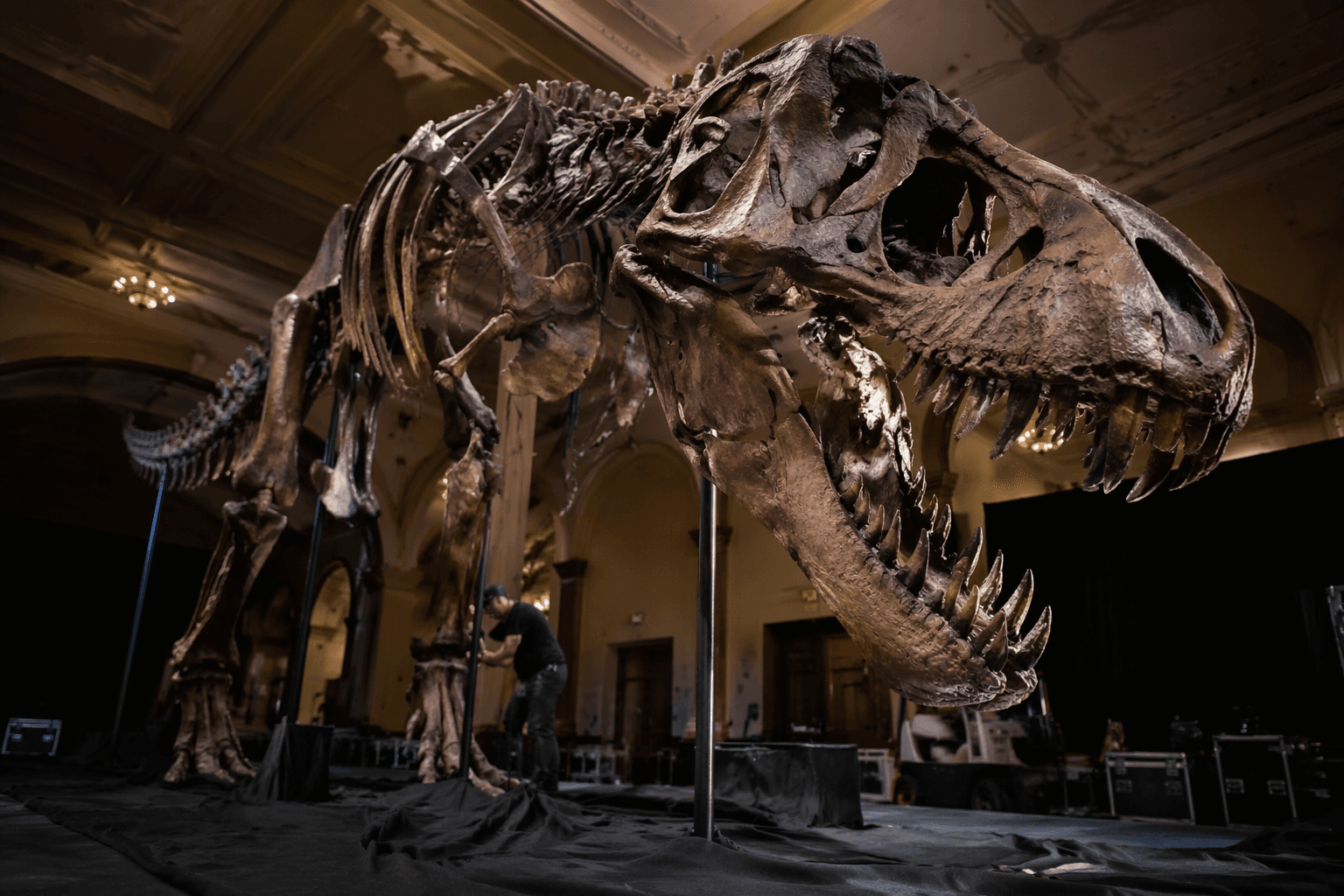
What gives Gus its scientific value is not only its size, but its injuries. The skeleton preserves fractured and healed bones, along with bite marks on the skull, details that can help researchers study how Tyrannosaurus rex was injured, how it recovered and how it scavenged. That is why the auction has stirred a familiar concern among paleontologists: once a fossil moves into private hands, access can narrow or vanish entirely. A private owner can deny researchers permission to examine a specimen or resell it, which can block verification, publication and follow-up study.
The anxiety is not hypothetical. Stan, one of the most famous T. rex skeletons ever found, sold for $31.8 million in 2020, then the record price for a dinosaur fossil. Scientists have been warning for years that headline-grabbing auctions can pull major specimens out of public science and into private collections where they may be displayed, warehoused or traded, but not studied. Cassandra Hatton, Sotheby’s vice chairman and worldwide head of science and natural history, said the market now reaches far beyond private collectors, drawing interest from U.S. museums, international museums, foundations and individuals building their own destinations.
The sale of Gus exposed the same tension that has shadowed dinosaur auctions for decades: whether a specimen with clear research value ends up as a public scientific asset or a privately controlled trophy.
This article was produced by Prism’s automated news system from verified source data, official records, and press releases, then run through automated quality and moderation checks before publishing. The system is built and supervised by the people who set the standards it runs under. Read our full AI policy.
Did this article answer your question?