Sounding-Rocket COLORS Prints Soft Matter in 267 km Microgravity Test
A COLORS payload on a sounding rocket reached 267 km and used six minutes of microgravity to 3D-print large droplets of a soft material similar to bio-inks, advancing models for soft-matter printing.
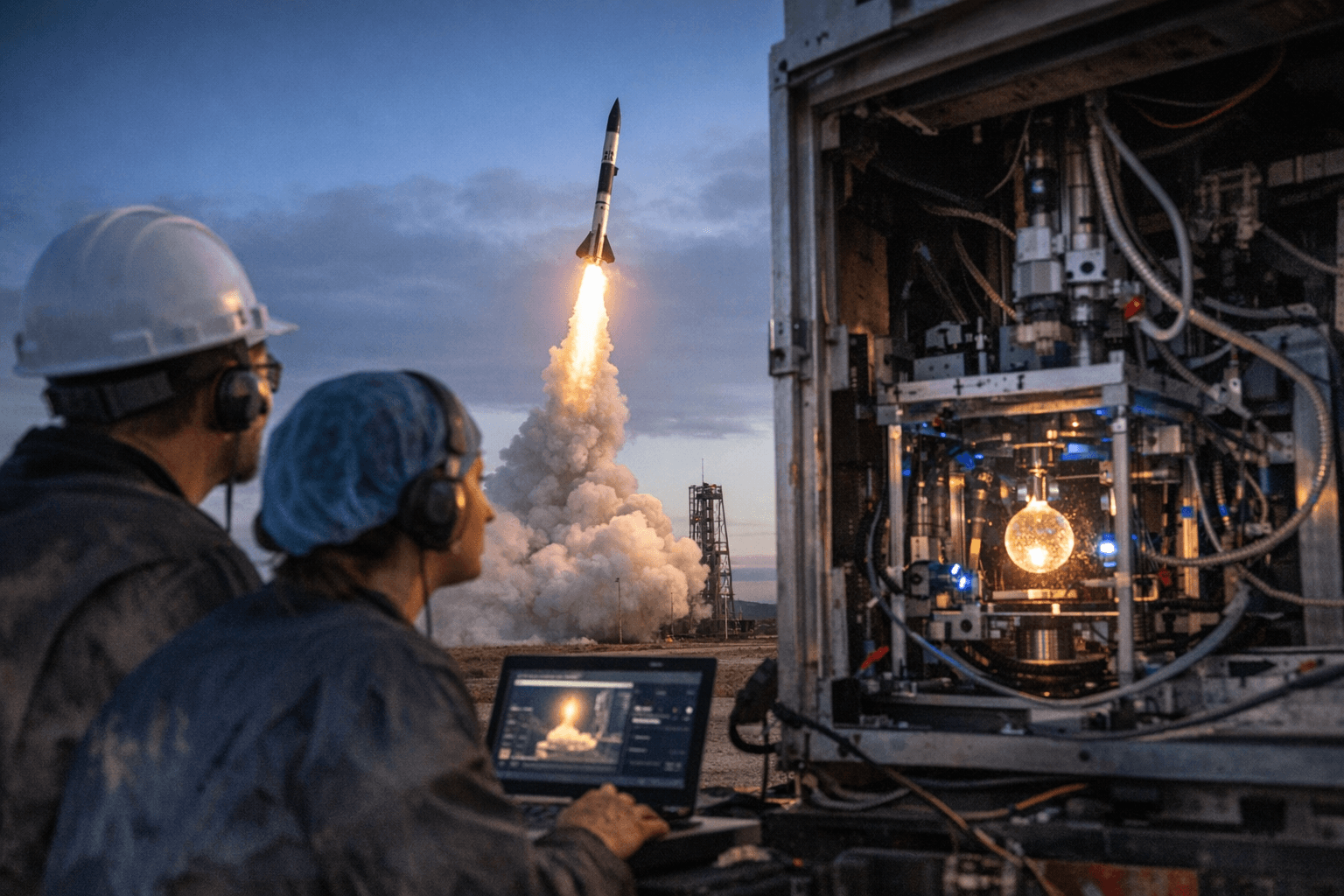
A sounding rocket carrying the COLORS experiment climbed to 267 km and delivered six minutes of continuous weightlessness in which researchers 3D-printed large droplets of a soft material similar to the inks used for bioprinting. The flight gives a rare, uninterrupted microgravity window to observe how soft fluids behave when gravity is removed, a problem that hides subtle forces on Earth.
Dr. Olfa D'Angelo, the VENI fellow who led the COLORS team, framed the test as an opportunity to watch stresses inside soft fluids in their native state. "By temporarily removing gravity, the suborbital flight lets us directly observe the stresses inside the fluid, while maintaining the other conditions relevant for advanced 3D printing and bioprinting," she said. D'Angelo added that the experiment aims to improve predictive models: "The results from COLORS will help us build more reliable models of fluid deposition and move closer to a true digital twin for additive manufacturing of soft materials. This is essential for increasing the reliability and reproducibility of 3D printed objects, including in demanding applications such as bioprinting, both in space and here on Earth."
The experiment was engineered by a multi-institution team. Mazi Jalaal of the University of Amsterdam and Thomas Voigtmann of the German Aerospace Center (DLR) are listed as joint investigators, and Martin Weiß at DLR led the experiment engineering. The payload used an optical method to capture the fluid behavior during deposition; the team is currently analysing the footage and expects to publish detailed results in the coming year. The group also plans to refine the optical technique to deepen understanding of how gravity influences soft-material processing.
COLORS focused on droplet-scale printing rather than cell-laden tissue constructs. That distinction matters for labs planning microgravity studies: the suborbital profile delivers one long continuous microgravity interval, while parabolic flights provide many short intervals. ETH Zurich recently reported a different approach, led by Parth Chansoria, using 30 parabolic flight cycles and a custom G-FLight system to 3D-print human muscle tissue from a light-sensitive bio-resin infused with living cells, with published comparisons of cell viability and fiber alignment. COLORS, by contrast, printed nonliving soft-material droplets and is still extracting quantitative behavior from video.
Technical work elsewhere points to additional solutions for microgravity printing challenges. A NASA white paper excerpt highlights electric-field-assisted Direct Ink Writing, or e-DIW, as a proposed way to counter worsened wetting and deposition under reduced gravity by using Coulomb forces to pull material toward a substrate. That modeling and experimental work is pitched toward fabrication of tissue constructs for space medicine and testing across lunar, martian, and microgravity regimes.
For the 3D printing community, the COLORS flight offers droplet-level insights that could ripple through simulation, printer control, and material formulation. Expect concrete numbers and plots when the team releases its analysis within the year; until then, the mission establishes a new, practical data point for anyone working on deposition, rheology, and the quest for a true digital twin for soft-matter additive manufacturing.
Know something we missed? Have a correction or additional information?
Submit a Tip