South Korea enacts sweeping AI Basic Act as startups warn of costs
The AI Basic Act takes effect today, setting transparency and safety rules while startups warn compliance costs and vague standards could hinder innovation.
South Korea put into force a comprehensive Artificial Intelligence law today, creating one of the world’s first full national frameworks to govern AI development and deployment while promising support for industry growth. The Act on the Development of Artificial Intelligence and Establishment of Trust, commonly called the AI Basic Act, was passed by the National Assembly in December 2024 and becomes binding nationwide on Jan. 22, 2026.
The law establishes new institutional machinery: a national AI control tower, an AI Safety Institute charged with safety and trust assessments, and a Presidential Council on National Artificial Intelligence Strategy to coordinate high-level policy. The Ministry of Science and ICT, designated as the implementation lead, has said it will set up a support center to work with smaller firms during rollout and will draft subordinate regulations to define operational details.
Substantive obligations in the statute target transparency, human oversight and safety processes. Developers and providers must give advance notice to users when services rely on generative or high-impact AI and must clearly label AI-generated outputs when they are hard to distinguish from human-produced content. For systems classified as high-impact, the law requires explicit human oversight and mandates AI risk assessments and other safety controls. Fields identified as high-impact include nuclear safety, drinking water production, transport, healthcare and financial services such as credit evaluation and loan screening. The Act also introduces legal safety duties for frontier or high-performance AI systems, an inclusion described by government advisors as unprecedented in national legislation.
Enforcement will begin gradually. Regulators have announced a one-year adaptation period before administrative fines are imposed. During that window firms are expected to receive guidance and time to comply. After the grace period, penalties for violations such as failing to label generative AI could reach up to KRW 30 million, roughly $20,400.
The law couples regulatory duties with industrial policy measures. It provides legal grounds for government support in research and development, standardization, national AI infrastructure such as training data and data centers, talent development and assistance for small and medium enterprises and startups seeking overseas expansion. Officials frame the statute as a dual mandate to boost national competitiveness while building public trust and ethical guardrails.
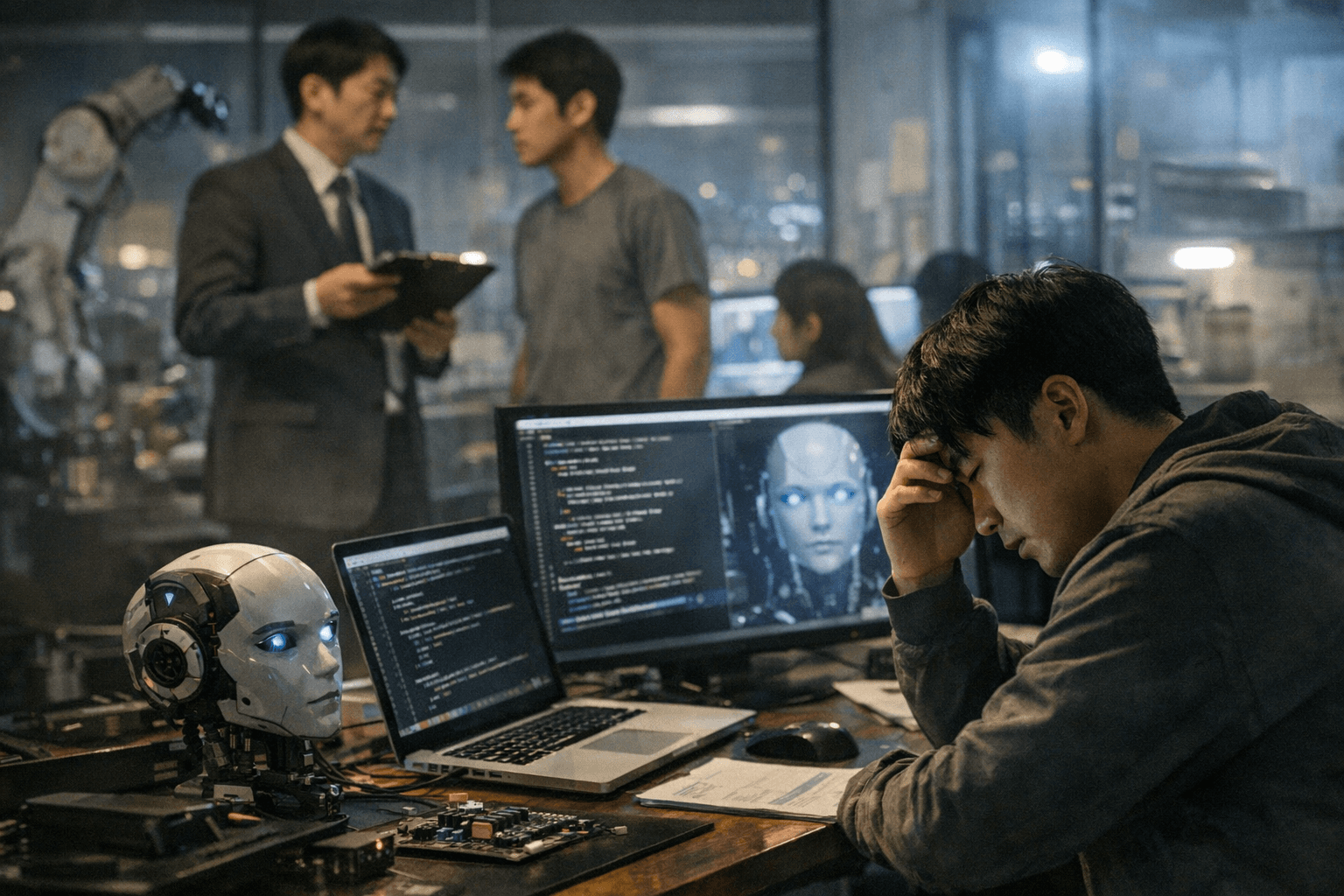
Reaction has been sharply divided. Early-stage founders and developers caution that compliance will impose heavy documentation and technical burdens, such as watermarking and rigorous risk assessments, that could slow experimentation. Some warn that vague definitions of high-impact or frontier systems and the cost of compliance could discourage creative and service-driven startups from innovating or competing with less-regulated firms abroad. At the same time, proponents argue that trust-focused rules may create opportunities: companies that build compliance-ready, transparent systems could gain credibility with global partners and investors increasingly focused on regulatory preparedness.
Practical questions remain. The precise contours of subordinate rules drafted by the Ministry of Science and ICT will determine how burdens are distributed across firms and whether enforcement reaches overseas platforms and small app developers without domestic representation. As Seoul moves faster than some peers, the Act positions South Korea at the center of a global debate over how to balance safety, competitiveness and innovation in the age of AI.
This article was produced by Prism’s automated news system from verified source data, official records, and press releases, then run through automated quality and moderation checks before publishing. The system is built and supervised by the people who set the standards it runs under. Read our full AI policy.
Did this article answer your question?


