South Korea growth unexpectedly slips as Q4 GDP contracts -0.3%
Bank of Korea flash estimates show a surprise quarterly contraction, weakening 2025 to its slowest annual growth since the pandemic.
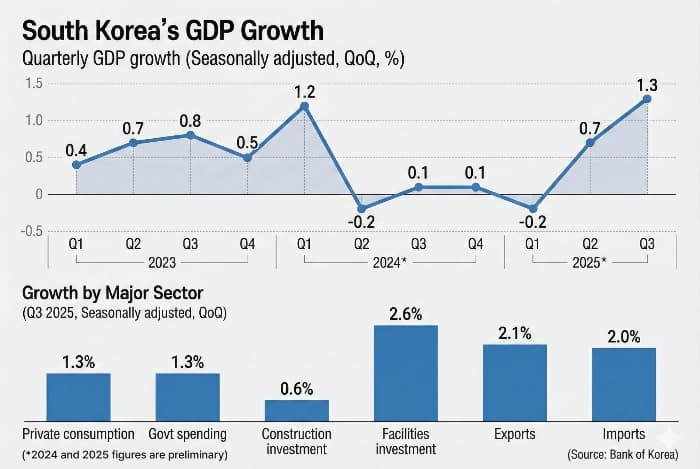
South Korea’s economy contracted unexpectedly in the October-December quarter, with preliminary Bank of Korea flash estimates showing seasonally adjusted real GDP fell 0.3 percent quarter-on-quarter. The Q4 drop was the first quarterly shrinkage since early 2024 and the sharpest quarterly fall since Q4 2022, leaving full-year 2025 growth at just 1.0 percent compared with 2.0 percent in 2024.
On a year-on-year basis, GDP rose 1.5 percent in Q4, down from 1.8 percent in Q3, underscoring a pronounced slowdown in momentum late in the year. The outcome also missed economists’ expectations for modest expansion; median forecasts had centered near +0.1 percent quarter-on-quarter and an earlier central bank projection had anticipated +0.2 percent growth for Q4.
The most important drag came from investment. Construction investment plunged 3.9 percent quarter-on-quarter while facilities investment slipped 1.8 percent, driving a sharp fall in overall capital spending. For the calendar year, construction investment fell 9.9 percent, the steepest annual decline since the late 1990s and a central factor pushing headline growth into negative territory in the last quarter.
External demand also turned from a tailwind into a small drag in Q4. Exports contracted 2.1 percent and imports fell 1.7 percent, producing a net negative contribution to GDP of roughly 0.2 percentage point. Exports for the year advanced 4.1 percent, a deceleration from a 6.8 percent gain in 2024, reflecting cooling external demand and a weakening in previously buoyant sectors such as semiconductors.
Domestic demand contributed little in the quarter. Private consumption inched up 0.3 percent after a 1.3 percent rise in Q3, when one-off government stimulus measures had supported spending. Overall domestic demand subtracted about 0.1 percentage point from Q4 growth, indicating that household spending and investment were insufficient to offset weakness in construction and trade.

Industry-level data showed manufacturing output fell 1.5 percent in Q4, with transport equipment and machinery particularly weak, while the electricity, gas and water supply sector plunged 9.2 percent. Quarterly growth through 2025 was uneven: a contraction in Q1 was followed by a rebound in Q2 and a stronger Q3, before the reversal in Q4 erased much of the prior gains.
Policy authorities now face a delicate balancing act. The Bank of Korea had left interest rates unchanged in the week before the flash release and signalled it was winding down its easing cycle, while emphasising foreign exchange stability and noting upside risks to growth for the coming year. The central bank projects 2026 growth of about 1.8 percent; the government is targeting roughly 2.0 percent, both implying only a modest recovery.
For markets and policymakers, the immediate implications are clear: slower growth and concentrated weakness in construction and facilities investment limit near-term upside for corporate investment and employment, while a softer export outlook raises downside risks if global demand does not firm. The flash estimate will be followed by more detailed preliminary and final GDP releases, which will be closely watched for revisions to the scale and drivers of the downturn and for signals on monetary and fiscal responses in 2026.
This article was produced by Prism’s automated news system from verified source data, official records, and press releases, then run through automated quality and moderation checks before publishing. The system is built and supervised by the people who set the standards it runs under. Read our full AI policy.
Did this article answer your question?

