South Korea says U.S. 25% tariff on AI chips will have limited immediate impact
Seoul says initial U.S. 25% tariff targets advanced processors, sparing memory chips for now and limiting immediate damage, but officials warn uncertainty remains.

South Korea’s trade officials say a new U.S. proclamation imposing a 25% tariff on certain high-performance artificial intelligence processors will have limited immediate effect on Korean exporters because it targets advanced GPU-class chips rather than the memory products that dominate Seoul’s shipments.
Yeo Han-koo, head of trade negotiations at the Ministry of Trade, Industry and Energy, told reporters in Seoul that the first-phase measures focus on advanced processors made by firms such as Nvidia and AMD and “Since the memory chips that South Korean companies mainly export are currently excluded, the immediate impact is expected to be limited.” The proclamation, signed by the U.S. president on Jan. 14, imposes the tariff on specified AI-capable processors and contains a series of narrow exemptions, the White House said, including imports for U.S. data centres, start-ups, non-data-centre consumer and civil industrial applications, U.S. public sector uses, and items devoted to research and development, repairs or supply chain resilience.
The U.S. action names examples of affected models, such as Nvidia’s H200 and AMD’s MI325X, and appears to apply in particular to chips imported into the United States and then reexported to third countries. Seoul’s immediate assessment rests on the fact that South Korean firms are heavily concentrated in memory production, high-bandwidth memory and server DRAM, rather than in the advanced processors singled out by the tariff proclamation.
Still, Yeo cautioned that “it is not yet time to be reassured,” noting the government cannot predict if or how a second phase of measures might expand the list of targeted goods. He delayed his return from Washington after the proclamations were signed to assess implications and to coordinate with industry. The ministry convened an emergency meeting and Industry Minister Kim Jung-kwan ordered officials to review response options, communicate Seoul’s position to Washington and intensify consultations with chipmakers.
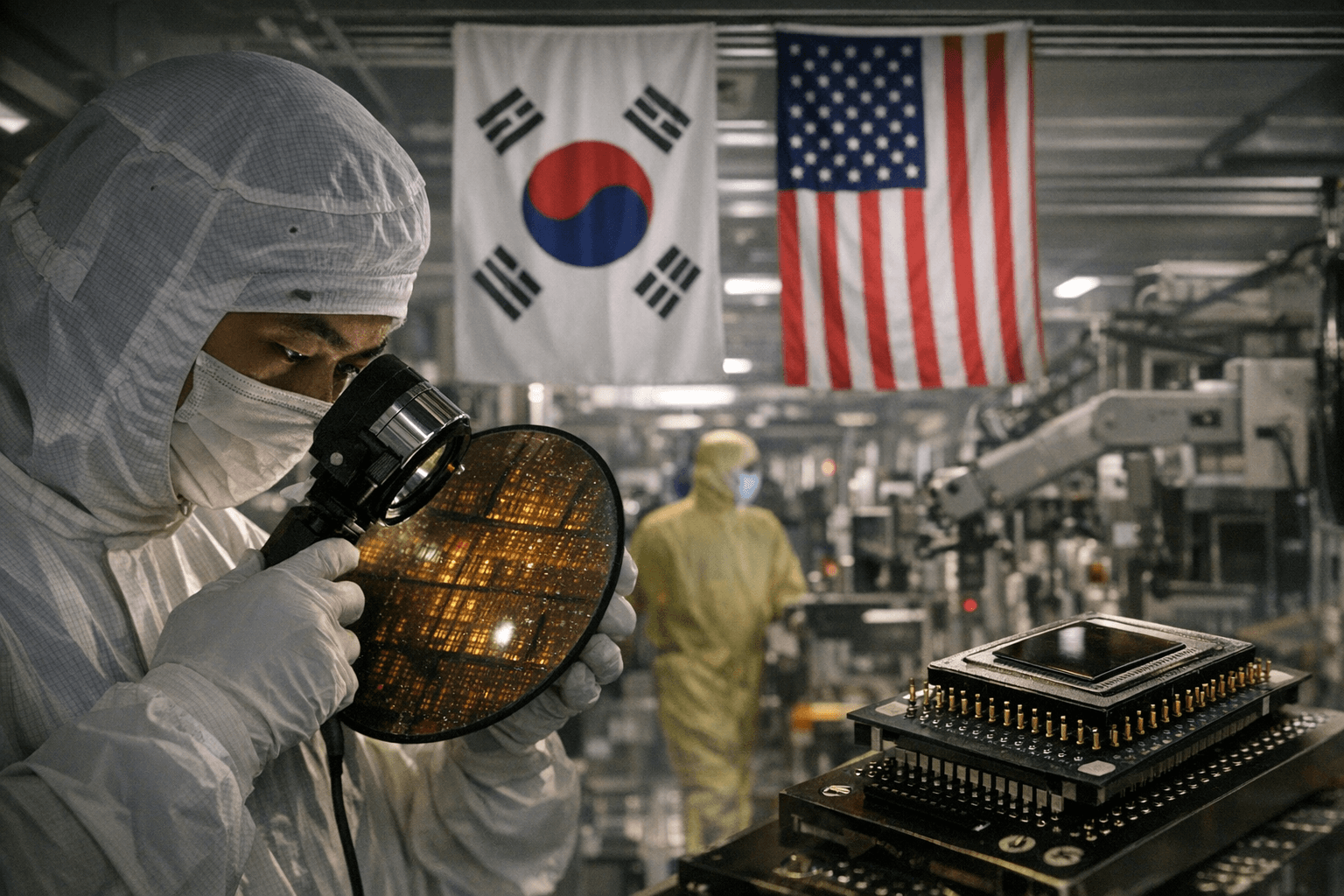
Samsung Electronics and SK hynix said they were closely monitoring developments. Both companies supply high-bandwidth memory and server DRAM used in AI systems, categories that analysts and government officials say are largely shipped to U.S. data centres, a use the White House explicitly exempts. One Korean government official described the initial action as “for now … targets China,” and emphasized that Korea is not being treated under U.S. export controls in the same manner as China.
The tariff move forms part of a broader U.S. push to address perceived national security risks in semiconductors and critical minerals, including a separate proclamation invoking Section 232 of the Trade Expansion Act. Seoul’s immediate objective is to ensure Korean firms do not face unequal treatment as Washington seeks to reshape supply chains.
Markets and manufacturers will now watch how exemptions are interpreted in practice and whether a second phase broadens the scope to include memory or related components. For the moment, South Korea’s dominant position in memory manufacturing appears to have blunted the near-term trade shock, but sustained uncertainty keeps policy makers and firms on alert as consultations with U.S. counterparts continue.
This article was produced by Prism’s automated news system from verified source data, official records, and press releases, then run through automated quality and moderation checks before publishing. The system is built and supervised by the people who set the standards it runs under. Read our full AI policy.
Did this article answer your question?

