South Korean startup LetinAR bets on tiny lens modules for AI glasses
Tiny lens modules, not the glasses, may decide the AI wearables race. LetinAR is trying to turn compact optics into the gatekeeper part of the stack.

The biggest fight in AI glasses may not be over the screen, the app, or the brand. It may be over the lens module tucked into the frame, and LetinAR, a South Korean startup founded in 2016, is trying to own that part of the stack.
LetinAR develops optical modules for augmented reality and smart glasses rather than selling its own consumer glasses. That distinction matters because the company is not trying to win attention with a flashy device on a store shelf. It is trying to become the enabling layer that determines whether future glasses are thin enough, light enough, and efficient enough to wear all day.
Why the optics matter
AI glasses only become mainstream if they solve a brutal set of design constraints at once. They have to stay comfortable on a face, keep power draw low, preserve image brightness, and avoid the bulky look that has held back earlier AR devices. LetinAR says its design goals are low power consumption, lightweight comfort, bright and clear vision, minimal components, and compatibility with OLED, microLED, and LCOS displays.
That is why optics can become a chokepoint. If a lens module determines how thick a device can be, how much battery it drains, and whether the image stays legible in normal use, then it becomes as strategic as the chip inside a smartphone or AI server. A company that can supply that part reliably, at scale, and at acceptable cost gains leverage over the entire category.
LetinAR’s current lineup reflects that strategy. Its Letinus lens module has a 22-degree field of view, while the newer FrontiAR module reaches 45 degrees. The company also offers evaluation kits such as T-Glasses and KeplAR, tools that help other companies prototype glasses without building the optics from scratch.

The patent moat behind the module
The company’s core technology is a pin-mirror, or pinhole-based, optical system. That approach is protected by U.S. patent 10,989,922, granted on April 27, 2021, for an augmented reality optics system with pin mirror. The invention was filed on December 29, 2017, and the inventors listed are Jeonghun Ha and Jaehyeok Kim.
For a hardware startup, that kind of patent portfolio can do more than block copycats. It can shape where the industry experiments, which suppliers device makers trust, and how much negotiating power the optics vendor has when larger partners come calling. LetinAR says it holds 92 patents, a number that suggests it is building not just a product line but a defensive wall around its approach.
The company’s backers also point to broader credibility in Korea’s startup and industrial ecosystem. LetinAR says its investors include Naver, Kakao, Lotte Ventures, Epson, DSC Investment, Korea Asset Investment Securities, and NAVER D2 Startup Factory. That mix of platform companies, industrial names, and financial investors helps explain why the company has stayed focused on infrastructure rather than consumer branding.
From prototypes to commercial devices
The clearest sign that LetinAR is moving beyond demonstration is the shift from lab optics toward actual customer hardware. In December 2023, the company said it would present customer devices at CES 2024 in Las Vegas, including smart glasses from Jorjin and Nimo built on its optics. It also said that year would mark seven consecutive CES appearances, a useful signal that its technology had stayed relevant long enough to keep returning to the industry’s biggest showcase.
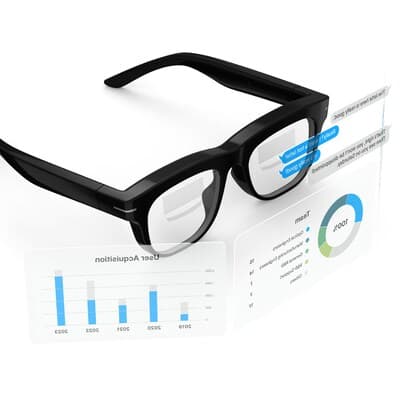
LetinAR also said its FrontiAR Pro lens improves brightness uniformity by roughly three times compared with prior PinMR optics. In practical terms, that matters because wearable displays live or die on clarity and consistency, not just raw resolution. A brighter, more even image is the difference between a convincing everyday device and a prototype that looks impressive only in a controlled demo.
Evidence of commercialization did not stop at trade-show language. IDTechEx reported in 2024 that LetinAR’s PinMR optical combiners are made from plastic, a choice that offers cost and durability advantages. The same analysis said the company had recently built its own fabrication line near Seoul, an important step for a component maker that wants more control over quality, supply, and output.
By October 2024, IDTechEx said LetinAR optics were being used in a soon-to-be-released device from NTT QONOQ Devices, the NTT Docomo-Sharp joint venture. LetinAR also said in late 2024 that it was launching its first mass-produced AR product through a partnership with Japan’s largest telecom group. Taken together, those developments show a startup moving from promising optics to actual production relationships in the telecom and device supply chain.
The technical bet on everyday wearability
The reason these details matter is simple: AI glasses have to disappear on the face before they can matter in daily life. LetinAR’s own pitch is built around that logic. Its compact lens modules are designed for lightweight, low-power, long-duration wear, and that makes them relevant to a market that is still trying to prove it can escape the clunky generation of headsets and early AR hardware.
A 2021 report on an ETRI demo offers a useful window into why LetinAR’s approach drew attention. ETRI said a LetinAR pin-mirror lens helped enable a glasses-style AR device in which objects as close as 20 to 30 cm could appear sharp. By comparison, ETRI said existing AR devices such as HoloLens required objects to be 80 to 120 cm away to be seen clearly.
ETRI also said the device used a 4 mm-thick OLED micro-display and achieved a 46.6-degree field of view per eye, or 80 degrees binocular. Those numbers matter because they point to a central tradeoff in wearables: every improvement in thinness and viewing comfort has to be earned through optical engineering, not marketing.
What to watch next
LetinAR says it has been recognized at CES for years and has collected multiple industry acknowledgments, including IMID Korea Display of the Year, SPIE PRISM Awards finalist selections in 2020 and 2024, and CES Innovation Awards in 2022 and 2023. It also says T-Glasses were sold out quickly to more than 14 global companies in the past year, a sign that demand for evaluation hardware is already outpacing supply.
The company’s broader claim is that the global AR market is projected to expand tenfold by 2028. That forecast may prove right or wrong, but the strategic logic is already visible: whoever supplies the optics that make glasses slim, efficient, and visually usable will have outsized influence over which brands can scale.
For investors, device makers, and policymakers watching the AI wearables race, LetinAR is a reminder that the most important layer is often the least visible. The winner may not be the company with the flashiest frame. It may be the one that owns the tiny lens module that makes the frame possible in the first place.
This article was produced by Prism’s automated news system from verified source data, official records, and press releases, then run through automated quality and moderation checks before publishing. The system is built and supervised by the people who set the standards it runs under. Read our full AI policy.
Did this article answer your question?