South Korea’s film industry turns to AI to cut costs and survive
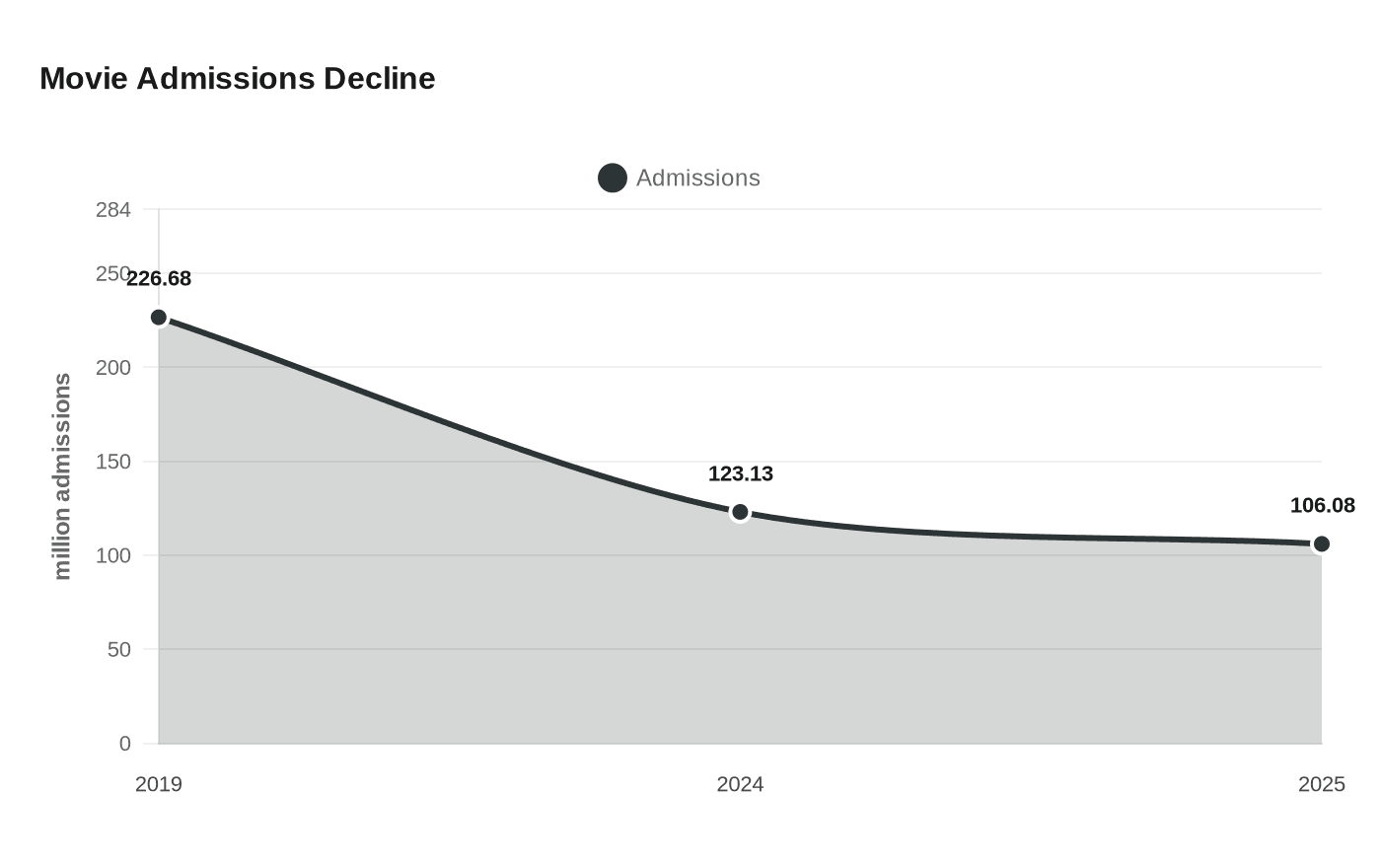
With moviegoers down to 106.08 million in 2025, South Korean studios are using AI to slash costs and keep K-film alive.

South Korea’s film business is treating artificial intelligence less as a novelty than as a survival tool. Domestic moviegoing fell to 123.13 million in 2024, barely 54 percent of the 226.68 million admissions recorded in 2019, and then slid further to 106.08 million in 2025, the worst post-pandemic performance for Korean cinema. As audiences stayed away, producers and distributors began looking for cheaper ways to make dramas and films, especially in pre-production, visual effects, translation and editing.
The financial pressure is now shaping policy. South Korea’s Culture Ministry said its 2026 film-industry budget would rise to 149.8 billion won, an 80.8 percent jump from 2025 and the largest allocation outside pandemic relief in 2022. The package set aside 8 billion won for planning and development, up from 4.7 billion won, while the ministry’s broader 2026 budget was finalized at roughly 7.85 trillion to 7.86 trillion won. Officials have also tripled the country’s AI budget in 2026, reinforcing the message that technology is no longer a side bet but part of the state’s industrial strategy.
Industry adoption is already visible. KOCCA-related reporting said generative AI use in Korea’s content sector reached about 20 percent in early 2025, with broadcasting and video production among the most active users. That helps explain why the debate has shifted from whether AI can be used to how fast it can be woven into production pipelines. In a market where box office takings remain well below pre-pandemic norms, even a modest reduction in labor and post-production costs can determine whether a project moves forward.
The trade-off is becoming harder to ignore. Filmmakers see AI as a practical way to keep projects moving in an industry still operating far below its 2019 scale, but critics warn that heavy reliance on machine-generated tools could erode the human touch that helped make Korean cinema distinctive. The concern is not only artistic. If AI speeds up translation, editing and effects work, the gains may accrue to studios, streamers and distributors that can stretch smaller budgets further, while freelancers and mid-level creative workers absorb the loss of work.
That tension gives South Korea a broader significance beyond one national film scene. Hollywood has approached generative AI more confrontationally, with unions and artists focused on job loss and creative control. In South Korea, the immediate problem is survival, and that makes experimentation easier to justify. The country’s film industry is now a test case for whether AI becomes a substitute for shrinking budgets, or simply another tool in a business trying to keep audiences coming back.
This article was produced by Prism’s automated news system from verified source data, official records, and press releases, then run through automated quality and moderation checks before publishing. The system is built and supervised by the people who set the standards it runs under. Read our full AI policy.
Did this article answer your question?