Southwest Jets Scramble to Avoid Mid-Air Collision Near Nashville
A Southwest go-around near Nashville turned into a near-miss when a controller’s instructions steered one jet toward another on a parallel runway, triggering TCAS alerts.
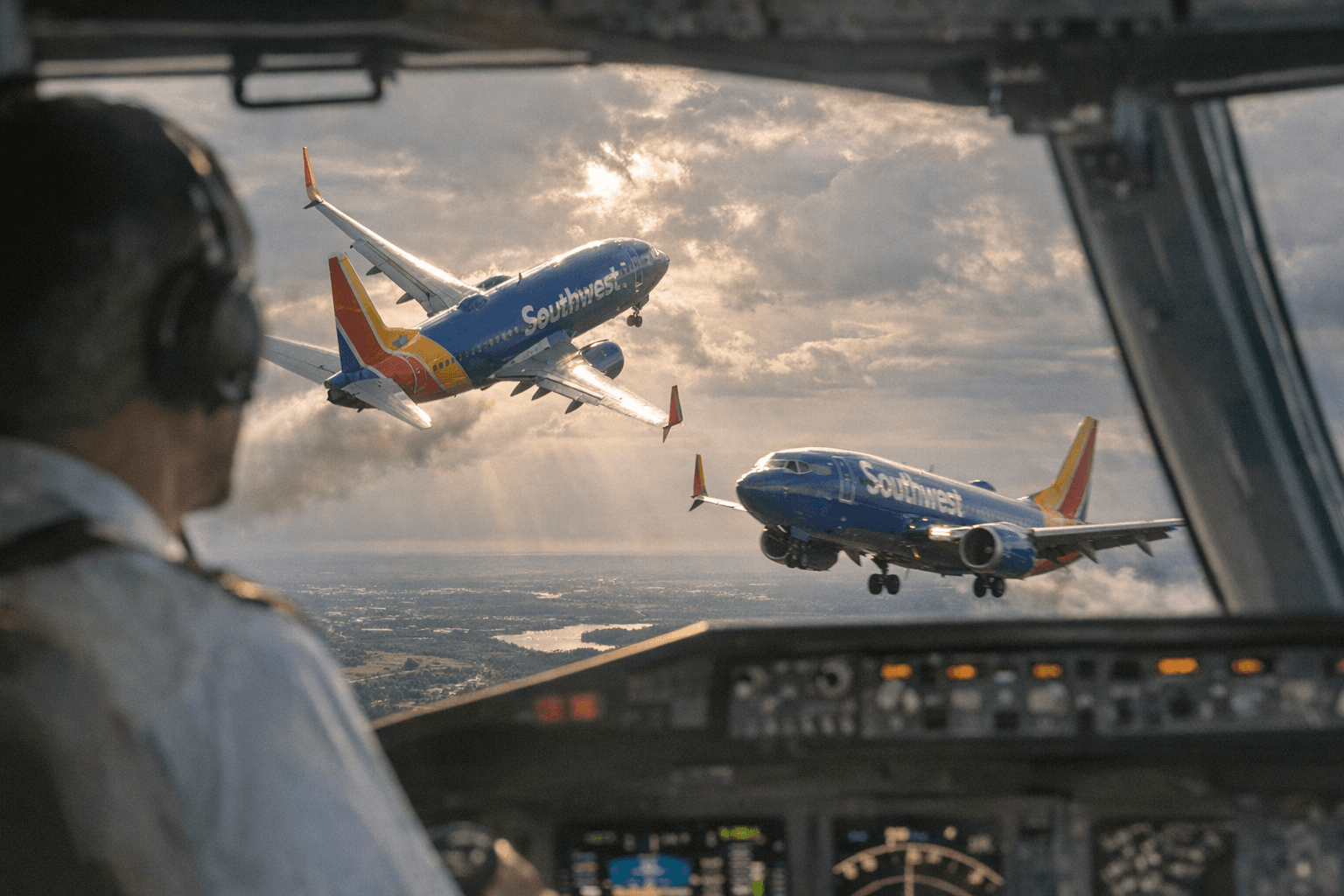
Two Southwest Airlines jets came within roughly 500 feet vertically of each other near Nashville International Airport after a landing go-around and a takeoff clearance converged in the same airspace, forcing both crews to take evasive action. The close call happened around 5:30 p.m. local time on Saturday, April 18, 2026, as gusty winds complicated operations over Runway 2 Left and Runway 2 Right.
Southwest Flight 507, a Boeing 737 Max 8 traveling from Myrtle Beach, South Carolina, to Nashville, had begun its approach to Runway 2 Left when the crew initiated a go-around. Air traffic control then gave instructions that placed the aircraft in the path of another Southwest jet, Flight 1152, a Boeing 737-700 that had been cleared for takeoff from the parallel Runway 2 Right for Knoxville, Tennessee. Preliminary flight data and air traffic recordings indicate the two planes may have passed with one aircraft appearing to fly over the other, though the exact separation remains under review.
Both crews reported onboard collision-avoidance warnings, and both aircraft reacted to Resolution Alerts from their Traffic Collision Avoidance Systems, or TCAS. The sequence mattered: the pilots were not relying on a single safeguard, but on a layered system of runway separation, controller direction and onboard automation. In this case, the first two layers failed to keep the aircraft apart, and TCAS became the last line of defense.
The Federal Aviation Administration said it is investigating and confirmed that the instructions given to Flight 507 put the flight in the path of another airplane departing from a parallel runway. News reports said the controller initially told Flight 507 to turn right, then tried to correct the conflict by instructing it to climb and directing Flight 1152 to hold at 2,000 feet, but the crew of Flight 1152 said it was already past the conflict point.
Southwest said it appreciated the professionalism of its pilots and flight crews and emphasized that safety remains its top priority. The Nashville incident has drawn sharper attention because it came less than a year after the January 29, 2025 American Airlines and Army Black Hawk crash near Washington, D.C., which killed all 67 people aboard both aircraft and renewed scrutiny of midair-collision prevention systems and air traffic control procedures. The latest close call suggests the most fragile link may still be procedure, not technology, even as aircraft systems did exactly what they were built to do.
This article was produced by Prism’s automated news system from verified source data, official records, and press releases, then run through automated quality and moderation checks before publishing. The system is built and supervised by the people who set the standards it runs under. Read our full AI policy.
Did this article answer your question?

