S&P 500 Futures Retreat as Oil Rebounds and Iran Conflict Drags On
Apollo Global's flagship private credit fund paid investors just 45 cents on the dollar after redemption requests hit 11.2%, more than double its quarterly cap.

Iran's parliament speaker called it "fabricated news." That denial was enough to unwind Wall Street's Monday optimism and send S&P 500 futures retreating Tuesday morning, as crude oil climbed back toward triple digits and Apollo Global Management disclosed a flood of investor exits from its flagship private credit fund.
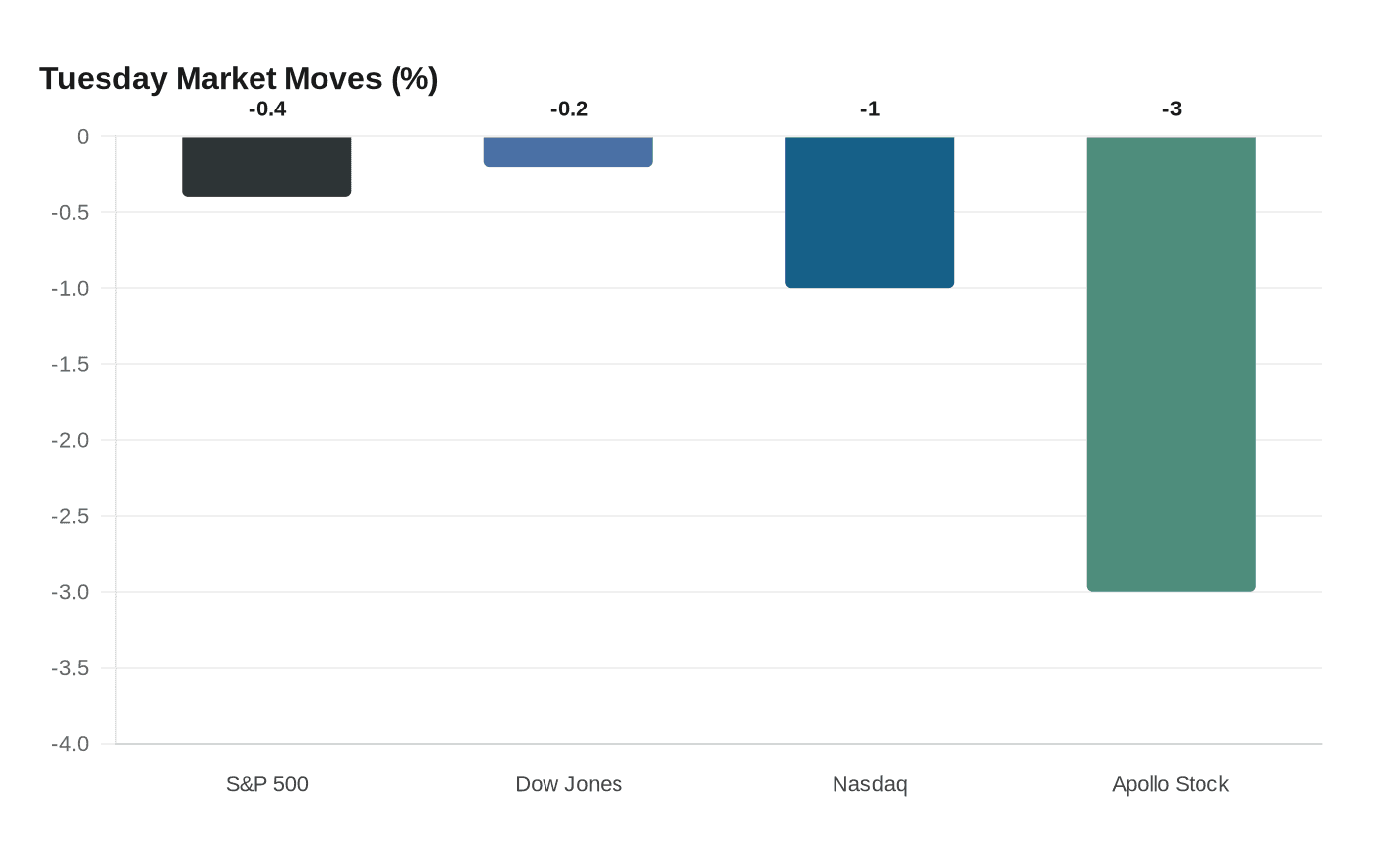
The S&P 500 pulled back on Tuesday, giving back some of the sharp gains seen in the previous session, as crude prices rose again while the Iran war moved further into its fourth week. The broad market index fell 0.4%, while the Dow Jones Industrial Average shed 82 points, or 0.2%, and the Nasdaq Composite dropped 1%.
Monday's rally had been built on thin diplomatic ice. The major averages all rose more than 1% on Monday after President Donald Trump said in a Truth Social post that the U.S. and Iran have held "very good and productive conversations regarding a complete and total resolution of our hostilities in the Middle East." Iranian state media reported that there were no direct talks between the two countries, however. Mohammad Bagher Ghalibaf, the Speaker of the Iranian Parliament, issued a scathing rebuttal, characterizing the U.S. claims as "fabricated news" intended to manipulate global financial and oil markets, and emphasized that "no negotiations have been conducted."
The geopolitical backdrop had already been volatile. Trump over the weekend threatened an attack on Iranian power plants if the Strait of Hormuz wasn't reopened, and Iran said it would target U.S. infrastructure as a retaliatory tactic. Iran had closed the Strait of Hormuz for the first time in history and threatened to attack any ship trying to pass through it. The strait connects the Persian Gulf with the Gulf of Oman and the Arabian Sea, with roughly 20 million barrels of oil passing through it daily.
Oil markets reflected the renewed uncertainty. International benchmark Brent crude futures with May delivery were traded up more than 1% at around $101 per barrel, while U.S. West Texas Intermediate futures for May traded more than 2% higher at roughly $90 per barrel. The uptick followed a sharp sell-off on Monday, with Brent crude falling about 11% to around $99 per barrel after topping $112 on Friday.
Into this already unsettled trading session came a disclosure that rattled private credit markets. Apollo's $15 billion private credit fund was hit with redemption requests totaling 11.2% of shares, more than twice its 5% quarterly limit, and will distribute roughly 45 cents on the dollar to investors. In a filing with the Securities and Exchange Commission, Apollo Debt Solutions BDC said that it received redemption requests equal to 11.2% of shares outstanding in the first quarter, far exceeding the 5% quarterly cap the fund allows.
The vehicle plans to return approximately $730 million to investors on a pro-rata basis, meaning redeeming shareholders will receive approximately 45% of their requested capital. While peers like Blackstone have eased redemption limits to accommodate demand, Apollo is sticking to its 5% cap, describing the move as a way to preserve value.
Cracks in confidence around private credit, broadly defined as lending directly to companies outside the traditional banking system, have widened as investors worry about limited transparency, lending discipline and exposure to software companies whose businesses could be disrupted by artificial intelligence. Even as Apollo has sought to distinguish itself by focusing on loans to large, stable businesses, software remains its largest sector exposure, accounting for 12.3% of the portfolio.
Shares of the asset manager slipped over 3% in premarket trading Tuesday and are down nearly 24% so far this year. Apollo joins peers Blackstone, Blue Owl, BlackRock, and Morgan Stanley in seeing record redemption requests in their non-traded business development companies marketed to retail investors.
The two disclosures signal mounting strain in the $1.8 trillion private credit market. The fund addressed shareholders in the filing, noting that "the start of 2026 has brought heightened market volatility and increased scrutiny to private credit as an asset class." With the Iran conflict now in its fourth week and oil refusing to stay below $100, that scrutiny shows little sign of easing.
This article was produced by Prism’s automated news system from verified source data, official records, and press releases, then run through automated quality and moderation checks before publishing. The system is built and supervised by the people who set the standards it runs under. Read our full AI policy.
Did this article answer your question?