Space Force Awards $3.2 Billion for Space-Based Missile Defense Prototypes
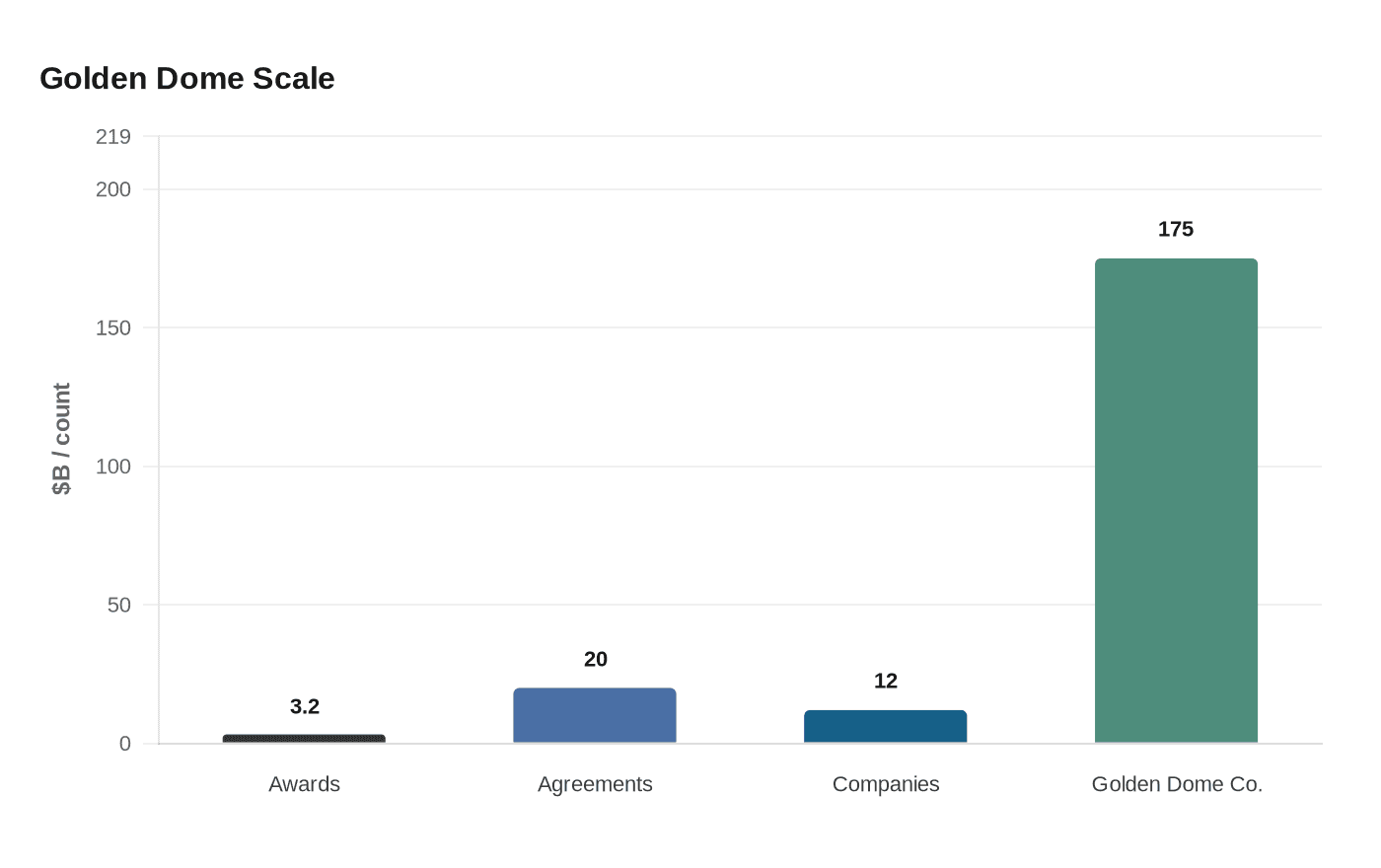
Space Force has put up to $3.2 billion behind 12 companies to build space-based interceptor prototypes, but its own leaders say affordability and scale will decide if the system moves forward.

The Space Force has committed up to $3.2 billion to prototype space-based missile defense interceptors, handing out 20 other transaction authority agreements to 12 companies as the Pentagon pushes the most ambitious layer of Donald Trump’s Golden Dome for America.
The awards, made in late 2025 and early 2026, went to Anduril, Booz Allen Hamilton, General Dynamics Mission Systems, GITAI USA, Lockheed Martin, Northrop Grumman, Quindar, Raytheon, Sci-Tec, SpaceX, True Anomaly and Turion Space Corp. The program office is at Redstone Arsenal in Huntsville, Alabama, underscoring that the work is no longer a paper concept but an organized acquisition effort aimed at building hardware fast.
Space Systems Command says the Space-Based Interceptor program is meant to demonstrate a capability integrated into the Golden Dome architecture by 2028. The concept calls for a proliferated low-Earth-orbit constellation designed to engage missiles in boost, midcourse and glide phases, a technically demanding mission that would place interceptors in orbit and require them to detect and strike targets quickly enough to matter.
That engineering challenge is exactly where the pitch meets the reality check. Space Force Gen. Michael Guetlein, who is leading Golden Dome, told lawmakers that the central issue is not whether the technology exists in theory, but whether it can be fielded affordably and at scale. “If boost-phase intercept from space is not affordable and scalable, we will not produce it.” That line has become the sharpest expression of the Pentagon’s caution: the military wants options, but it is not committing to serial production until the price and the performance make sense.
Space Force Col. Bryon McClain said adversary missile capabilities are advancing rapidly and that the acquisition strategy has to move quickly. He said the service expects to demonstrate an initial capability in 2028, a timeline that leaves little margin for delay if the program is to stay aligned with Golden Dome’s broader promise.
Trump launched Golden Dome for America with Executive Order 14186 on January 27, 2025. The Congressional Research Service describes it as an integrated air and missile defense initiative, and says Trump has put its cost at about $175 billion while describing completion by the end of his term. CRS has also flagged major oversight and funding questions, which now shadow the space-interceptor effort as much as the technology itself.
For all the momentum behind the awards, the real test is not how many contractors are involved. It is whether orbital interceptors can be made reliable, affordable and numerous enough to become a deployable shield rather than a politically branded moonshot.
This article was produced by Prism’s automated news system from verified source data, official records, and press releases, then run through automated quality and moderation checks before publishing. The system is built and supervised by the people who set the standards it runs under. Read our full AI policy.
Did this article answer your question?