Starmer faces leadership pressure after Labour’s poor local election results
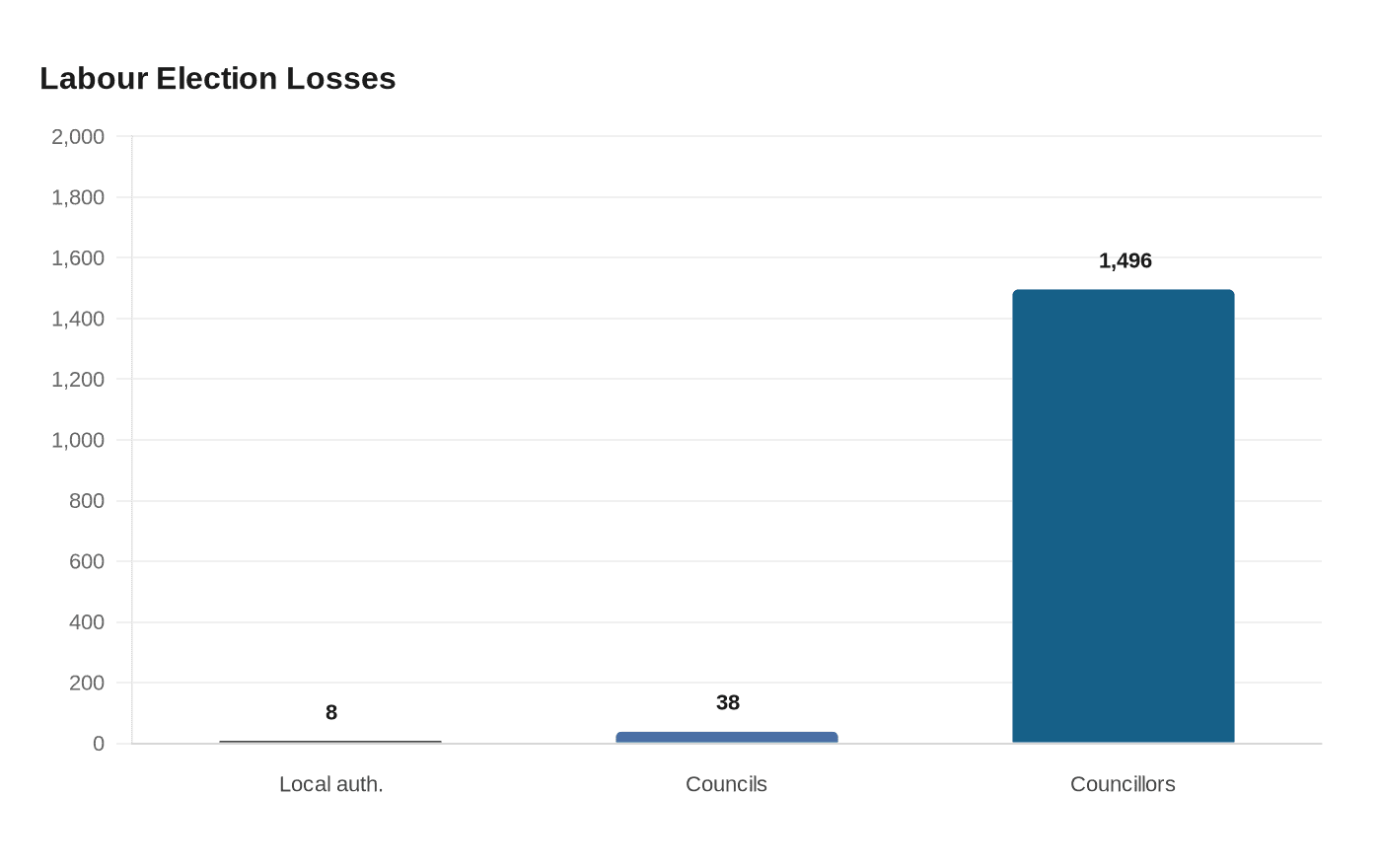
Labour lost 1,496 councillors in one tally and 38 councils in England, and more than 40 MPs have already called for Starmer to go.

Keir Starmer’s grip on Labour has been shaken by the party’s poor local election results, which stripped it of control of eight local authorities in England and, in one count, left it down 1,496 councillors and 38 councils. Reform UK’s gains sharpened the sense that this was not a routine setback but an early verdict on Labour’s direction less than two years after its landslide general election win.
Starmer tried to halt the panic on 8 May, saying he was “not going to walk away” and taking responsibility for the losses. That was meant to draw a line under a bruising week, but the pressure only deepened as more than 40 Labour MPs reportedly called for him to resign, while about 100 MPs signed a letter backing him to stay. Wes Streeting’s resignation as health minister added to the impression that the government’s top table is under strain.

The real danger for Starmer is not just noise from Westminster but the way the numbers are now splitting Labour’s own coalition. A YouGov survey of 706 Labour members found 61% wanted him to stand down before the next general election, even though 66% said he had done a good job as prime minister. That leaves Starmer with a party membership that is not wholly disillusioned, but is clearly questioning whether the local election losses reflect a temporary wobble or a deeper rejection of his strategy.
The mechanics of any challenge still heavily favour the incumbent. Labour has no formal confidence-vote mechanism to remove its leader, and any contest would need the backing of 81 MPs, or 20% of Labour’s Commons contingent, to be triggered. That means the key power centre is not the polling commentariat but Labour’s parliamentary numbers, where wavering MPs, cabinet allies and would-be challengers must decide whether Starmer’s authority is weakened enough to make a move.
Supporters of Andy Burnham have been positioning the Greater Manchester mayor as a possible successor, but he is not currently an MP and would have to return to Parliament to run. The comparison being drawn with Tony Blair’s departure misses the crucial difference: Gordon Brown had a clear path to power, and Labour does not yet have an obvious successor with that same inevitability.
Starmer’s problem is that Labour won 411 seats and a 174-seat majority on 4 July 2024 after 14 years of Conservative rule. The local election backlash has turned that commanding start into a test of whether the party’s mandate was a durable shift in politics or an early warning that the coalition behind it is already fraying.
This article was produced by Prism’s automated news system from verified source data, official records, and press releases, then run through automated quality and moderation checks before publishing. The system is built and supervised by the people who set the standards it runs under. Read our full AI policy.
Did this article answer your question?

