Statewide Survey Finds 87% Support Building Kauhale Tiny-Home Villages for Homeless Residents
A Ward Research survey for HomeAid Hawai‘i finds 87% of 714 statewide respondents back building kauhale tiny-home villages; HomeAid plans 30 kauhale on all islands by the end of the year.
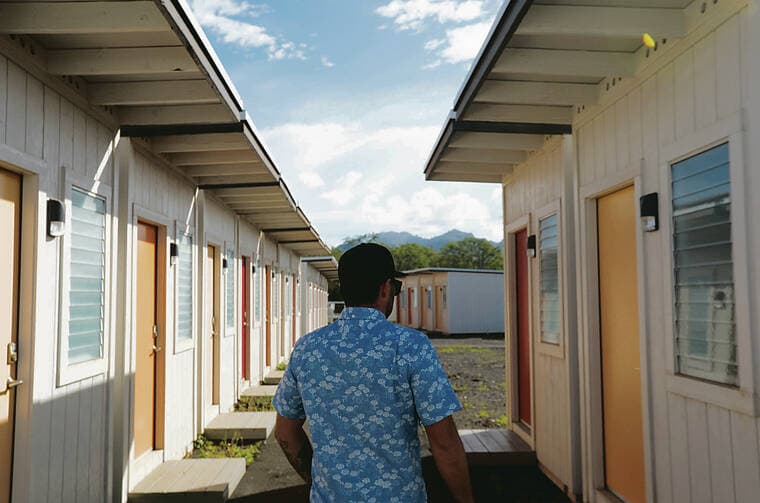
A statewide Ward Research survey released by HomeAid Hawai‘i finds 87% of 714 adult respondents support building kauhale tiny-home villages to move people experiencing homelessness into low-cost, community-oriented housing, and HomeAid says it expects to construct 30 kauhale on all islands by the end of the year — Kauai residents should monitor HomeAid Hawai‘i’s project updates for local siting and volunteer opportunities.
Ward Research collected the data between Nov. 3 and Nov. 21 with a margin of error of ±3.7%, and the survey shows even stronger support when the question frames beneficiaries as the working poor: 92% of respondents backed kauhale for the working poor. The survey measured intensity of support; 49% of respondents strongly support kauhale for people who are homeless and 38% somewhat support, while 7% somewhat oppose, 4% strongly oppose and 3% said they don’t know (n=714).
Governor Josh Green, in a statement included in HomeAid’s release, framed the results as a mandate for faster, accountable housing delivery: “The overwhelming support for Kauhale shows that our state wants practical, deeply affordable housing solutions delivered with speed and accountability. This progress has only been possible through strong public-private partnerships between the State and the building industry. When we remove the bottlenecks and work together, we can build housing faster, more efficiently, and at lower cost. That’s how we protect public health and strengthen Hawaii’s future. The survey confirms what we are seeing across Hawaii — residents understand that housing is healthcare. When people have stable housing, health improves, families stabilize, and communities become safer and stronger.”
Kimo Carvalho, CEO of HomeAid Hawai‘i, tied the public backing to widespread housing angst across generations: “More than nine out of 10 residents support kauhale because they don’t just see it as a solution for homelessness — they see it as a solution for themselves,” Carvalho said. “Housing insecurity is no longer isolated to one group. Families, seniors and working residents across Hawaii understand how close they are to instability. Kauhale represents an attainable, community-based model that can serve people before they fall into crisis.” HomeAid reports that, to date, it and the State have developed six kauhale villages and delivered homes or communal facilities for two more; on Oahu crews continued work on utility access at the Hookahi Leo kauhale complex in Iwilei, pictured in recent coverage.
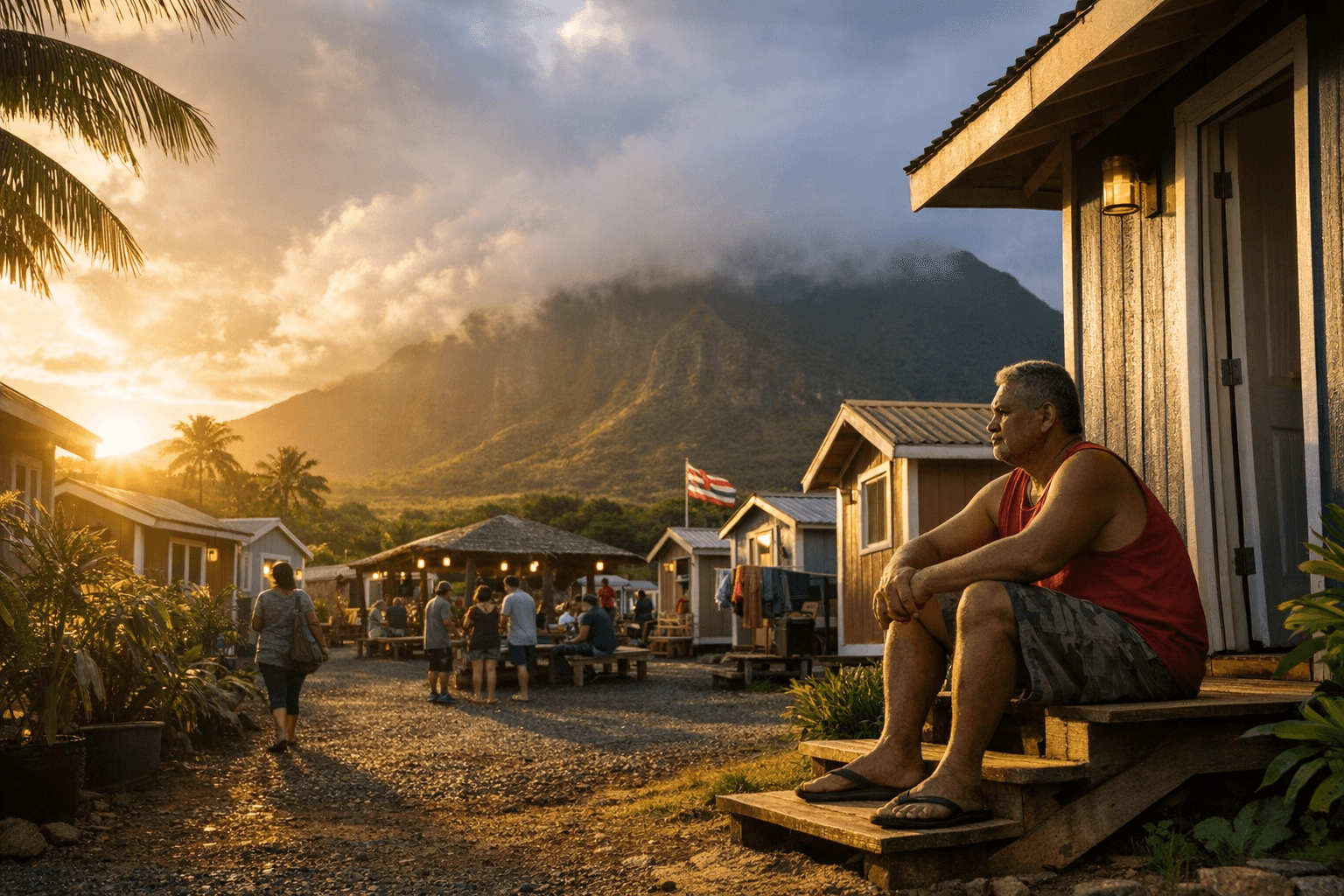
The survey also measured familiarity and information sources. Respondents said they were 16% very familiar and 50% somewhat familiar with kauhale housing, while 21% said not that familiar and 12% not at all familiar (n=714). A separate question (n=632) asked where residents had heard about kauhale, listing options such as news reports, social media, Governor Josh Green, word of mouth, personal experience, visually seeing projects and events or fundraisers. Among the 74 respondents who opposed kauhale, the survey captured categories of reasons including opposition to free housing, a belief that kauhale become problem areas, concern that kauhale do not address root issues, a preference to prioritize the working class, questions about attitudes and behavior of the homeless, and other reasons.
The HomeAid survey release cites broader housing context: a 2024 HHFDC planning study estimated more than 208,000 households face housing insecurity with roughly 27% at risk of homelessness, and reporting around the survey has summarized state shortfalls at 50,000 to 70,000 more affordable units. HomeAid’s non-profit development model aims to reduce construction costs by partnering with the building industry, private sector and nonprofits to stretch dollars for deeply affordable housing. With 87% statewide support and a stated plan to build 30 kauhale across all islands by the end of the year, HomeAid’s timetable sets a concrete benchmark for county-level planning and potential Kauai project proposals in the months ahead.
Sources:
Know something we missed? Have a correction or additional information?
Submit a Tip