Stocks Surge Sharply as Hopes Grow for End to US-Iran War
The Dow surged 1,125 points Tuesday, its best session since May, after Iran's president signaled willingness to end the war and Trump said U.S. involvement won't last "much longer."

Wall Street delivered its most euphoric session in nearly a year Tuesday as twin diplomatic signals, one from Tehran and one from the White House, ignited a broad market rally that briefly overshadowed one of the worst quarters for U.S. stocks since 2022.
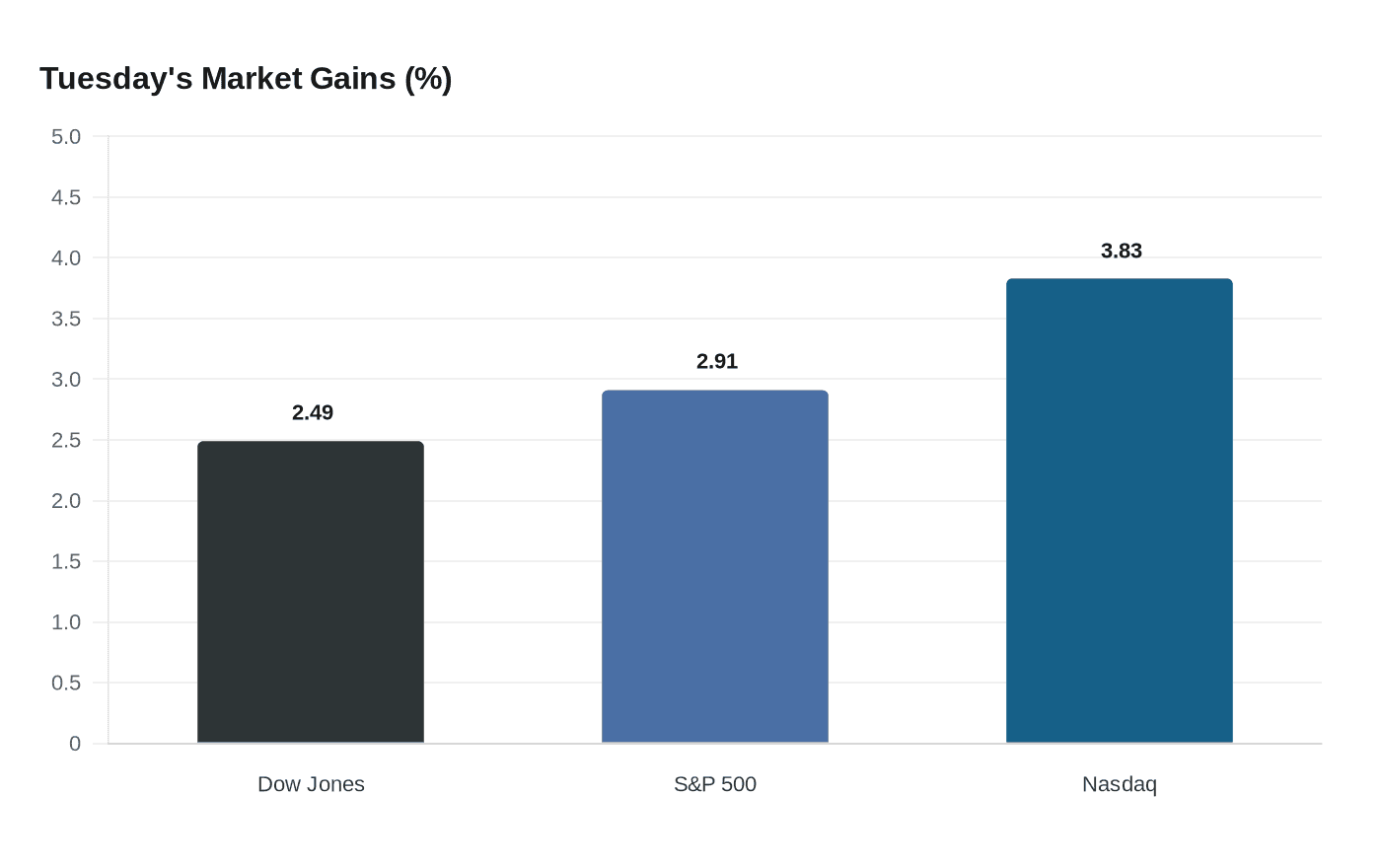
The Dow Jones Industrial Average closed up 1,125.37 points, or 2.49%, at 46,341.51, while the S&P 500 gained 2.91% to end at 6,528.52. The Nasdaq Composite advanced 3.83% to 21,590.63, with each of the three major indexes posting their best single session since May.
The catalyst was a report that Iranian President Masoud Pezeshkian had issued a statement declaring Tehran is ready to end the war in exchange for security guarantees, which Iran's state media later confirmed. Iran's official news agency reported an unconfirmed phone call between Pezeshkian and the European Council president, in which the Iranian leader said his country had the "necessary will" to end the war, provided "essential conditions are met, especially the guarantees required to prevent repetition of the aggression."

President Donald Trump compounded the optimism, telling aides he would be willing to end U.S. military operations even if the Strait of Hormuz remains largely closed, and telling the New York Post that the war will not last "much longer." Separately, Trump said the U.S. could exit the conflict within two to three weeks without requiring a formal deal.
Technology stocks, which have been under pressure for much of 2026, led the rebound. Major names including Nvidia, Alphabet, Meta Platforms, and Amazon posted strong gains, while the PHLX Semiconductor Index also jumped, reflecting renewed investor appetite for growth stocks. Chipmaker Marvell Technology surged after Nvidia invested $2 billion in the firm, while CoreWeave rallied following an $8.5 billion loan to expand artificial intelligence infrastructure.
The persistent fear driving Wall Street lower throughout the conflict has been that a prolonged war could keep oil and natural gas from the Persian Gulf out of global markets, threatening a severe inflationary shock. Brent crude, the international benchmark, fell 3.2% on Tuesday to settle at $103.97 per barrel.
Tuesday's gains, however impressive in isolation, could not erase the damage accumulated since the conflict escalated in late February. The Nasdaq closed out the quarter down 7%, its worst performance since the first quarter of 2022. The S&P 500 declined 5.1% in March alone, its worst month since the prior year, and shed 7.33% for the full quarter, the index's steepest three-month loss since June 2022.
Markets have seesawed sharply each time diplomatic signals have flickered on or off. The S&P 500 surged immediately after Pezeshkian's reported remarks to the European Council president, even though it was not immediately clear whether the statement represented a substantive shift, given that the Iranian leader had posted nearly identical language on X earlier in the month. The market's hair-trigger sensitivity to any hint of a ceasefire underscores just how much of the current equity discount is priced around the war's duration rather than any fundamental change in the corporate earnings outlook.
This article was produced by Prism’s automated news system from verified source data, official records, and press releases, then run through automated quality and moderation checks before publishing. The system is built and supervised by the people who set the standards it runs under. Read our full AI policy.
Did this article answer your question?