Supreme Court declines review, leaves MLB antitrust exemption intact
The justices refused an appeal by a Puerto Rico team owner, keeping baseball’s century-old antitrust shield and preserving lower-court rulings.
The U.S. Supreme Court declined on March 2, 2026, to consider an appeal that sought to overturn the judicial doctrine shielding Major League Baseball from broad federal antitrust scrutiny, leaving in place lower-court rulings that apply the exemption.
The appeal came from Thomas J. Axon, a former owner of the Cangrejeros de Santurce in Puerto Rico’s six‑team Liga de Beisbol Professional de Puerto Rico. Axon’s dispute arose after he was ousted following public demands for stadium improvements and threats to move the club out of San Juan. With the high court’s refusal, the exemption continues to block some antitrust claims tied to baseball governance and club relocations.
At the same time, Major League Baseball quietly resolved separate litigation with a group of minor‑league teams that had sued after losing big‑league affiliations. Attorney James W. Quinn said “a settlement had been reached in all three cases,” and that the terms are confidential. A federal case in Manhattan had been dismissed on the basis of baseball’s antitrust immunity and that dismissal was affirmed by the U.S. Court of Appeals for the Second Circuit before the settlements were announced.
The practical effect of the Supreme Court’s declination is immediate: longstanding precedent that treats much of organized baseball as beyond ordinary antitrust reach remains the controlling law. For critics, that outcome preserves a legal structure that has long insulated league decisions about franchise movement, expansion and the business conduct of clubs from antitrust suits.
The exemption traces to Federal Baseball Club v. National League in 1922, when Justice Oliver Wendell Holmes wrote that baseball exhibitions were not interstate commerce and therefore outside the scope of federal antitrust law. The Court reaffirmed that ruling in Toolson v. New York Yankees in 1953 and left the doctrine intact in Flood v. Kuhn in 1972, with the Court at that time suggesting any meaningful change should come from Congress. Congress did carve out a narrow change in 1998 applying antitrust law to certain major‑league player employment practices, but the broader immunity for league conduct endures.
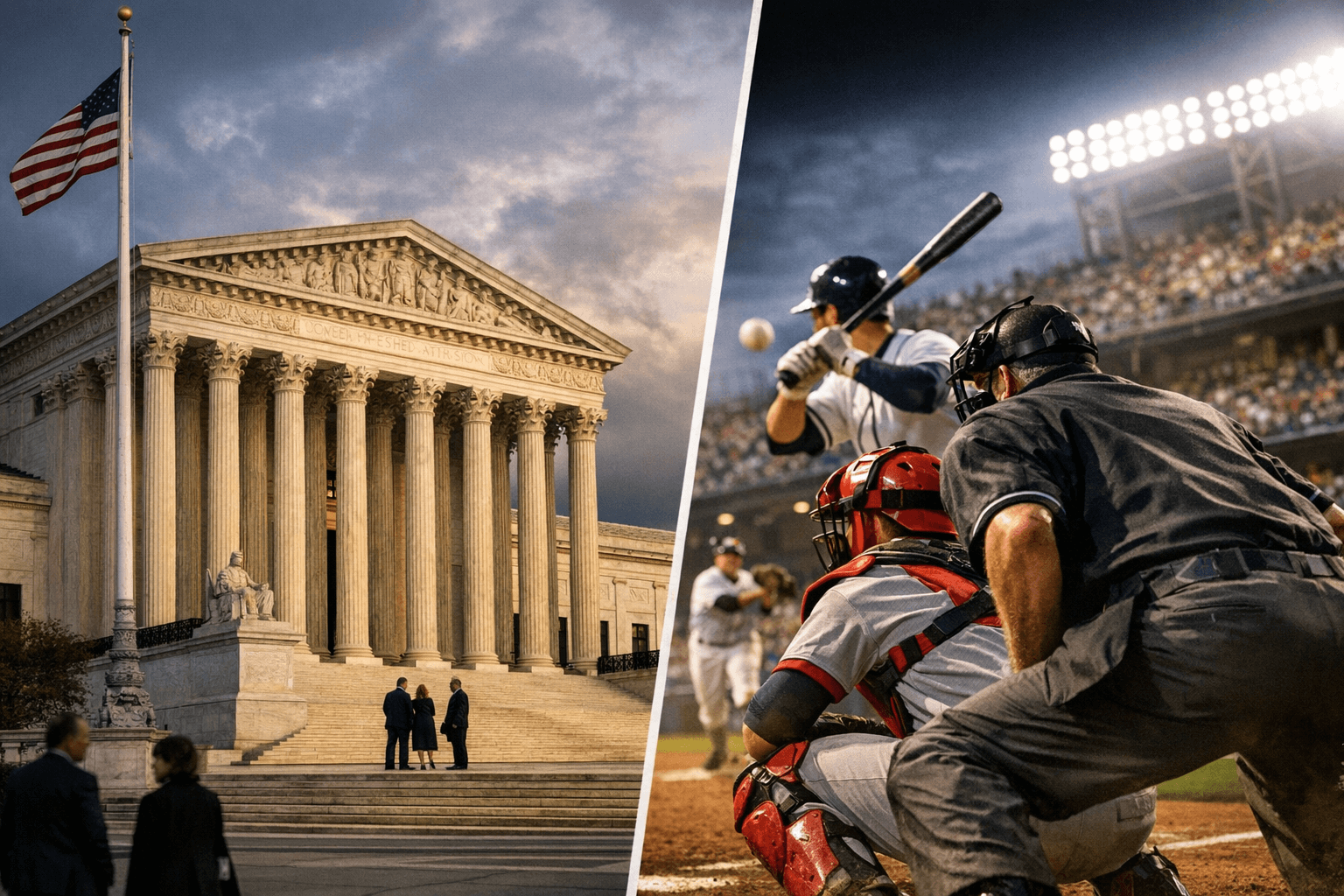
Judicial application of the exemption has diverged across jurisdictions. The Ninth Circuit held in City of San Jose v. Office of the Commissioner of Baseball that relocation decisions are central to a league’s functioning and therefore insulated; the Minnesota Supreme Court has read the precedent broadly as well. By contrast, Florida’s high court in Butterworth refused to apply the exemption to a sale-and-relocation dispute. That circuit and state split has been central to calls for the Supreme Court to clarify the doctrine’s scope.
The Major League Baseball Players Association urged the court to take up challenges, arguing in filings that the exemption is “bad for baseball, baseball fans and affected communities, as well as for all economic sectors professional baseball affects.” Legal analysts say a reversal would have opened the sport to litigation over relocations, expansion and staff salaries, a prospect that could have reshaped franchise bargaining and competitive dynamics.
The decision to deny review leaves the legal status quo intact and shifts the pressure back to Congress and litigants in state courts for any substantive reform. The century‑old doctrine that began with the Federal League litigation remains a singular anomaly in American sports law, one that a former justice later called regrettable and that continues to provoke debate about how much special treatment professional baseball should receive under antitrust law.
Know something we missed? Have a correction or additional information?
Submit a Tip