Supreme Court rules government cannot bar gun ownership over marijuana use
The Court said federal law cannot strip gun rights from marijuana users, a ruling that could unsettle other status-based firearm bans.

The Supreme Court opened a new front in the fight over gun rights and marijuana policy on Thursday, ruling that the federal government cannot use a person’s admitted marijuana use alone to bar gun ownership. The decision in United States v. Hemani put one of Washington’s most-used disarmament tools under fresh constitutional strain and raised immediate questions about how far federal law can go in treating legal but restricted conduct as a basis for taking away firearms.
Ali Hemani, a dual U.S.-Pakistan citizen born in Texas, had lived most of his life in the Dallas area and worked a stable job when agents searched his family home in 2022 as part of a terrorism-related investigation. Hemani cooperated with investigators, surrendered a gun he kept in the house, pointed agents to marijuana on the property, and told law enforcement he used marijuana about every other day. More than six months later, federal prosecutors charged him under 18 U.S.C. §922(g)(3), the unlawful-user provision that bars gun possession by people who use controlled substances.
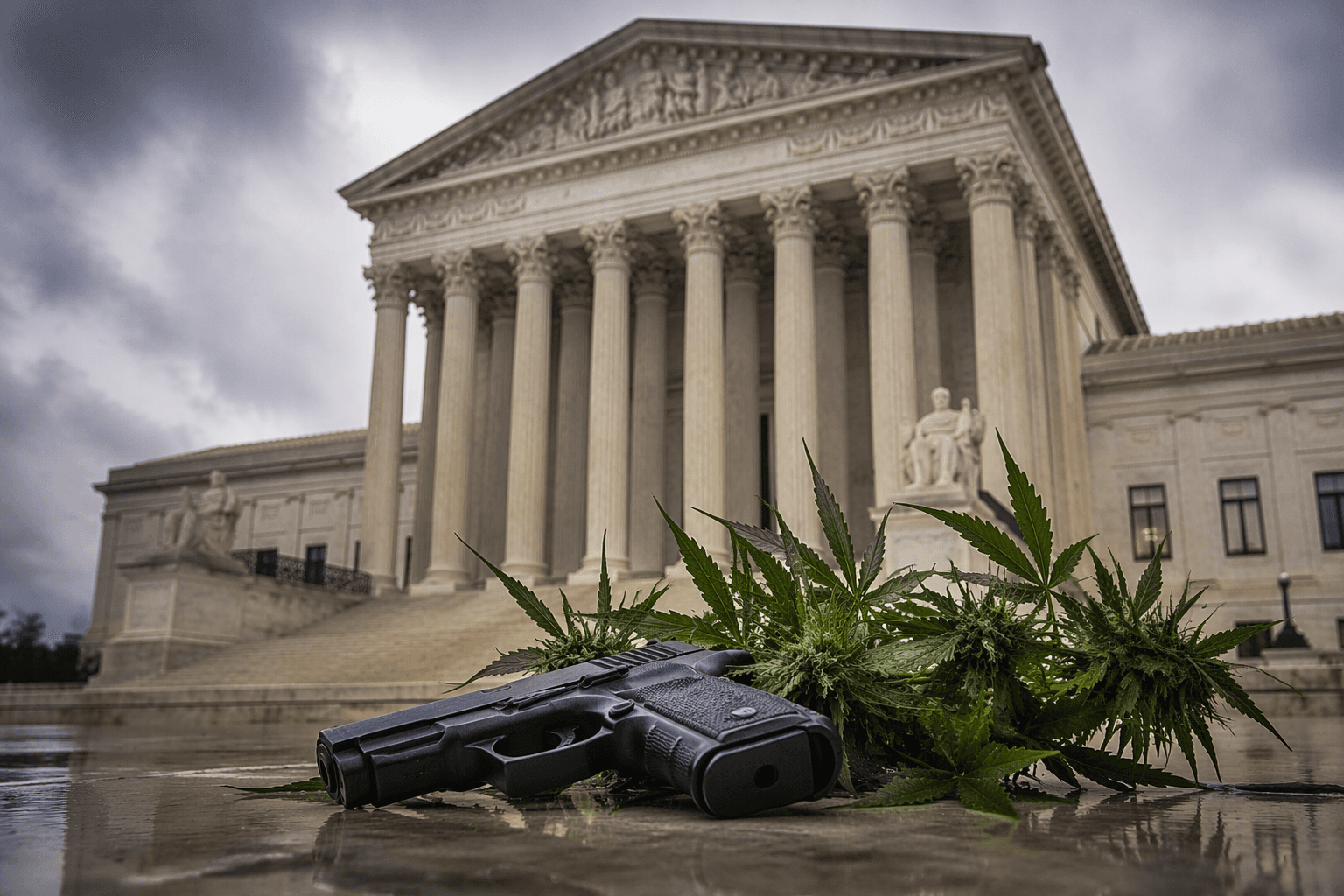
The district court dismissed the indictment, and the United States Court of Appeals for the Fifth Circuit left that ruling intact after the government’s appeal failed. The Supreme Court then took the case, hearing arguments on March 2 and issuing its decision on June 18. The Court held that the prosecution under §922(g)(3) was inconsistent with the Second Amendment.
In doing so, the justices reaffirmed the framework from Bruen, saying the government must show any firearm regulation fits within the Nation’s historical tradition of gun regulation. The Court said Washington does not have to find a historical twin, only a relevantly similar analogue grounded in the same historical principles. That standard leaves room for some modern regulations, but not for laws that cannot be tied closely enough to the country’s past firearm restrictions.
The ruling lands in the middle of a broader policy shift. The opinion noted that the U.S. Department of Justice has directed federal prosecutors to curtail enforcement against marijuana users, that most states have legalized marijuana use to some degree, and that the federal government recently moved some marijuana products from Schedule I to Schedule III. Those developments, the Court said, weakened the government’s case for continuing to treat marijuana users as a category that can be disarmed.
The decision also carries political force because §922(g)(3) was used in Hunter Biden’s federal gun case. By rejecting the statute as applied here, the Court has set a boundary that could invite new challenges to other status-based firearm restrictions, especially laws that rely more on modern policy judgments than on close historical analogues.
This article was produced by Prism’s automated news system from verified source data, official records, and press releases, then run through automated quality and moderation checks before publishing. The system is built and supervised by the people who set the standards it runs under. Read our full AI policy.
Know something we missed? Have a correction or additional information?
Submit a Tip