Switzerland, U.S. Trade Talks to Continue Beyond March Deadline
A February Supreme Court ruling upended the legal basis for Washington's trade framework, leaving $35.5 billion in annual Swiss pharma shipments in tariff limbo past the March deadline.
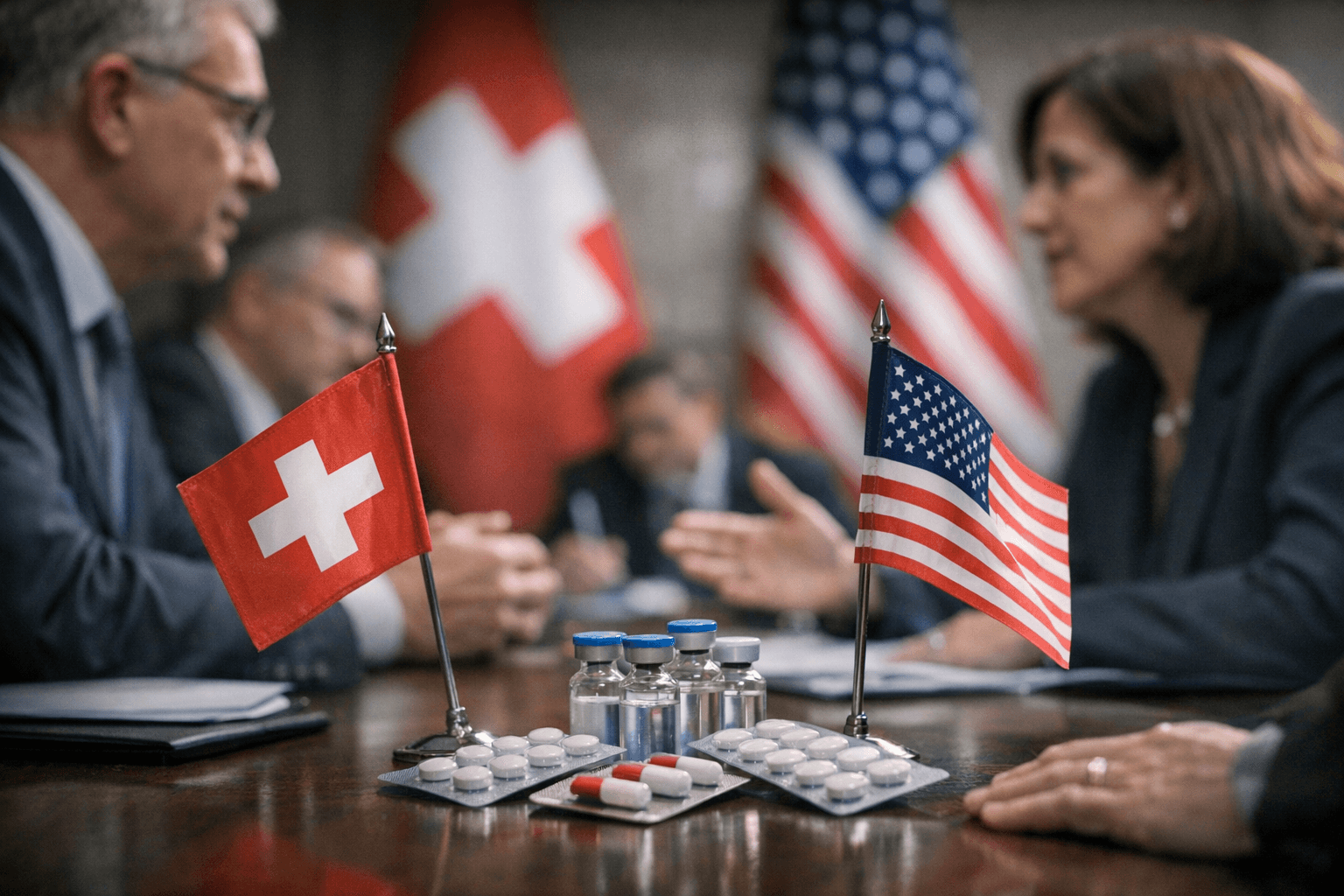
The deadline Washington had been pressing to meet passed on Saturday without a deal, and Swiss President Guy Parmelin did not pretend otherwise. Speaking to state broadcaster RSI, Parmelin, who also serves as the country's economy minister, said the end-of-March target was "de facto" no longer applicable, with negotiations set to continue into the second quarter.
The miss extends a dispute that traces back to August 2025, when the Trump administration imposed a 39% tariff on Swiss imports, the steepest levy applied to any European country. The duties hit an export base built on high-value goods: pharmaceuticals account for 50 to 60 percent of everything Switzerland ships to the United States, followed by precision instruments, luxury watches, medical devices, and specialty foods. Those sectors collectively underpinned a $38.3 billion Swiss goods surplus with the U.S. in 2024 alone.
A November framework deal appeared to clear the path. The White House announced a preliminary agreement slashing the tariff rate from 39% to 15%, matching the treatment extended to the European Union. "This agreement puts Switzerland on an equal footing with the European Union and brings the tariff level down from 39% to 15%," Parmelin said when the deal was announced. Critically, the accord also capped any future Section 232 national security duties on pharmaceuticals at 15%, a ceiling that mattered enormously for Roche, Novartis, and Sandoz. The U.S. spent $35.5 billion on Swiss pharmaceutical imports in 2024, and the administration had floated Section 232 rates as high as 100% on certain patented drugs, a threshold that could have severed supply relationships built over decades.
Then the U.S. Supreme Court intervened. In a February 20 ruling, the court found that the International Emergency Economic Powers Act, the statute the administration had used to justify its broad tariff authority, does not permit the imposition of general customs duties. Washington responded by introducing new across-the-board tariffs of 10% under a separate legal framework, valid for 150 days.
The ruling rewrote the ground rules for the Swiss talks. "Two meetings have already taken place and more are planned," Parmelin said. "But the U.S. Supreme Court's decision has cast doubt on part of the legal basis used by the United States." That legal reworking, not any breakdown in political will, is the primary reason technical teams are still moving through tariff lines, quotas, and product-by-product treatments. "Despite this, negotiations are continuing, and there is no need to wait until July to reach a result," Parmelin added.
The stakes for American households are concrete. Without a finalized deal, the 15% ceiling on Swiss pharmaceuticals, surgical instruments, and medical devices remains provisional. A reversion toward the 39% level would push costs directly into drug pricing and hospital procurement budgets. KOF, the Swiss economic research institute, estimates that a sustained lower tariff rate would push Swiss economic growth past 1% in 2026; without it, growth is projected at just 0.9%.
The November framework also carried benefits flowing the other direction: Switzerland and Liechtenstein agreed to open their markets to U.S. medical devices and remove tariffs on American agricultural exports including nuts, seafood, certain fruits, and spirits. Those concessions are similarly in limbo until a formal agreement is signed.
An April negotiating session is expected to be the next critical juncture. U.S. Trade Representative Greer had previously stated that the deal should incentivize Swiss pharmaceutical companies to build manufacturing plants in the United States, framing the accord as an industrial investment story as much as a tariff one. How Washington handles a neutral, wealthy trading partner with no geopolitical friction but a large goods surplus will offer the clearest preview yet of how the administration intends to close out its remaining bilateral trade negotiations.
This article was produced by Prism’s automated news system from verified source data, official records, and press releases, then run through automated quality and moderation checks before publishing. The system is built and supervised by the people who set the standards it runs under. Read our full AI policy.
Did this article answer your question?