Tablertown Museum Preserves Ohio Black Settlement’s Civil Rights Legacy
A pole barn museum is carrying Tablertown’s Black history forward, and its next move could decide how the community’s civil-rights memory survives.
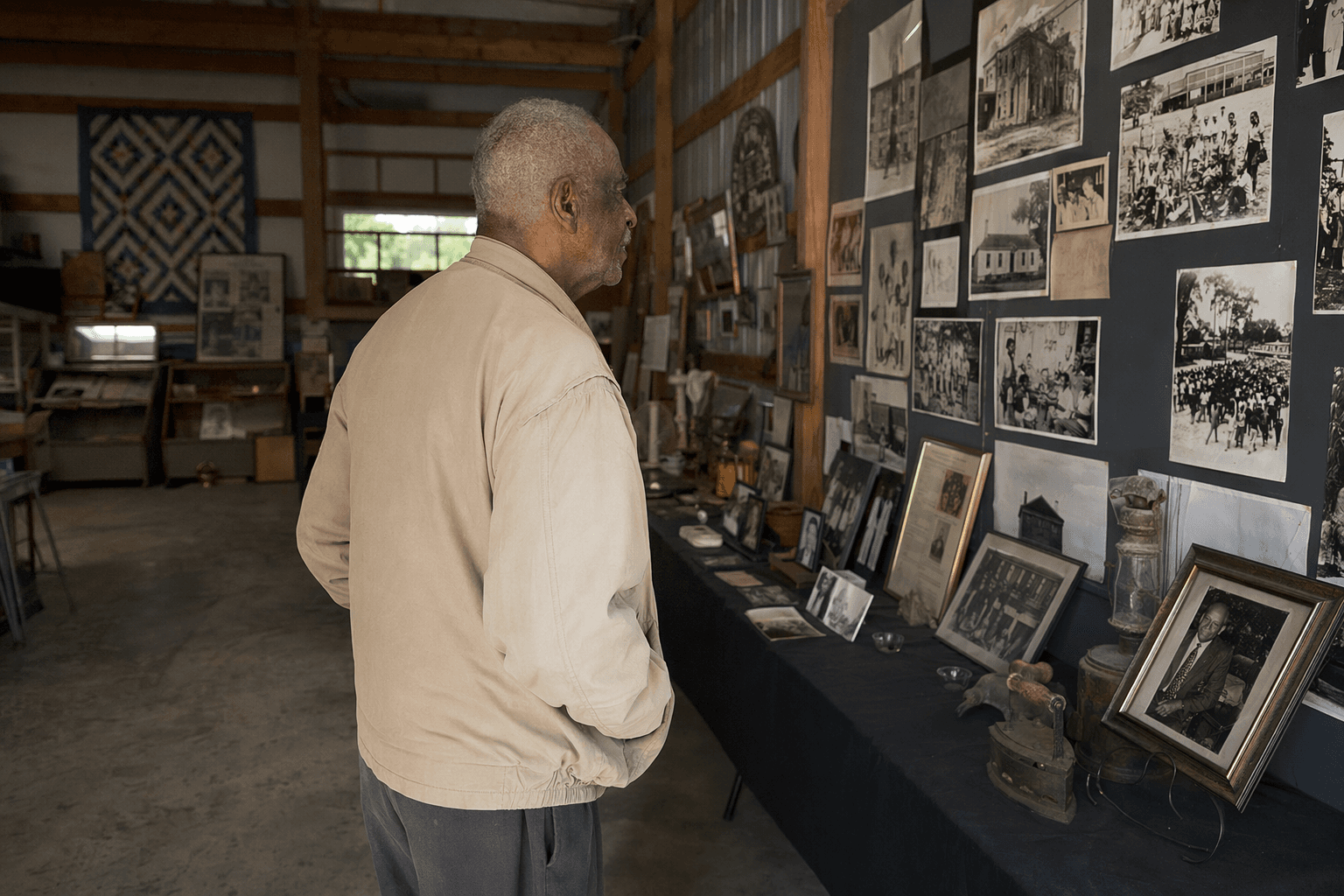
A museum built from memory
Inside a modest pole barn beside the log cabin he calls home near Stewart in Athens County, David Butcher has created a place where local Black history is not allowed to fade quietly. The Tablertown People of Color Museum is more than a collection of artifacts. It is Butcher’s answer to a familiar American problem: when institutions overlook a community, the burden of preservation falls to families, volunteers, and whoever is determined enough to keep records, stories, and places intact.
Butcher founded the museum in 2018, building on public history work that began 15 years earlier with an exhibit he curated at Ohio University’s Kennedy Museum of Art. The museum describes itself as a nonprofit social enterprise dedicated to preserving cultural artifacts and community history, countering stereotypes, and strengthening pride in family lineage. That mission makes the museum as much a civic project as a cultural one, a local institution trying to protect a fragile archive before time, development, and neglect erase it.
The roots of Tablertown reach back to emancipation
Tablertown, also known as Kilvert, sits at the center of this story because its origin is not abstract. It traces to the early 19th century and to the family line of Michael Tabler and Hannah. Ohio University says Michael Tabler fathered six children with Hannah, one of his father’s enslaved women, purchased Hannah’s freedom, emancipated their six children, and moved the family to Athens County in the early 1830s so they could live as free people and inherit property.
That history matters because it places Tablertown within the larger geography of Black settlement in Ohio, where freedom was often secured through family determination, land ownership, and constant negotiation with the racial order of the day. Butcher’s own family settled there in 1830, making the museum not just an interpretive site but a descendant’s response to a lineage that has remained visible only because people kept insisting it mattered.
Butcher has said he cannot tell African American history in the area without also discussing his German and Native American ancestry. That framing broadens the story beyond a single family tree. It shows how the community’s identity was shaped by intertwined inheritances and by the practical reality that local history often refuses the neat categories that textbooks prefer.
What the museum preserves on the ground
The museum’s tours move beyond display cases and into the landscape itself. Visitors can see the Kilvert Church, Kilvert Cemetery, and Pioneer Cemetery, which the museum identifies as Athens County’s oldest non-native cemetery. That detail gives the site unusual weight: it is not only a place to learn about the past, but one of the physical remnants that proves the past happened here.
The exhibits emphasize Appalachian diversity, the Civil War-era experience of Black residents, and local figures such as Milton Holland, whom Ohio University describes as the only person in Athens County awarded the Medal of Honor. That choice of emphasis is important. It pushes back against the false idea that Appalachia was culturally uniform, and it restores Black residents to a region’s story too often told without them.
This is where the museum’s work becomes a guide for understanding community history more broadly. Preservation is not just about objects in storage. It is about the routes people walked, the cemeteries they maintained, the churches they built, and the names they fought to keep on the map. In Tablertown, those places function as evidence, memory, and identity all at once.
Why funding and recognition decide what survives
The museum’s future makes a larger point about the economics of memory. In 2024, the museum received grant funding to research connections between the Underground Railroad and a historic Black community in southeast Ohio. That kind of support is crucial because historical work is expensive: it requires archival research, fieldwork, interpretation, conservation, and the time to turn scattered evidence into a public record.
Butcher’s effort also shows how quickly local history can become vulnerable when it lacks institutional backing. A family can preserve stories for generations, yet still face the limits of private funding, volunteer labor, and makeshift space. That is why official recognition matters. In 2025, Ohio University reported that Butcher helped restore Tablertown to its original name, a correction that signals how naming itself is part of preservation. If a place loses its name, it can lose much of its public memory with it.
The museum has also become a destination for visitors worldwide, according to Ohio University. That growth suggests demand for rooted, place-based history that connects national civil-rights narratives to specific communities. It also shows how preservation can generate cultural value even in rural places that are often treated as footnotes in broader economic or educational planning.
A new site, and a test of long-term commitment
The next chapter will move the museum from a small private structure toward a more permanent public future. In late 2025, Ohio University reported that about $1 million in combined state and federal funding had been secured for a new museum and community resource center on a former mine site in Tablertown proper. The plan is significant for more than symbolic reasons. Reclaiming contaminated land for cultural use turns a site of extraction and damage into a place of education, gathering, and continuity.
That kind of investment reflects a broader policy question: who pays to preserve community history when the people who made that history are no longer able to do the work alone? In Tablertown, the answer so far has been a mix of individual resolve, grant support, and public funding. The museum’s trajectory shows that civil-rights memory does not survive by sentiment alone. It survives when land, money, and institutions are finally aligned with the communities that have carried the story for generations.
Butcher’s museum has grown from a pole barn into a serious preservation effort, and its expansion could secure Tablertown’s place in Ohio history more permanently. The stakes go well beyond one settlement in Athens County. They speak to a national struggle over whose past gets archived, whose names stay visible, and whether local Black history is left to vanish or given the infrastructure it needs to endure.
This article was produced by Prism’s automated news system from verified source data, official records, and press releases, then run through automated quality and moderation checks before publishing. The system is built and supervised by the people who set the standards it runs under. Read our full AI policy.
Did this article answer your question?