Tempe community built for walking and biking redefines car-free living
Tempe’s Culdesac turns car-free living into a real-world test, pairing light rail, on-site retail and no resident parking in a neighborhood built from the ground up.
A new kind of Tempe address
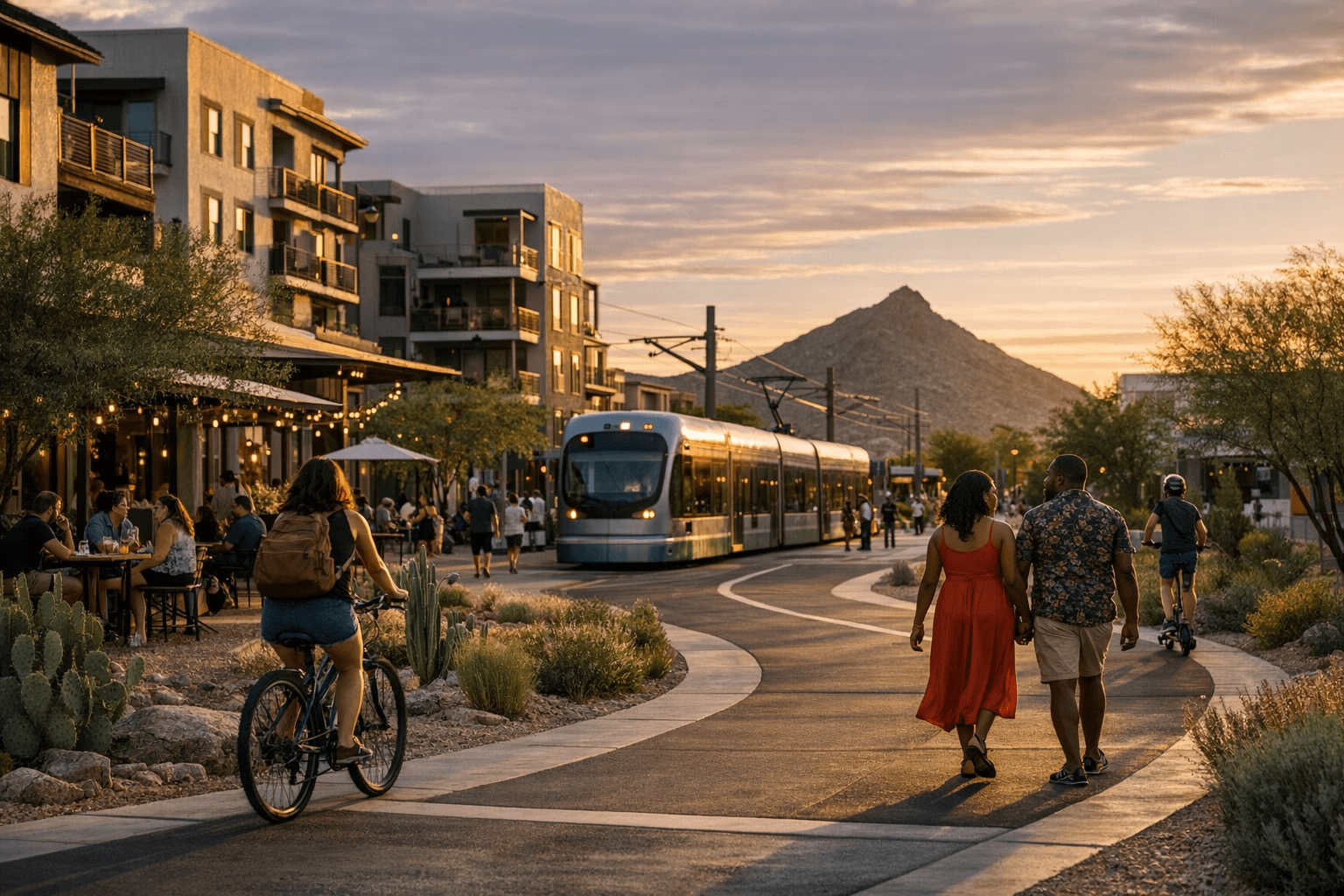
Culdesac Tempe is built to make driving optional from the moment people move in. The 17-acre neighborhood at 2025 E. Apache in Tempe sits on a light rail station next to downtown, with walking and biking at the center of daily life and transit just outside the door.
The company describes it as the first truly walkable neighborhood built from scratch in the United States, and also the first car-free community built from scratch in the country. That claim matters because Culdesac is not retrofitting an old district. It is testing whether a new neighborhood can function without defaulting to parking lots, oversized road space and car ownership as the baseline assumption.
The project officially opened in 2023 after roughly three years of development. Tempe reporting described it as the first-ever agreement between a developer and a city for zero residential parking, a policy choice that pushes against the parking-heavy zoning rules that still shape much of American housing.
How daily life works without a resident parking lot
The strongest argument for Culdesac is not ideology. It is errands. ABC News reported that the neighborhood includes boutiques, restaurants, a farmers market and a plant shop, which means residents can handle many everyday needs on foot rather than planning each trip around a vehicle.
That on-site mix is what turns a car-free concept into something more practical. A resident can pick up food, grab coffee, shop for small items and spend time in shared public space without crossing a parking lot or starting the engine. The design is meant to reduce the friction that often makes car-free living feel like a sacrifice rather than a convenience.
Culdesac says the neighborhood has no resident parking, but it does provide parking for visitors, deliveries and mobility partners. That distinction is important: the site is designed to limit private car storage without shutting out access for service vehicles, guests or people who need another way to get around.
The site also works as a mobility hub. Residents receive a complimentary Valley Metro platinum transit pass, with light rail access steps away and bus service nearby. Culdesac says residents can also use Waymo and Envoy electric carshare vehicles, with Envoy starting at $7 per hour. Earlier reporting noted scooters for rent and Lyft discounts, adding more layers to the transportation package.
Ryan Johnson, Culdesac’s CEO and co-founder, has said the site is also used by fire trucks and food trucks, a reminder that car-free does not mean access-free. Emergency service and delivery access still matter, especially in a dense residential environment.
A neighborhood built for the desert, not against it
Culdesac’s design also tries to answer a local problem that extends beyond transportation: Phoenix-area heat. Johnson told ABC News the neighborhood is about 15 degrees Fahrenheit cooler than a nearby apartment complex because it uses more shade, more trees and little to no asphalt.
That is not a cosmetic detail. In metro Phoenix, heat shapes how far people walk, when they are willing to leave home and whether outdoor space feels usable in the first place. A car-light community in this climate has to do more than remove parking. It has to make the public realm comfortable enough that people will actually use it.
The emphasis on shade, courtyards and plazas gives Culdesac a different physical feel from a conventional apartment project. The site includes award-winning homes, retail and gathering spaces that are intended to keep daily activity close together instead of scattered across roads and surface lots. In a region where asphalt magnifies heat, that layout is part transportation policy and part survival strategy.
What residents say the model changes
The most revealing evidence comes from the people living there. Electra Hug told ABC News that the neighborhood allows her to live without a car, and she said the absence of traffic makes her feel safer. That point carries particular weight because Hug is legally blind. For her, the difference is not abstract. It is about whether the environment feels navigable and secure.
Jacob Steinkamp said walking and biking make it easier to meet neighbors and recognize the people around him. That speaks to a quieter but central promise of car-free design: if people are not sealed off behind windshields and garage doors, they are more likely to encounter one another in shared spaces.
That social effect is one reason communities like this get attention beyond the planning world. Culdesac is not only testing transportation habits. It is testing whether a neighborhood organized around proximity can produce more casual contact, more familiarity and a stronger sense of place.
The scale question that decides whether this lasts
Culdesac says the full project is expected to reach about 700-plus apartment homes and roughly 1,000 residents. Other company materials describe the completed development as 761 apartments and 16,000 square feet of retail. Those figures place it well beyond a pilot site, but still far below the scale needed to reshape a region as car-dependent as metro Phoenix.
That gap is the real policy test. A place like this can work when transit is right outside, retail is built in, and the city allows zero residential parking. Scaling the model would require more cities to accept that parking minimums are not neutral, that housing near transit deserves different rules, and that walkable neighborhoods can be treated as infrastructure rather than luxury branding.
Tempe Tourism now promotes Culdesac as a first-of-its-kind car-free residential community in the United States. The branding may be new, but the underlying question is old and consequential: can American housing be planned around access, shade, transit and human contact instead of parking supply?
Culdesac does not settle that debate. It shows what changes when a city and a developer are willing to try. And it puts the burden on other places to decide whether car-light living remains a niche curiosity or becomes a serious housing model.
This article was produced by Prism’s automated news system from verified source data, official records, and press releases, then run through automated quality and moderation checks before publishing. The system is built and supervised by the people who set the standards it runs under. Read our full AI policy.
Did this article answer your question?