The Book of Mormon at 15, Asking if It Could Be Made Today
Fifteen years on Broadway and still selling out the Eugene O'Neill, "The Book of Mormon" now faces a harder question than any it puts onstage.
A Show That Still Sells Out, Still Shocks
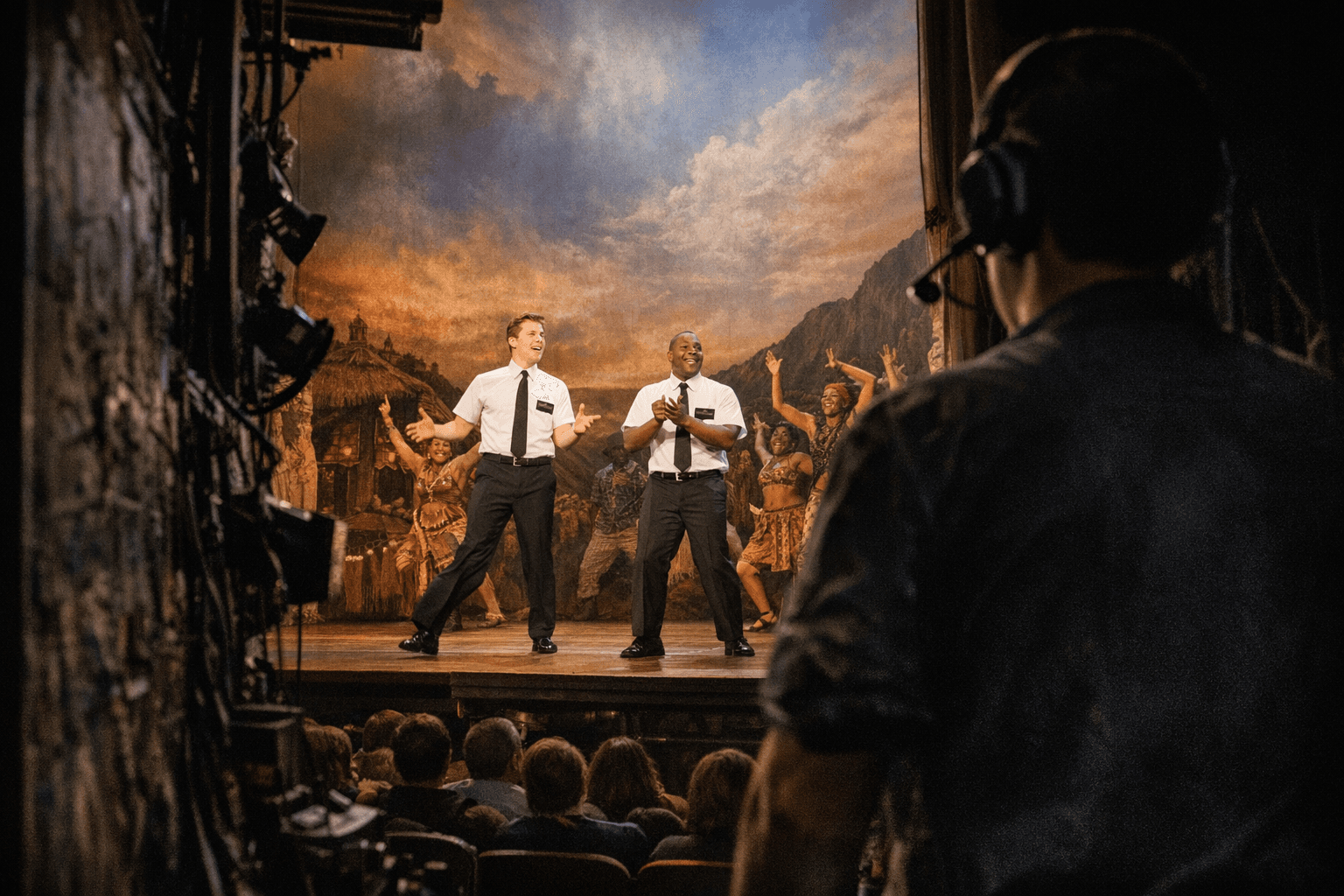
When "The Book of Mormon" opened at the Eugene O'Neill Theatre on March 24, 2011, its creators were braced for protests, not pandemonium. What followed was one of the most unlikely triumphs in Broadway history: a profane, ferociously funny satire built around two mismatched Mormon missionaries dispatched to Uganda, written by Trey Parker and Matt Stone, the minds behind "South Park," alongside Robert Lopez, the Tony Award-winning co-creator of "Avenue Q" who would later become a two-time EGOT winner for his work on "Frozen" and "Coco." The show broke the Eugene O'Neill Theatre house record more than 50 times, has grossed over $800 million, and as of late 2025 ranked as the tenth longest-running show in Broadway history, having crossed the 5,000-performance threshold. The New York Times called it "the best musical of this century." Entertainment Weekly went further, declaring it "the funniest show ever." Fifteen years later, a new question hangs over the anniversary: could it be produced today?
That question, posed by Jesse Green and Brian Karlsson in a New York Times piece timed to the milestone, cuts to something genuine. The show is taboo-busting and gasp-inducing by design, a calculated assault on audience comfort that skewers institutional religion, colonial naivety, and the peculiarities of Mormon doctrine all at once. But the satire does not distribute its targets equally. The missionary characters, Elder Price and Elder Cunningham, are the butt of the joke in one register, while the Ugandan villagers they encounter carry a different kind of dramatic weight. Critics of the show have long argued that while its mockery of Mormonism is sharp and targeted, its depictions of African characters rely on stereotypes that the show never fully interrogates. These are not new objections, but the cultural climate has sharpened them considerably since 2011.
What Nine Tonys Cannot Settle
The production arrived in a very different moment for American theater. It collected nine Tony Awards at the 2011 ceremony, including Best Musical, along with a Grammy Award for Best Musical Theatre Album, five Drama Desk Awards including Best Musical, the New York Drama Critics Circle Award, the Drama League Award for Best Musical, and four Outer Critics Circle Awards. Andrew Rannells and Josh Gad, who originated the roles of Elder Price and Elder Cunningham respectively, became stars overnight. Nikki M. James won the Tony for Best Featured Actress in a Musical for her portrayal of Nabulungi, and Rory O'Malley earned a nomination for Elder McKinley. The show was co-directed by Parker and choreographer Casey Nicholaw, whose staging matched the material's manic energy beat for beat.
None of those accolades settles the harder conversation that has grown louder over the intervening years. The show's central comedic architecture places two earnest, oblivious white Americans in the middle of a community facing AIDS, female genital mutilation, and a brutal warlord. The horror of those realities is the canvas on which the musical's jokes are painted. Defenders argue that the satire ultimately indicts the missionaries' ignorance, not the Ugandan characters' suffering. Critics counter that intent does not neutralize impact, and that three white American men writing broad caricatures of African village life is a structural problem that no amount of craft can dissolve. By the standards that have reshaped conversations about representation in theater since the early 2020s, those structural concerns are harder to wave away than they were when the show opened.
The Anniversary Moment
The show's 15th anniversary is not being treated quietly. In mid-March 2026, Trey Parker, Matt Stone, and Robert Lopez appeared on "The Late Show with Stephen Colbert" to announce a "Magical Mormon Mystery Week" of special performances scheduled for June 9 through 14 at the Eugene O'Neill Theatre. Every performance during that week will feature appearances by original cast members Rannells, Gad, James, and O'Malley, performing select scenes and songs alongside the current company, with the lineup shifting from show to show so that no two nights are identical. The creators themselves will make surprise appearances at certain performances, as will members of the original ensemble and additional guests. The event is being billed as a first of its kind on Broadway.
The nostalgia is real, and so is the commercial logic. The show has been running continuously since 2011 with rotating casts and has spawned a long-running West End production that opened in London in March 2013, along with multiple national tours. Bringing back the original company, even briefly, is both a celebration and a reminder of the particular alchemy that made the show work in the first place. Rannells and Gad were not stars when the show opened; they became stars because of it. Watching them return to the Eugene O'Neill is its own kind of cultural document.
Faith, Satire, and What 2025 Changed
The broader media landscape surrounding the show's anniversary reflects how differently religion, race, and representation sit in public conversation now. The question of whether Hollywood and Broadway are reckoning with faith is being asked openly. Lauren Jackson's New York Times piece from 2025 observed that movies and pop stars were wrestling with faith in ways that may be shifting culture. Shivani Gonzalez, also writing for the Times, documented how Mormon women have become a significant presence across reality television, social media, and bestselling books, raising the church's profile in popular culture through avenues that look nothing like the ones "The Book of Mormon" imagined.
Meanwhile, the Church of Jesus Christ of Latter-day Saints has itself changed in visible ways. Dallin H. Oaks's elevation to church president marks a new chapter in an institution that the show essentially treated as a fixed target. The show's headline framing, "sorry if you were offended for 15 years," captures a posture of cheerful unapologetics that was easier to sustain in 2011, when provocateur comedy carried a different cultural valence, than it is in 2026, when the same material lands on an audience that has spent years reconsidering which voices get to tell which stories and at whose expense.
The Durability of Discomfort
What keeps the show running is not just its awards case or its gross. It is the fact that discomfort, properly calibrated, remains theatrically powerful. Audiences still fill the Eugene O'Neill every night. The show still produces gasps and laughter in approximately equal measure. Whether a producer in 2026 would greenlight the exact same script from scratch is a different question from whether the script still works on its own terms after 15 years. Both questions are worth asking, and neither has a tidy answer.
The "Magical Mormon Mystery Week" in June will offer one data point: an audience watching the original cast perform material that is now old enough to have a cultural history, in a city and a theater culture that have been transformed by everything that happened between 2011 and today. If the jokes still land, and the discomfort still feels productive rather than gratuitous, the show will have made its argument more persuasively than any defense in print. If they don't, that too will tell us something worth knowing about how much fifteen years can change what a room full of people is willing to laugh at together.
This article was produced by Prism’s automated news system from verified source data, official records, and press releases, then run through automated quality and moderation checks before publishing. The system is built and supervised by the people who set the standards it runs under. Read our full AI policy.
Did this article answer your question?