The Growing Debate Over Replacing Human Explorers With Robots
Five days after Artemis II made humans cosmic travelers again, a budget crisis is forcing the sharpest reckoning yet over whether robots should replace astronauts entirely.
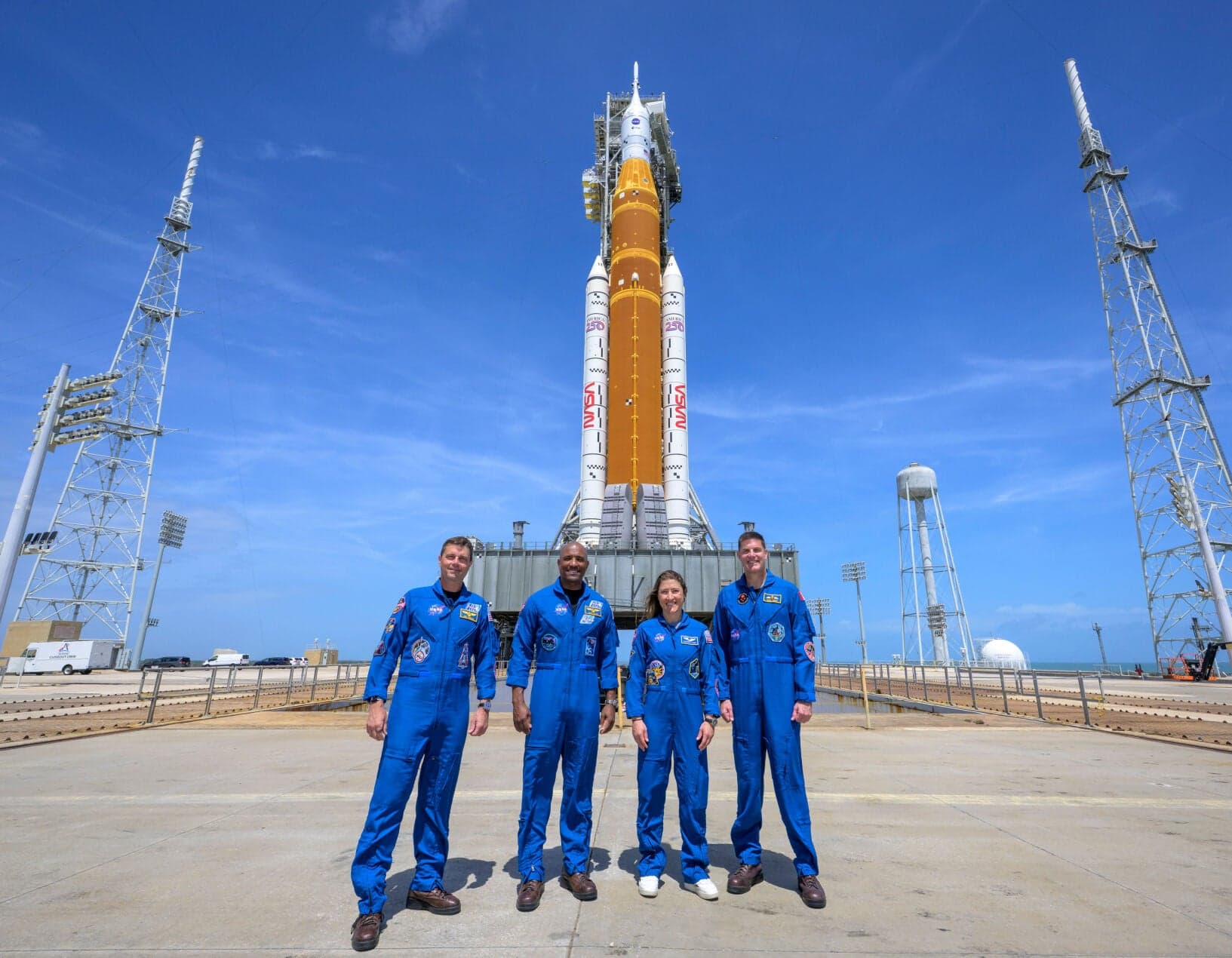
When NASA's Space Launch System lifted off from Kennedy Space Center on April 1, 2026, it carried four astronauts beyond Earth orbit for the first time in over half a century. The imagery was historic and undeniably stirring. But even as mission controllers celebrated, a parallel conversation was intensifying in congressional offices, research institutions, and space agencies worldwide: given how rapidly robotic and artificial intelligence technology has advanced, is the human body still worth the price of admission?
A Budget That Forces the Question
The fiscal arithmetic is difficult to ignore. NASA's Office of Inspector General calculated the operating cost of the Space Launch System and Orion spacecraft at $4 billion for a single Artemis mission, and a 2024 audit found that by the originally scheduled launch window, NASA would have spent more than $55 billion on SLS, Orion, and its Exploration Ground Systems combined. That figure arrived alongside a pointed political verdict: the Trump administration's own fiscal year 2026 budget proposal, released in May 2025, described the SLS as "grossly expensive" and noted the program was 140% over its original budget.
The overall FY2026 budget proposal would cut NASA's top line by $5.6 billion, or 23%, with cuts to the science budget approaching nearly 50%. The recent NASA budget request would fund Artemis II and III but cancel all SLS missions from Artemis IV onward. For those who have long argued the money would be better spent on robotic science, the administration's own language handed them an unexpected endorsement.
The cost gap between crewed and uncrewed missions is not merely a matter of accounting. Human spaceflight is currently on the order of thirty times more costly than robotic missions. Compare that to the track record of machines: Mars Pathfinder returned a treasure trove of data and pictures for only $265 million. India's Chandrayaan-2 lunar mission cost $142 million. The Apollo program, by contrast, cost an estimated $25 billion at the time, which amounts to roughly $150 billion in today's dollars, with only six successful lunar landings across eleven piloted missions.
What Robots Can Already Do
The most powerful arguments for robotic exploration are no longer theoretical. On Christmas Eve 2024, NASA's Parker Solar Probe achieved a milestone in space exploration, venturing closer to the Sun than any human-made object before, flying through the Sun's atmosphere to study its mysteries in a feat that unfolded without direct human involvement. No human could survive those conditions; no crewed spacecraft could have made that journey at any cost.
On Mars, the pace of robotic capability is accelerating sharply. In past missions, rovers like Curiosity and Opportunity relied mostly on human instructions from millions of miles away to safely navigate the Martian landscape. Perseverance, by contrast, has zipped across the alien, boulder-ridden terrain almost completely autonomously, smashing previous records. Whereas Curiosity completed about 6.2 percent of its travels autonomously, Perseverance had completed about 90 percent of its travels autonomously as of its 1,312th Martian day.
In December 2025, that autonomy reached a new frontier. NASA's Perseverance Mars rover completed the first drives on another world planned by artificial intelligence, with the demonstration executed on December 8 and 10 and led by the Jet Propulsion Laboratory. The system used generative AI to create waypoints for Perseverance, a complex decision-making task typically performed manually by human rover planners. NASA Administrator Jared Isaacman called it a signal of things to come: "Autonomous technologies like this can help missions to operate more efficiently, respond to challenging terrain, and increase science return as distance from Earth grows."
The communication lag is at the core of why AI autonomy matters so profoundly. Mars sits between 55 million and 400 million kilometers from Earth depending on orbital positions, making real-time remote operation physically impossible. Every command a ground team issues to Curiosity must be verified meticulously before execution, meaning a task a human geologist might accomplish in two hours can take a robot weeks.
The Case That Humans Still Can't Be Replaced
The counterargument centers on the irreplaceable flexibility and cognitive depth of human explorers. The Apollo 17 mission offers a striking data point: astronauts Gene Cernan and Harrison Schmitt drove 35 kilometers across the lunar surface in just three days, averaging 11.6 kilometers per day. Curiosity, in six-plus years on Mars, covered roughly 20 kilometers total, averaging about 9 meters per day. That disparity reflects not a failure of engineering but a fundamental difference in adaptive intelligence under novel conditions.
The argument extends to scientific breadth. Astronauts aboard the ISS performed more than 300 different experiments during a single expedition, ranging from fully automated observations to hands-on procedures requiring direct human judgment, with astronauts themselves serving as research subjects. No robotic system currently deployed can replicate that versatility within a single mission.
There is also the political economy of space budgets to consider. Space scientists frequently make the mistake of assuming that the space exploration budget is a zero-sum game, lamenting money spent on the manned program that could fund robotic missions. If the manned program were canceled today, its budget would likely disappear rather than be redirected to scientific exploration. Human spaceflight, with its astronaut heroes and dramatic launches, sustains the public enthusiasm and congressional support that funds everything else, including the robots.
The Voices Calling for a Shift
The intellectual case for ending human spaceflight has gained serious institutional weight. Lord Martin Rees, the UK's Astronomer Royal, argues against using public funds for human space missions, stating: "Robots are developing fast, and the case for sending humans is getting weaker all the time," and highlighting the risks and high costs associated with human space travel. That view is not fringe. A book co-authored by astronomer Donald Goldsmith and Rees makes a sustained argument that the era of the astronaut has effectively passed, that robotic systems will accomplish more science at a fraction of the human cost, and that the emotional pull of the crewed mission is an insufficient justification for the risk and expenditure.
The physical argument for robots is elemental. Human exploration has always been constrained by biology: the need for breathable air, drinkable water, pressurized environments, and thermal regulation. A robotic or AI-guided system faces none of those constraints. It can inhabit environments that would instantly kill any astronaut, from the crushing methane seas of Titan to the infernal winds of Venus to the lethal radiation fields near the Sun.
A Hybrid Future, for Now
Despite the sharpening debate, the near-term reality is neither robots nor humans alone but both, often in the same mission. NASA's Mars Sample Return program aims to bring back samples collected by Perseverance via a Mars Ascent Vehicle that would mark humanity's first rocket launch from another planet, a mission that blends robotic collection with future human analysis. On the Moon, NASA selected Blue Origin in September 2025 to carry the VIPER rover to the lunar surface, targeting 2027, using Blue Origin's Blue Moon lander on a New Glenn rocket. If successful, VIPER will become the first rover equipped with its own lighting system, capable of exploring craters in permanent darkness.
Even aboard the ISS, the human-robot partnership has been literal. Robonaut 2, developed by NASA's Johnson Space Center in partnership with General Motors and launched to the ISS in February 2011, was designed to work directly alongside astronauts. Equipped with more than 350 sensors, 38 processors, and hands capable of handling payloads up to 18 kilograms, it represented an early experiment in the kind of shoulder-to-shoulder collaboration that proponents of a hybrid approach see as the logical endpoint of the debate.
The decision is not purely scientific or economic. It carries a philosophical dimension that no cost-benefit analysis fully captures. The image of a human standing on a distant world generates a category of wonder and political solidarity that a rover selfie, however remarkable, has not yet replicated. Whether that distinction still justifies the price tag is the question that Artemis II's launch has made unavoidable. That sentiment has been quietly acknowledged in the space community for years, but it has not been reflected in formal policy. As AI continues to close the performance gap between machines and astronauts, the window for deferring that formal reckoning grows narrower.
This article was produced by Prism’s automated news system from verified source data, official records, and press releases, then run through automated quality and moderation checks before publishing. The system is built and supervised by the people who set the standards it runs under. Read our full AI policy.
Did this article answer your question?