The Stories Behind Golf's Most Iconic and Memorable Images
A fist pump, a sky-punch, a roar: the photographers who froze golf's greatest moments made decisions in fractions of a second that defined how we remember the sport.
The Frame Before the Frame
Every iconic sports photograph begins with a decision made before the shutter clicks. In golf, those decisions carry unusual weight because the sport offers almost no forgiveness for the photographer who is in the wrong place, using the wrong lens, or simply not paying attention at the precise moment a match turns. The images that endure from golf's greatest tournaments were not accidents. They were the product of access negotiated with officials, positions staked out hours in advance, glass chosen deliberately, and an intimate understanding of the player in the viewfinder.
Seve Ballesteros: The Photographer's Dream, St Andrews 1984
Few images in golf are as instantly recognizable as Seve Ballesteros punching the air on the 18th green at St Andrews after claiming the 1984 Open Championship, his smile stretching as wide as the Old Course's first fairway. The man behind the lens was Getty Images photographer David Cannon, who had made a career of positioning himself wherever Ballesteros was competing.
Cannon described Ballesteros as "a photographer's dream and one of the very few who always guaranteed to give you a memorable photo." That guarantee came not from luck but from something structural: every day you went out with him, you knew there was a pretty high chance of a brilliant picture. His personality and his passion made him every photographer's dream.
There was also a technical dimension that modern photographers no longer enjoy. Ballesteros played in an era when the top golfers generally didn't wear hats, so you truly got to see their whole expression; Seve showed every emotion on his face. For a photographer trying to capture the exact instant of joy or anguish, an unobstructed face is not a small advantage. It is the difference between a picture that feels intimate and one that feels remote.
Even four decades on, Ballesteros' heroics at St Andrews still resonate. Jon Rahm, born a decade after Seve won his second Open, called it "an iconic image not only for us but for the world of golf." That longevity is partly photographic: Cannon's composition, the body language, the background crowd frozen in equal disbelief and delight, combined to make an image that requires no caption.
Tiger Woods: Remote Cameras and the 400mm Tower, Augusta 1997
Tiger Woods' first Masters victory in 1997 arrived with a 12-shot margin that announced, as one photographer put it, the most astonishing performance by a young golfer in history. Capturing that magnitude on film required more than a single camera position, and David Cannon's approach to the 18th green that Sunday illustrated how professional golf photographers think in layers.
"I shot this picture using a remote camera clamped to the infamous, now removed, photographers' tower beside the 18th green, while shooting Tiger 'tight' at the same time with a 400mm lens from that great vantage point," Cannon explained. That dual setup, one camera controlled remotely and one operated by hand, gave him simultaneous wide context and close emotion. The tower, since dismantled, provided elevation that no rope-line position could match, turning a standard closing hole into something almost theatrical.
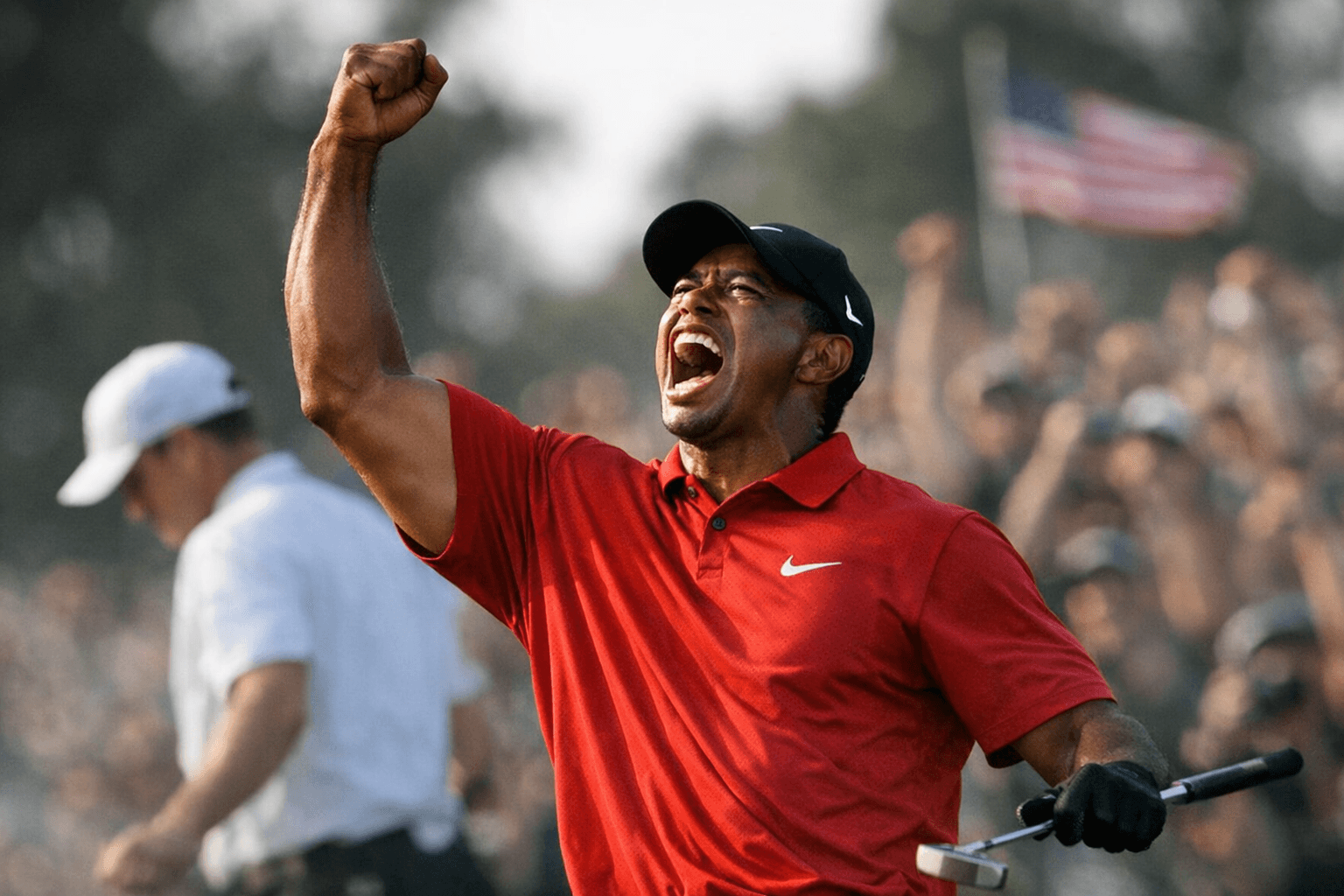
Tiger's fist pump grew to define golf over 15 years, becoming as synonymous with Woods as Woods himself became with the sport. But the fist pump only translates into a photograph if the photographer anticipates it. Woods' pre-shot routine, his tempo, even the arc of his follow-through became reference points that experienced photographers memorized. Knowing that a fist pump was coming on a made putt meant choosing a shutter speed fast enough to freeze the motion and a focal length tight enough to fill the frame with face and fist, not green and sky.
Fred Vuich, another photographer who spent decades documenting Woods at the Masters, was recognized by the Golf Writers Association of America for his ability to capture memorable moments on and off the course. "Fred's ability to capture memorable moments on and off the golf course is second to none," said PGA of America President Don Rea Jr. Vuich's career, which started when he walked a photograph directly to an editor and pitched it in person, underlines a truth common to every great golf image: access and relationship-building matter as much as equipment.
Rory McIlroy: The Approach at 15, Augusta 2025
Some photographs earn their place in the canon because the moment itself is historic. At the 2025 Masters, with McIlroy striding down the 15th fairway in Sunday's final round, photographer C. Hunkeler was positioned behind the ball with a clear line to both the player and the gallery beyond. The resulting image, McIlroy moving through his shot in full stride with the crowd erupting behind him, became one of the most discussed sports photographs of the year.
"The sensation I felt watching Rory stride after his shot through my camera, followed by one of the loudest, most impassioned roars I've ever experienced, on a hole that has decided so many tournaments, is a moment and a feeling that I will remember forever," Hunkeler said. He was candid about his vantage point, noting he is not a full-time tournament photographer, which made the result all the more striking. The 15th at Augusta is a par-5 reachable in two, a hole with a history dense enough that every significant moment there carries amplified meaning.
Why Most Attempts Fail: The Rules and Realities of Golf Photography
Golf is unique among major sports in the restrictions it places on photographers. Golf is the only sport where you're not allowed to photograph a player during their backswing. That rule eliminates the most physically dramatic moment of every shot, pushing photographers toward the follow-through, the reaction, and the result. It is a constraint that paradoxically produces better storytelling photographs, because emotion lives in the face after the ball has gone, not in the mechanical act of striking it.
Super-telephoto lenses, such as the 300mm f/2.8 or 400mm f/2.8, are standard tools for capturing action from distance without distracting the golfer with shutter noise. These lenses, weighing anywhere from 6 to 11 pounds, require support on a heavy-duty monopod and demand physical stamina across a five-hour round on a course that may cover six miles of walking. Setting autofocus to a continuous tracking mode ensures the lens keeps pace with a player moving through impact, but the photographer still has to predict where the decisive moment will be.
The most important positional rule is to remain only one arm's length from the rope, which keeps photographers off fairways and prevents interference with play. That restriction defines the available angles for every shot on every hole, meaning that photographers study course layouts in advance, identify the positions where a significant outcome is likeliest, and commit to a location before they know whether that hole will matter.
What the Great Images Have in Common
Strip away the specific tournaments and the famous names and a pattern emerges. Cannon's Seve image worked because he had built a relationship with a player who performed openly and expressively, in an era before hat brims obscured faces. His Tiger image worked because he deployed technology, the remote camera on the tower, to get an angle no rope-line position could offer. The McIlroy image at Augusta worked because the photographer was on a hole historically charged with drama and was prepared when the drama arrived.
The practical lesson from each of these images is the same: the photograph is earned before the moment happens. Positioning, preparation, equipment choice, and knowledge of the player's body language all collapse into a single shutter click. The golfer provides the emotion; the photographer's job is to have already solved every other problem before the ball lands.
This article was produced by Prism’s automated news system from verified source data, official records, and press releases, then run through automated quality and moderation checks before publishing. The system is built and supervised by the people who set the standards it runs under. Read our full AI policy.
Did this article answer your question?
.jpg&w=1920&q=75)