Three Los Alamos physicists win major American Physical Society honors
Three Los Alamos National Laboratory scientists were honored by the American Physical Society for major contributions to physics. The awards underline local strengths in national-security science and fundamental physics.
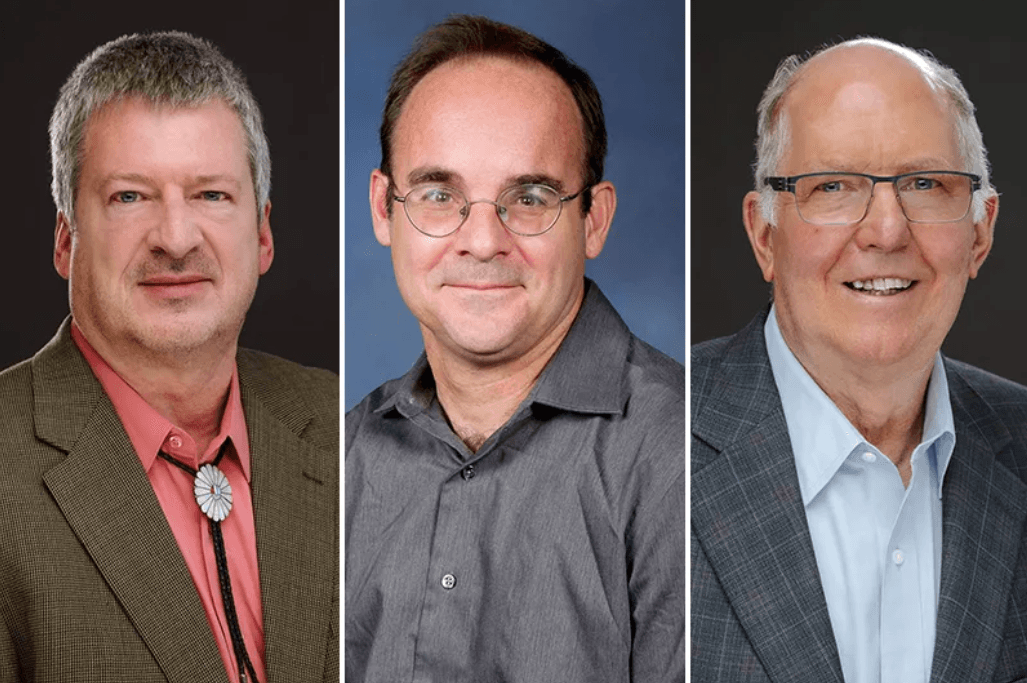
Three Los Alamos National Laboratory scientists received top honors from the American Physical Society on Jan. 16, 2026, a recognition that highlights the county's concentration of expertise in both applied national-security science and fundamental physics. The awards bring national visibility to work performed on the Pajarito Plateau and carry implications for Lab funding, recruitment and community oversight.
Larry Glenn Hill was elected an APS fellow for his contributions to shock physics and high-explosives research. Hill's work advances understanding of material behavior under extreme conditions, a domain closely tied to stockpile stewardship, safety assessments and other defense-related missions that are central to Los Alamos National Laboratory's portfolio. Election as an APS fellow is a peer recognition of sustained impact in the field and signals continued leadership in applied experimental and computational efforts.
Christopher Fryer received the 2026 Hans A. Bethe Prize for his research on stellar collapse, supernovae and compact-object formation. Fryer's work connects Los Alamos scientists to astrophysics questions about how massive stars end their lives and seed the universe with heavy elements. That line of inquiry reinforces the Lab's role in large-scale computational astrophysics and helps sustain collaborations with universities and national observatories.
Christopher Morris earned the 2026 Tom W. Bonner Prize in Nuclear Physics for pioneering ultracold neutron source development and precision neutron-lifetime measurements. Precision neutron studies speak to fundamental questions in particle and nuclear physics, and the techniques Morris advanced strengthen Los Alamos contributions to international experimental efforts that test the Standard Model and inform basic science.
These honors serve multiple local purposes. They enhance Los Alamos County's scientific brand, which can aid in attracting and retaining technical talent and sustaining partnerships with research universities. They also matter to taxpayers and local policymakers because much of the Lab's work is federally funded and tied to national-security priorities. Recognition from a major professional society can influence congressional and agency deliberations over research portfolios and infrastructure investments, and it underscores the need for continued community engagement with Lab governance, environmental stewardship and workforce planning.
For residents, the immediate effects are civic and economic rather than ceremonial: awards of this scale can help preserve high-skill jobs, support student pipelines into STEM careers and justify continued investment in research facilities. Moving forward, county leaders and voters should track how the Lab translates prestige into tangible community benefits while maintaining transparency around priorities and oversight.
Sources:
Know something we missed? Have a correction or additional information?
Submit a Tip