To Lam seeks expanded powers as Vietnam’s party congress opens in Hanoi
Nearly 1,600 delegates convene as General Secretary To Lam aims to consolidate China-style dual authority, shaping leadership and economic goals amid regional tension.
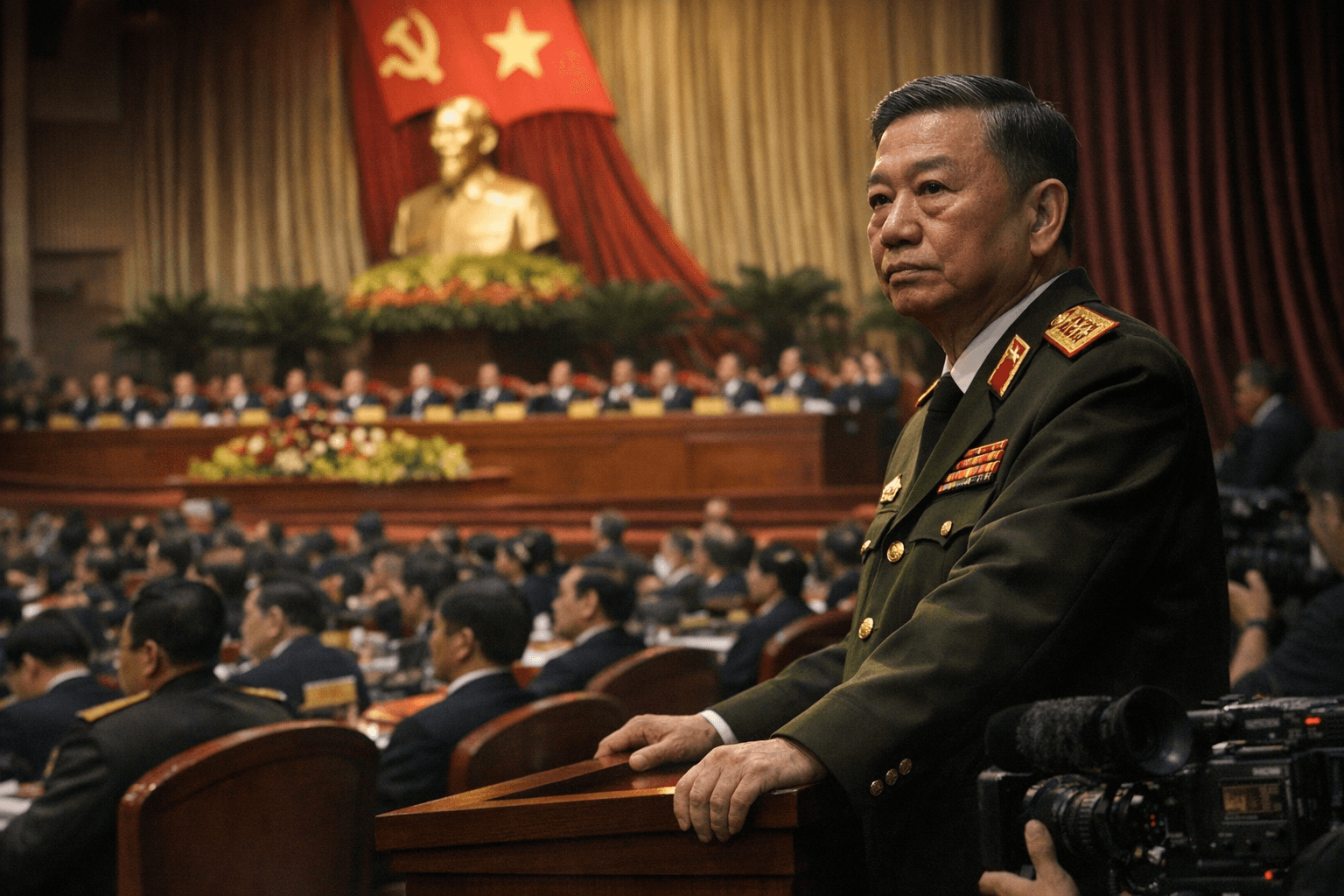
Nearly 1,600 delegates have gathered in a flag-draped Hanoi auditorium for the Communist Party's once-in-five-years congress, a tightly controlled conclave that will determine Vietnam's leadership and policy direction for the coming half-decade. State media said the opening ceremony would be broadcast live, and heightened security is apparent around the venue as delegates begin a week-long process of tightly choreographed decision making.
The congress will first see delegates elect roughly 200 members to the Party Central Committee. That body is expected to select 17 to 19 Politburo members from a pre-arranged shortlist, and the Politburo will then nominate the country's top state leaders. The sequence culminates in formal appointments by the National Assembly after legislative elections scheduled for March 15 and the Assembly's expected April session to ratify the new team. The congress runs through Jan. 25, with the new leadership likely to be revealed on the final day.
General Secretary To Lam, who was elevated by the Central Committee on Aug. 3, 2024 after the death of his predecessor, has spent decades in the Ministry of Public Security and served as minister starting in 2016. Since assuming the party's top post, he has driven an ambitious program of administrative and economic reforms that officials say is intended to accelerate growth and streamline governance. Measures include cutting tens of thousands of public-sector positions, redrawing administrative boundaries to speed decision making, pushing major infrastructure projects, reducing bureaucratic bottlenecks and accelerating investment approvals.
The campaign has been accompanied by a continuation of high-profile anti-corruption purges that began under the previous leadership. Those efforts led to the removal of six Politburo members out of 18, including two former presidents and the parliamentary head, reshaping elite dynamics and clearing space for new political alignments. To Lam has consolidated authority and expanded the influence of the security apparatus he once led, while projecting himself as a more visible face of Vietnam abroad.
At the heart of the congress is To Lam's bid to broaden his mandate by assuming the state presidency in addition to the general secretaryship. If successful, that dual role would mirror a model seen in other single-party systems and would signal the ascendancy of a security-dominated faction within Vietnam's ruling elite. Conservative elements inside the party are reportedly uneasy with the speed and direction of change, warning that concentrated power and rapid reforms risk unsettling the “Vietnamese socialist system” and seeking to preserve countervailing voices in the leadership.
Delegates will also finalize a policy resolution that anchors economic strategy through the remainder of the decade. A draft circulated in October sets an ambitious target of average annual GDP growth of 10% or more from 2026 to 2030, after the country posted 8% growth in 2025 and missed an earlier mid-decade goal of 6.5%–7.0. The resolution formalizes a pro-private-sector orientation, elevates foreign affairs and international integration alongside national defense and security, and signals a willingness to give large private conglomerates greater roles in major projects.
The congress therefore serves a dual purpose: it will confirm who governs and it will map how Vietnam seeks to navigate intensifying U.S.-China rivalry, global fragmentation and the push to become a high-income economy by 2045. Choices made inside the closed deliberations in Hanoi will be transmitted through the party-state machinery and tested in the months ahead as new leaders assume public office and pursue a tightly packed reform agenda.
This article was produced by Prism’s automated news system from verified source data, official records, and press releases, then run through automated quality and moderation checks before publishing. The system is built and supervised by the people who set the standards it runs under. Read our full AI policy.
Did this article answer your question?


