Toe wrestlers battle for glory at quirky championship
Toe wrestling has turned a novelty into a serious title fight in Ashbourne, where a 50-year championship still draws loyal competitors, prize money and local pride.
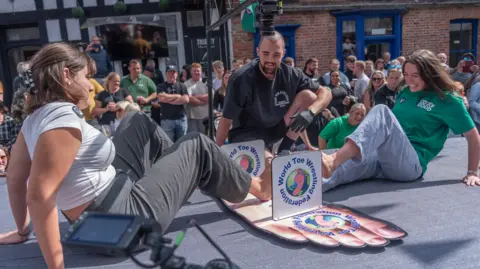
Toe wrestling turns a comic image into a real contest in Ashbourne, where leverage, balance and pain tolerance decide who leaves with the medals. The World Toe Wrestling Championship marked its 50th anniversary with Ben Woodroffe, known as “Toe-tal Destruction”, and Lisa Shenton, “Twinkletoes”, taking the winning medals at Ashbourne Market Place in Derbyshire.
A championship built to last
The sport has been around since 1970, and the anniversary underlined how thoroughly it has outgrown the one-laugh novelty treatment. A 2024 event listing placed the World Toe Wrestling Championships in England on August 31, and the competition has continued to surface in video coverage, including a men’s final round that kept the action visible beyond the day itself.
That longevity matters because toe wrestling has preserved a small but structured sporting culture around it. Reuters had already turned to the event in 2018 with a story headlined “Toe wrestler ‘Nasty’ nails another world championship,” a reminder that the competition has had recurring champions and a narrative history, not just a single odd moment.
How the contest works
The rules are stripped down and physical. Contestants lock feet and try to force an opponent’s toe down or outmaneuver them in a test of strength, leverage and grit. A 2018 video of the men’s final shows the sequence in practical terms: the wrestlers start by locking right toes, then left, then right again.
The setting helps give the contest its identity. Matches take place in The Toedome, where the choreography is simple but the demands are not. Competitors train for balance, ankle strength and endurance, because the sport rewards control as much as stubbornness. What looks playful from the stands is still a pain-management contest once the feet are locked and the pressure starts to build.
The names that give the sport continuity
Every fringe competition needs its regulars, and toe wrestling has them. Alan “Nasty” Nash has become one of the sport’s best-known long-running champions, the kind of figure who gives a niche event a lineage the crowd can follow. His presence in past Reuters coverage shows that the championship is not just a one-off spectacle, but a repeat arena where reputations are built and defended.
The commitment can also be extreme. One champion had toenails surgically removed to improve stamina, a stark example of how far some competitors will go for an edge. That detail strips away any easy assumption that the event is merely theatrical: beneath the laughter, there is a field of people treating a highly specific contest as seriously as any other title bout.
Why Ashbourne keeps showing up on the toe-wrestling map
Ashbourne’s championship endures because it sits at the intersection of local pride, community ritual and eccentric British sport. The crowd includes committed regulars and curious spectators, but the event’s staying power comes from the participants who return year after year and from the town that keeps giving the contest a public home.
The official Toe Wrestling Championship site shows how organized the event remains. Applications are open for the 2026 World Championship, with 32 places and a £9,000 prize fund, and entry is free. Those details matter: they make the sport look less like a stunt and more like a recurring competition with rules, prizes and a gatekeeping process that helps preserve its character.
The championship’s public footprint also stretches beyond the ring. BBC News reported the 50th anniversary winners in Ashbourne Market Place, while video and event listings continue to document the annual rhythm of the contest. That combination of medals, named champions, prize money and location gives the sport its backbone.
What the championship reveals
Toe wrestling survives because it does several things at once. It entertains on first glance, but it also rewards training, produces repeat champions and gives a small crowd a shared local ritual to care about. The joke is real, the title is real, and the effort is real enough that competitors keep coming back to lock toes in The Toedome.
That is why the championship keeps drawing attention far beyond its size. It is not simply an oddity preserved for laughs. It is a compact example of how community sport endures when people commit to it, defend it and keep showing up to fight for a title that only looks absurd from a distance.
This article was produced by Prism’s automated news system from verified source data, official records, and press releases, then run through automated quality and moderation checks before publishing. The system is built and supervised by the people who set the standards it runs under. Read our full AI policy.
Did this article answer your question?