Tolu Coker Fall 2026 Celebrates Regal Tailoring and Community-Centered Design
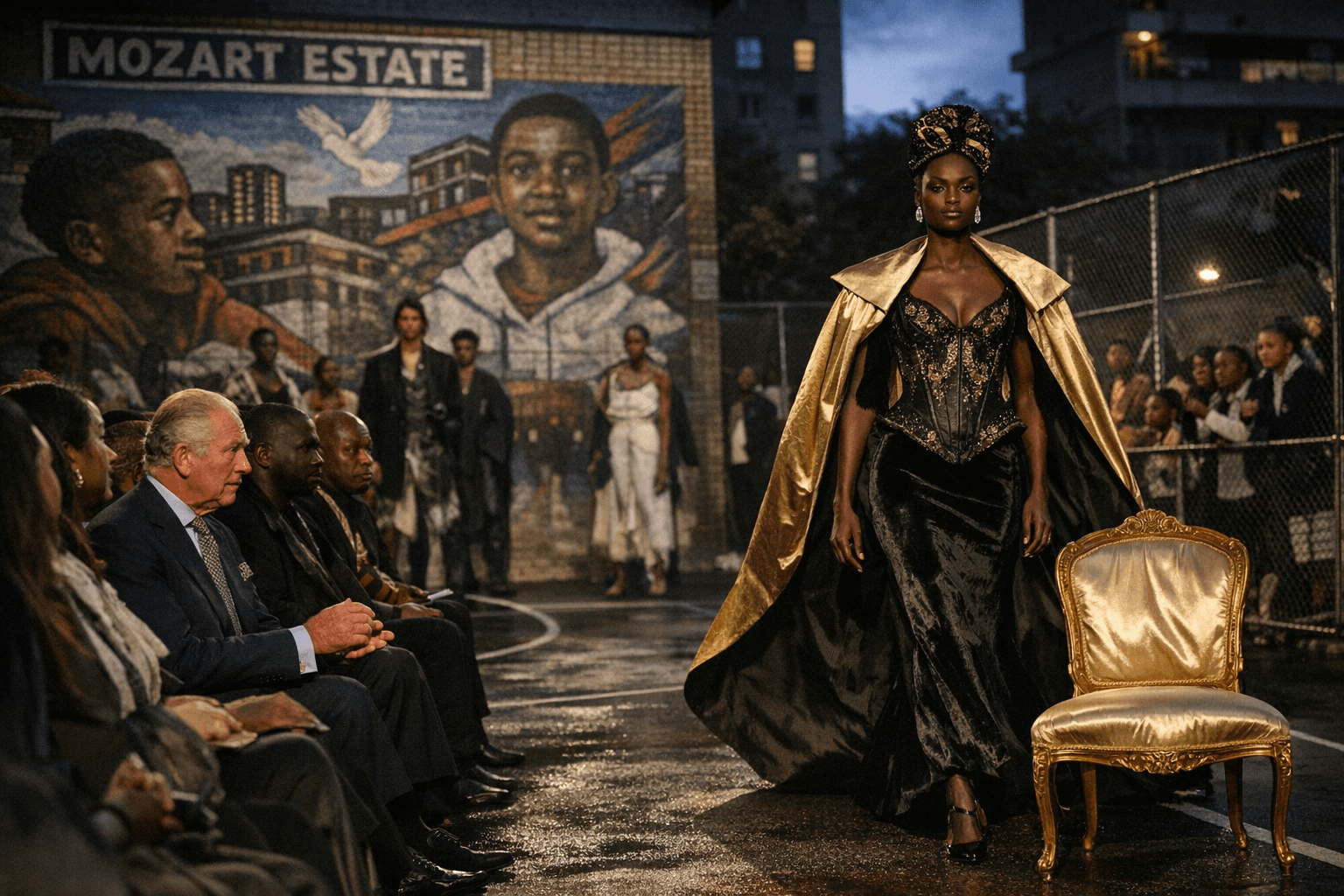
A recreated Mozart Estate—basketball court, community mural and a single satin-topped chair—framed Tolu Coker’s NewGen show at London Fashion Week, where King Charles III sat front row as Coker staged “Survivor’s Remorse.”
A basketball court, a community mural and bench seating described by WWD as “backache-inducing” formed the set when Tolu Coker staged her Fall 2026 ready-to-wear at the NewGen showspace during London Fashion Week. The tableau made headlines: Vogue captured “King Charles III…walking across the Mozart Estate” recreation, and both WWD and CNN noted the monarch in the front row, variously described as seated on “a sole white lawn chair topped with a satin pillow” (WWD) and “on a gold cushion” (CNN), surrounded by Stella McCartney, Seán McGirr and Martine Rose among others.
The collection carried a name and a mission. CNN reported the line as “Survivor’s Remorse,” and Coker framed it as “a look at Britishness through the lens of the African diaspora,” saying, “This collection was one about grief, aspiration, assimilation and then coming back to one’s self.” WWD’s assessment landed the practical point: “While overflowing with star power, ultimately it was a collection rooted in community,” a through-line reinforced by the Mozart Street homage.
Coker made the homage literal. Vogue and WWD describe the set as a recreation of the West London Mozart Estate where she grew up; CNN quoted her backstage saying, “It was looking at my block in the ‘90s, when I was born.” That personal geography intersected with a public one: WWD reminded readers that Coker is a former beneficiary of the King’s Trust, noting she “booked onto a four day course at the [then] Prince’s Trust” when she was starting her brand, and CNN flagged her 2025 LVMH Prize semifinalist status and her position as one of the few Black female designers with her own label.
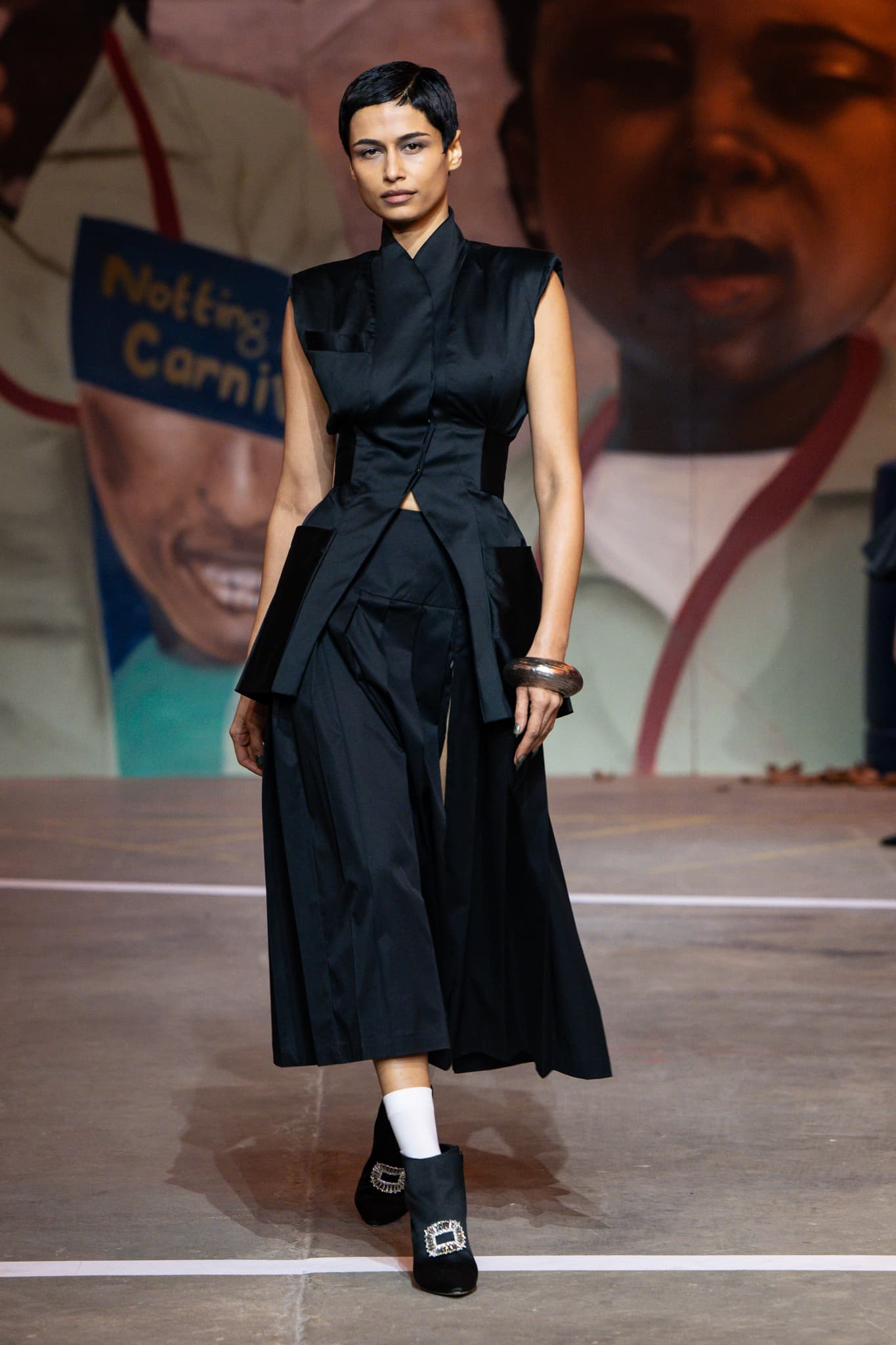
The clothes answered Coker’s questions about mobility and tailoring. She asked, “I was thinking about materiality and this idea of the tracksuit, but what does that then look like for someone mobilizing? How do you give something like that a tailored sensibility and a sense of shape, while maintaining that comfort?” WWD and Vogue showed the answer in sober gray tailoring wools, houndstooth denims and corseted leotards with dimensional hip constructions and swaying peplums; weighty taupe felt hooded jackets and track pants arrived with darts at the bust, skimming seams and sensuous cutouts at the hip—pieces WWD called “equally power suits, armor and a material hug.”
CNN supplied the pop references and silhouette notes that punctuated Coker’s tailoring: cropped double-breasted jackets, sailor hats, crisp frock coats in pastel hues and a blue-and-pink tartan mini-skirt that married Yoruba colorways with a wink to the 1995 film Clueless. CNN also captured Coker’s intent to tilt properness into play: “It’s like, you get to your block and you lose that bit of properness and it becomes fun and playful.”
The show’s staging amplified the message. Vogue’s scene-setting—“The opening hours of London Fashion Week proffered an image that will no doubt be one of this season’s most widely circulated”—paired with WWD’s line “Even the king seemed impressed” to underline how Coker married spectacle and sincerity: a recreated community block, a single chair or cushion interrupting the bench rows, and a front row that included fashion names while the collection kept its focus on Mozart Street’s textures and stories.
With a royal in the front row, a LVMH Prize semifinalist credit and a clear thesis about mobility, materiality and diaspora, Tolu Coker’s Fall 2026 show crystallized her argument that tailoring can be both regal and communal. The result positions Coker not as a fleeting sensation but as a designer translating neighborhood memory into structured, wearable power.
Know something we missed? Have a correction or additional information?
Submit a Tip