Top 5 3D Printers for Jewelry in 2026, Ideal for Castable Resins
Find the best resin and wax-jet printers that actually meet jewelry casting needs, ranked from dental-grade pros to cost-conscious resin options.
1. Formlabs Form 4L — the professional benchmark for repeatable, clean resin workflows
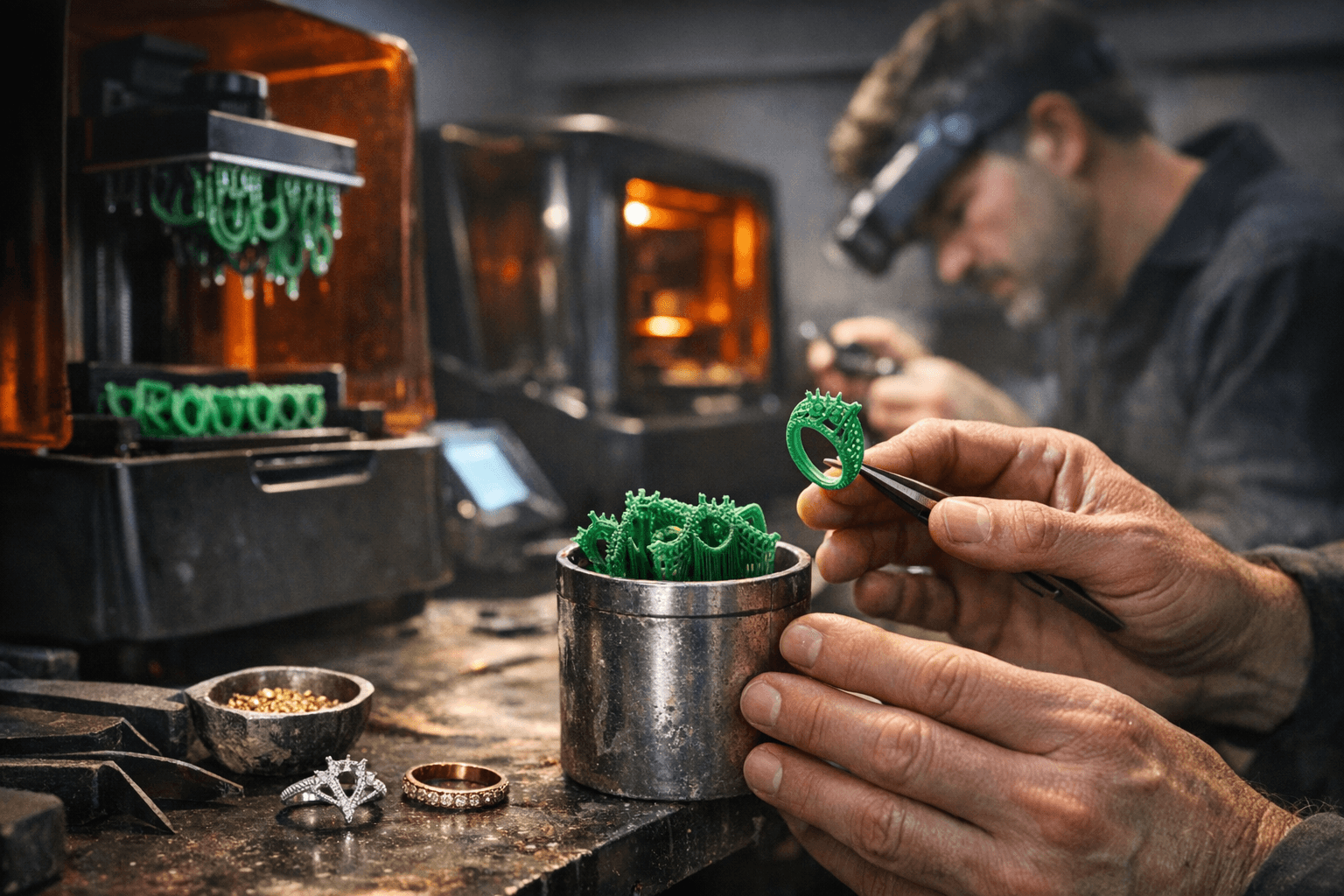
Formlabs retains clear professional desktop leadership: Ufmdesign calls the Form 4 a “gold standard, particularly in dental laboratory settings,” and the pro-sized Form 4L appears on reviewer roundups at a $9,999 price point. Its advertised Low Force Display technology and self-contained resin cartridges are designed to promote clean, consistent operation, which matters when repeatable castable-resin performance and shop cleanliness affect cast outcomes. If you prioritize service network, cartridge-managed supplies, and a workflow already validated in dentistry, the Form 4L is the safest high-end pick for jewelers scaling from prototyping to repeat production.
2. Uniformation GKTwo — ultra-high resolution with thermal control for consistent castable resins
Uniformation markets the GKTwo with an explicit claim of “12K resolution accuracy” and integrated thermal control, noting that a heated resin vat is “critical for maintaining consistent material viscosity, thereby ensuring reliable printing.” That matters for castable resins which can be temperature-sensitive in shop environments: stable vat temperature reduces layer variation and helps preserve fine prong tips, filigree, and thin walls. Uniformation’s focus on thermal management and 12K-class resolution makes the GKTwo especially compelling where micro-detail and dimensional predictability are non-negotiable.
3. HeyGears Reflex Turbo — purpose-built LCD resin precision with explicit jewelry positioning
HeyGears advertises the Reflex Turbo as “equipped with an 8K high-resolution LCD screen and a printing accuracy of approximately ±15 μm,” and positions it as “particularly well suited for jewelry applications” capable of “reproducing complex geometries and delicate textures with clarity.” HeyGears also states plainly: “For producing jewelry models that require high precision and fine detail, a resin 3D printer is generally the most suitable choice,” and recommends castable resin or wax-like materials for metal casting workflows. For small studios and bench jewelers who need a balance of micron-level detail, explicit accuracy claims, and a manufacturer guide to casting-ready prototypes, the Reflex Turbo is the pragmatic mid-tier contender noted for cost efficiency and an onboarding-friendly ecosystem.
4. SprintRay Pro 95 S — speed and clinical-grade accuracy useful for fine jewelry prototypes
SprintRay’s Pro 95 S is described as engineered “for clinical dentistry,” with “high speed and proven accuracy” that enable seamless integration with intraoral scanning workflows. Dental-oriented systems translate well to jewelry because both disciplines demand sub-millimeter fidelity, predictable feature reproduction, and throughput for iterative design verification. If your workflow values fast, reliable print runs of tiny crowns and bridges, those same strengths apply to rings, bezels, and detailed settings—SprintRay’s pedigree in clinical use signals strong positional accuracy and production robustness for jewelers who measure value in successful cast runs and fit-first prototypes.
5. Flashforge WaxJet series (WJ530, WaxJet 510, WaxJet 400) — direct wax workflows for casting-first shops
Flashforge’s product names appear explicitly in manufacturer material: WJ530, WaxJet 510, WaxJet 400, under a solutions taxonomy that lists the “Jewelry Industry” alongside other manufacturing sectors. The WaxJet line and the broader Flashforge product taxonomy (including Guider 3 Ultra and R1/R1 Max) indicate a vendor commitment to wax and hybrid workflows rather than only photopolymer resins. For traditional lost-wax casting shops that prefer true wax patterns instead of castable photopolymer burnout, WaxJet-class machines are the only option that directly targets wax-printable consumables and jewelry production pipelines.
Practical context and comparisons you need to know now The market in 2026 ranges from sub-$400 hobby machines to near-five-figure pro systems, and that pricing spread matters for castable-resin workflows. A community jeweler on Reddit set a practical ceiling of “lets say +- budget up to €1000” and listed models they were considering: Elegoo Saturn 4 Ultra 16K, Phrozen Sonic Mighty, and Anycubic Photon P1, explicitly asking for real-world feedback on print quality and reliability in casting workflows. Reviewer roundups also place many consumer and prosumer options well below that ceiling: Bambu Lab A1 Mini $219, A1 $359, P2S $550, while higher-tier filament and multi‑material FDM systems like the Prusa CORE One L ($1,800) and QIDI Max4 ($1,100) occupy adjacent niches. Keep in mind those Bambu Lab and other listed machines often serve FDM or general-purpose roles and are not substitutes for photopolymer systems when surface finish and micron detail for castable resins are the objective.
Why photopolymer remains the default for jewelry prototyping HeyGears summarizes the relevant technology point with clarity: “Photopolymer 3D printers, including SLA, DLP, and LCD systems, build objects by curing liquid resin layer by layer using UV light,” and “this technology is the most widely used and most mature solution for 3D printed jewelry today,” because it “allows for fine textures, thin walls, and complex geometries.” For jewelers converting prints to metal, HeyGears explicitly recommends “castable resin or wax-like materials” as the practical next step. That technological reality is why most top recommendations here emphasize resin and wax-printing platforms over filament machines.
Design and software notes you should budget for Design tools matter as much as the machine: Blender, Fusion 360, Rhino with Grasshopper, and Tinkercad are all explicitly cited as core software choices in industry material, with Blender praised for parametric geometry nodes and photoreal rendering, Fusion 360 for non-destructive parametric edits and manufacturing modules, Rhino/Grasshopper for NURBS precision and algorithmic design, and Tinkercad for rapid STL exports. Factor software proficiency and file export workflows into any purchase decision: precise models, printable supports, and burned-out patterns all start in the design stage.
Final assessment If you run a production bench and can justify the spend, the Formlabs Form 4L remains the easiest path to dental‑grade repeatability and service-backed operation; Uniformation’s GKTwo promises the tightest claimed XY fidelity with thermal control; HeyGears’ Reflex Turbo gives a clear, advertised ±15 μm accuracy and a jewelry-focused value proposition; SprintRay’s dental focus translates to the speed and accuracy jewelers rely on; and Flashforge’s WaxJet family is the direct answer for shops committed to wax-first casting. Each choice trades off cost, ecosystem, and material path: pick the platform whose stated features, temperature control, and material compatibility match your castable resin or wax burnout requirements, then validate with test prints of the tiniest features you need to cast.
Know something we missed? Have a correction or additional information?
Submit a Tip