Toyota February Sales Slip 2.3% as China Weakness, Middle East Risks Loom
Toyota's February sales fell to 806,905 units, but the 70% of Japan's auto aluminum that ships through Middle East corridors now under threat is the bigger number to watch.

Roughly 70% of the aluminum flowing into Japan's auto factories travels through shipping corridors now threatened by a widening Middle East conflict. Toyota Motor Corp.'s February sales figures arrived just as that threat sharpened, and what starts as a 2.3% annual sales dip could escalate into a far more serious supply crunch.
Toyota reported global vehicle sales of 806,905 units in February, down from the same month a year earlier. Two forces were already squeezing the automaker before the regional conflict expanded: cratering demand in China and softening domestic consumption in Japan. Toyota and Lexus brands together saw China sales fall 13.9%, with production in the country declining roughly 11.5%, a figure the company partly attributed to the timing of this year's Lunar New Year holiday. The China result carries particular weight because domestic EV manufacturers have dramatically undercut Japanese models on price, compressing margins and market share in the world's largest auto market.
The February numbers, however, did not yet fully capture what may become the more consequential pressure. The Japan Automobile Manufacturers Association flagged early effects from the Middle East conflict on deliveries and material supplies, with aluminum singled out as especially vulnerable. If the Strait of Hormuz faces sustained disruption, shipping would likely divert around Africa's Cape of Good Hope, adding significant time and cost to every cargo transit. JAMA estimated that rerouting would raise costs substantially and compress inventory buffers that automakers have only recently rebuilt following pandemic-era shortages.
Toyota and other major manufacturers signaled production adjustments for March and beyond in direct response to those risks. Nissan indicated reductions in certain production lines, while Honda planned to reallocate manufacturing toward markets with more stable demand. For consumers already watching sticker prices, the near-term implications include longer wait times on popular models, a likely pullback in dealer incentives as inventory tightens, and the possibility of model-year scheduling delays if parts pipelines grow irregular.
The supply pressure landed alongside a separate product headache. Toyota and its Chinese joint-venture partners announced a recall covering more than 560,000 sport-utility vehicles over a second-row seat defect, part of a broader global action touching approximately 1.23 million vehicles across Toyota's operations worldwide. North America faces comparable recall volumes, layering regulatory and logistics complexity onto an already strained operating environment.
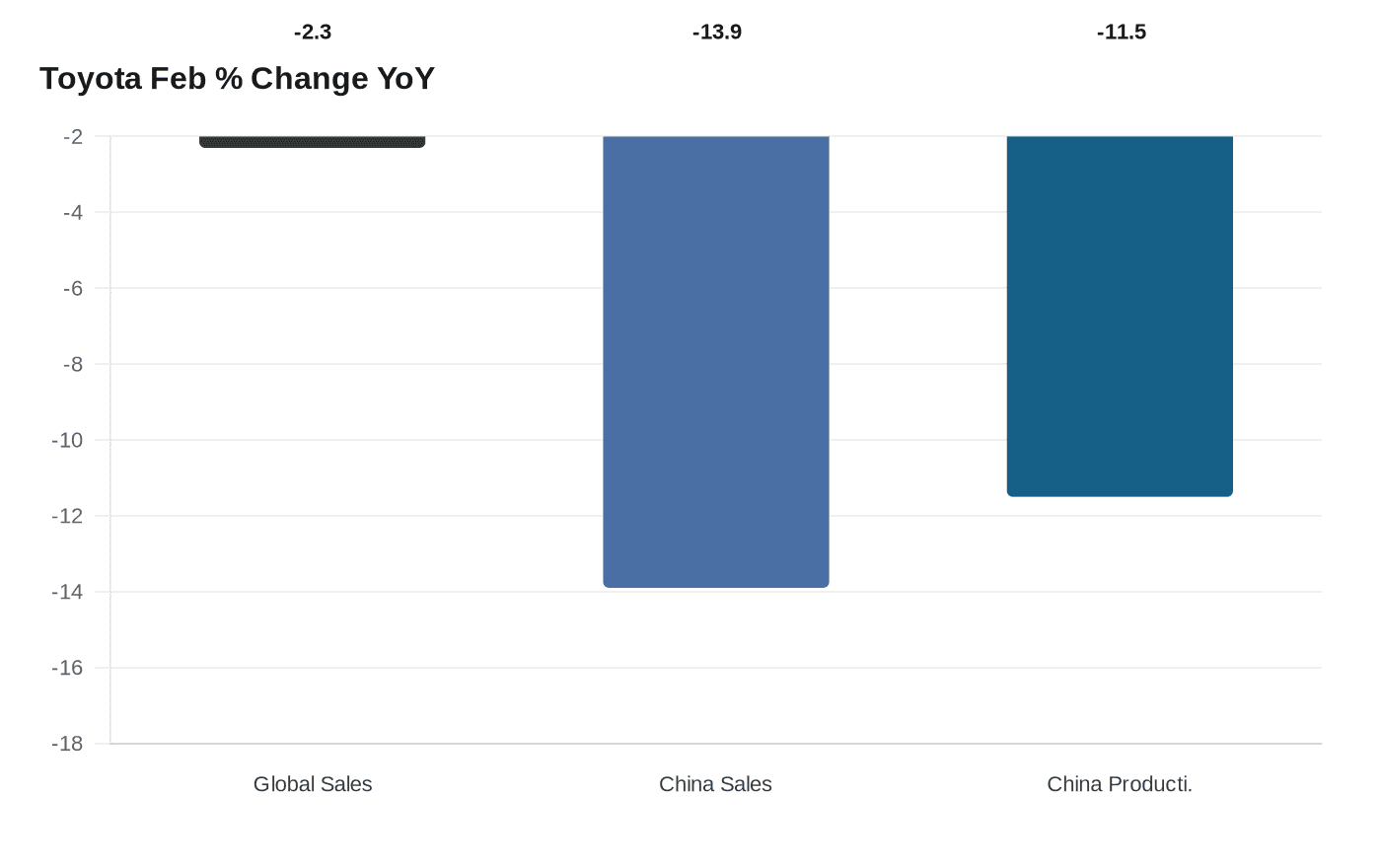
The confluence of a 13.9% China sales drop, aluminum supply routes at risk, active production revisions at multiple automakers, and a seven-figure recall positions February's figures as a leading indicator rather than a seasonal blip. How swiftly Toyota can accelerate local sourcing, lock in alternative material contracts, and stabilize its competitive position in China will determine whether this soft patch deepens into something that reshapes production schedules and dealer inventories well into the second half of the year.
This article was produced by Prism’s automated news system from verified source data, official records, and press releases, then run through automated quality and moderation checks before publishing. The system is built and supervised by the people who set the standards it runs under. Read our full AI policy.
Did this article answer your question?

