Trump Administration Renames U.S. Institute of Peace, Installs Signage
The Trump administration placed a new sign reading Donald J. Trump Institute of Peace on the U.S. Institute of Peace headquarters in Washington, D.C., days before a high profile peace ceremony, intensifying a legal battle over control of the congressionally created institution. The move raises questions about the independence of a body meant to mediate international conflicts and could reshape congressional and judicial scrutiny of federal governance and civic trust.
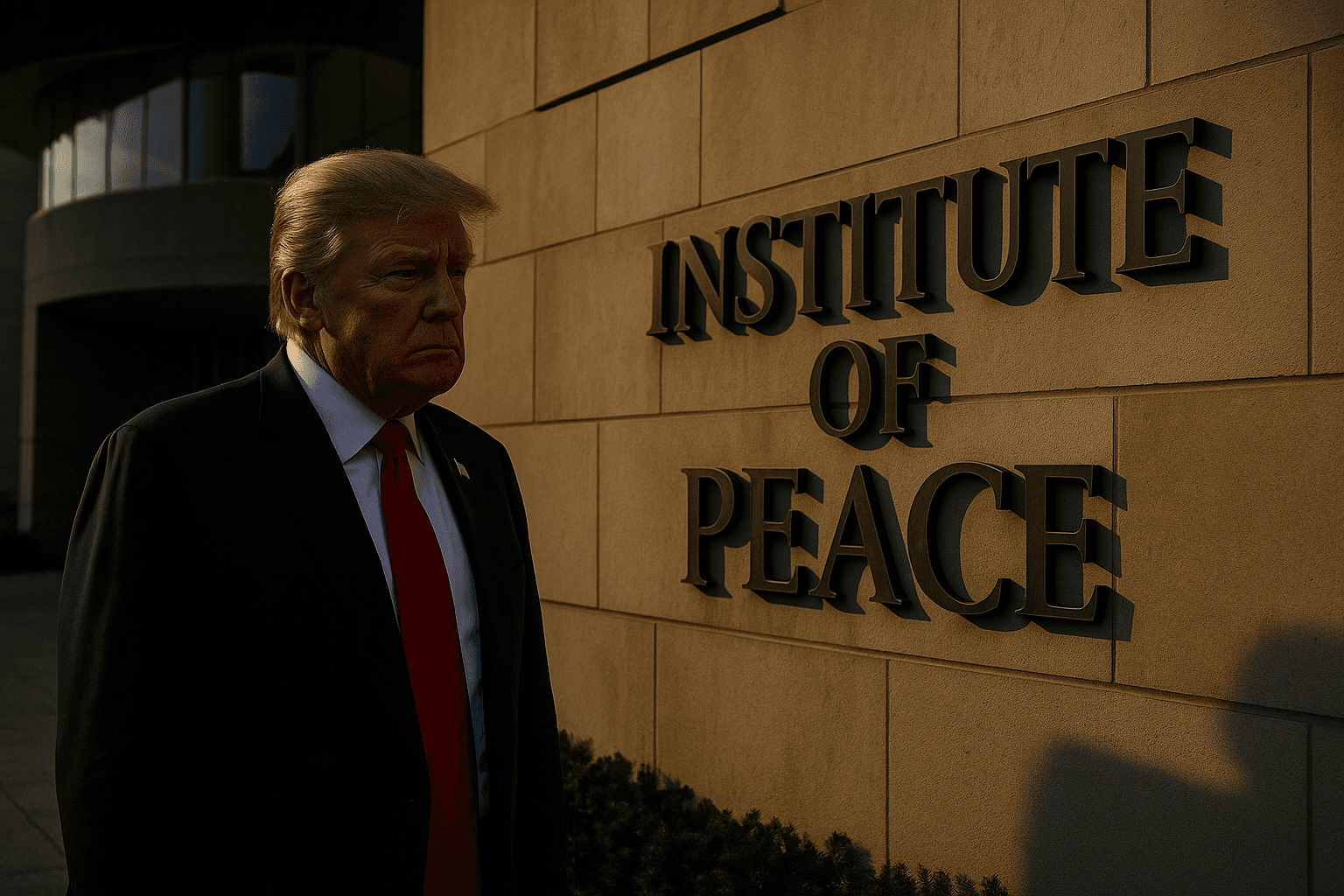
The sign bearing the name Donald J. Trump Institute of Peace was installed on the United States Institute of Peace headquarters near the State Department in early December 2025, days before the building hosted a ceremony where U.S. officials helped broker a peace agreement between leaders of Rwanda and the Democratic Republic of the Congo. The administration announced the rebranding on social media platform X and confirmed the change through State Department and White House spokespeople.
The action came amid months of litigation and institutional upheaval that began earlier in 2025 when the administration’s Department of Government Efficiency removed USIP’s board and moved to transfer control of the headquarters to the General Services Administration. Those removals were challenged in federal court. A district judge ruled the takeover unlawful, a ruling that has since been stayed on appeal, and control of the building has changed hands multiple times as the appeals process continues.
The administration framed the renaming as recognition of the president’s role in recent diplomatic initiatives, describing him in its messaging as a great dealmaker and characterizing the change as a reflection of strong leadership. Press materials for the Rwanda and DRC ceremony referenced the renamed building. Administration officials also criticized the institute’s prior operations as wasteful in public statements accompanying the announcement.
Former USIP officials and their lawyers sharply criticized the move, calling the renaming an insult to injury and arguing that it undermines an institution created by Congress to serve as an independent center for conflict resolution and peacebuilding. Critics say the installation of presidential signage while governance and independence remain contested transforms a neutral operational environment into a political stage, risking damage to USIP’s credibility with foreign partners and with the scholars and practitioners who contribute to its work.
The legal contest has implications beyond a name on a building. USIP’s statutory independence was designed to insulate its research, training, and mediation efforts from partisan influence. If courts ultimately uphold the administration’s actions, scholars and policymakers say it could set a precedent for executive branch control over other congressionally established independent institutions, prompting new rounds of litigation and congressional oversight.
Congressional Democrats criticized the renaming and sign installation, signaling potential legislative scrutiny. For civic stakeholders and the public, the dispute raises questions about accountability and the norms that govern federal institutions. Observers note the symbolism may also affect donor behavior and staff morale at USIP, complicating the institute’s operational capacity at a critical time.
The appeals process continues and the courts will ultimately determine the legality of the administration’s takeover attempts. For now, the renamed sign stands outside USIP’s headquarters as legal briefs and political objections proceed, crystallizing a high stakes battle over institutional independence, the role of presidential branding in foreign policy settings, and the boundaries of executive authority over congressionally created entities.
This article was produced by Prism’s automated news system from verified source data, official records, and press releases, then run through automated quality and moderation checks before publishing. The system is built and supervised by the people who set the standards it runs under. Read our full AI policy.
Did this article answer your question?

