Trump Appeals Court Ruling Halting $400 Million White House Ballroom Construction
Trump's emergency appeal to restart the $400M White House ballroom revealed a classified military bunker he described on Air Force One as "a massive complex."
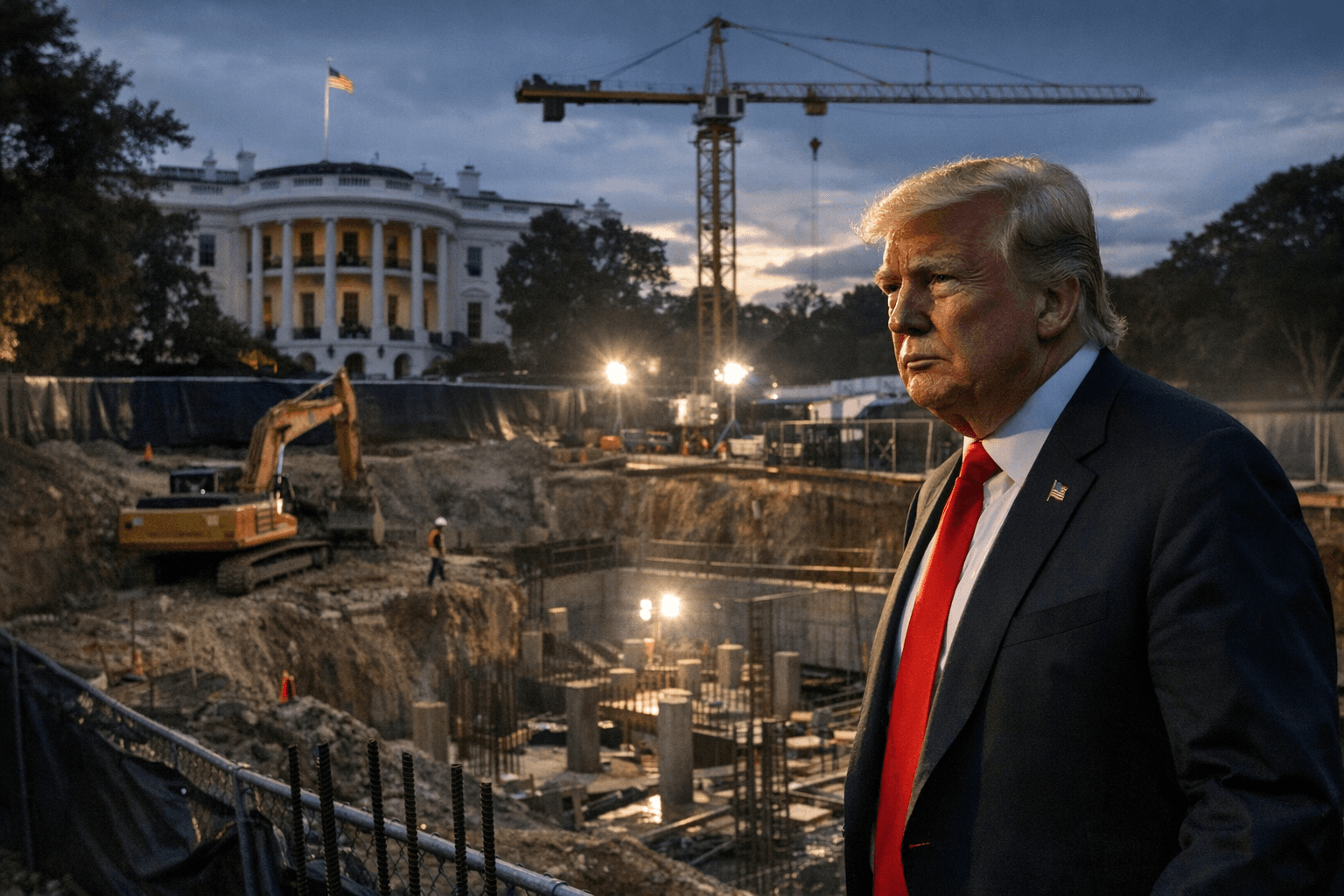
The Trump administration filed an emergency appeal Friday with the U.S. Court of Appeals for the District of Columbia, asking the federal appellate court to revive construction on a $400 million White House ballroom project after a lower court ruling halted work. National Park Service lawyers, filing on behalf of the administration, argued that U.S. District Judge Richard Leon's injunction left the executive mansion "open and exposed" to security threats. At the core of that security argument is something Trump himself inadvertently disclosed: a classified military bunker being built beneath the ballroom.
Leon, a George W. Bush appointee, issued a preliminary injunction on March 31 ordering work to stop. "No statute comes close to giving the President the authority he claims to have," he wrote, in a ruling notable for its repeated use of exclamation points. Construction "must stop until Congress authorizes its completion," Leon declared, after finding that the National Trust for Historic Preservation, which sued in December 2025, was likely to prevail. He carved out a narrow exception permitting work "strictly necessary to ensure the safety and security of the White House" to continue.
The security argument hinges entirely on what lies beneath the proposed structure. Trump disclosed the classified component himself aboard Air Force One, telling reporters: "The military is building a big complex under the ballroom, which has come out recently because of a stupid lawsuit that was filed." He described the above-ground ballroom as essentially "a shed for what's being built under" and called the underground facility "a massive complex." As for why the secret got out: "It was supposed to be secret, but it became unsecret because of people that are really unpatriotic saying things."
That underground facility replaces the Presidential Emergency Operations Center, a bunker originally constructed during World War II to protect Franklin D. Roosevelt from aerial attack. The historical weight of the PEOC is considerable: on September 11, 2001, Vice President Dick Cheney used it to authorize fighter jets to intercept United Airlines Flight 93. The new below-grade structure is described as larger and deeper. White House officials have designated its details classified.
The project has expanded dramatically since Trump announced plans in July 2025 for a permanent venue to host state guests. The cost climbed from $200 million to $250 million by September, to $300 million in October, and reached $400 million by late 2025. Washington firm Shalom Baranes Associates designed the 90,000-square-foot glass-and-steel structure; Clark Construction holds the initial contract. The entire project is funded through private donations, and the White House has not disclosed any donor names. Demolition of the East Wing, which had housed the first lady's offices, began in October 2025 with little public warning. White House Director of Management and Administration Joshua Fisher later cited chronic water intrusion, mold contamination, and obsolete electrical infrastructure to justify the demolition before regulators.
Two days after Leon's injunction, the National Capital Planning Commission voted 8-1 on April 2 to formally approve the project. The commission's chair is William Scharf, who also serves as Trump's White House Staff Secretary. The lone dissent came from D.C. Council Chair Phil Mendelson, who called the ballroom too large. The vote followed reports that White House officials had requested edits to NCPC review materials to soften language describing the commission's formal oversight authority, reframing it as "voluntary cooperation." Construction had already been underway for months before that regulatory approval.
In October 2025, Trump also fired all six members of the Commission of Fine Arts, a body that customarily reviews changes to landmark federal buildings, and has not appointed replacements. If completed, the project would represent the most significant structural change to the White House in more than 70 years. Congressional authorization, which Leon's ruling effectively requires, has not been sought. Neither Trump nor House Speaker Mike Johnson has indicated any intention to bring such a vote before Congress.
This article was produced by Prism’s automated news system from verified source data, official records, and press releases, then run through automated quality and moderation checks before publishing. The system is built and supervised by the people who set the standards it runs under. Read our full AI policy.
Did this article answer your question?

