Trump Budget Seeks Wartime Defense Surge While Cutting Housing, Family Programs
Trump's FY2027 budget requests $1.5 trillion for defense, a 44% surge funded in part by cutting entitlements, housing, and medical research by hundreds of billions.

The largest military budget request in decades arrived five weeks into an active shooting war. President Trump's fiscal year 2027 budget, released April 3, proposed $1.5 trillion in defense spending, a 44% increase of nearly $500 billion over current levels, funded in part by eliminating affordable housing programs, gutting medical research, and cutting entitlement programs for low-income families by as much as $346 billion in a single year.
The backdrop is Operation Epic Fury, the coordinated U.S.-Israel air campaign launched February 28 that killed Iranian Supreme Leader Ali Khamenei in approximately 900 strikes over 12 hours. With the conflict still unresolved when the budget landed, the White House cast wartime necessity as justification for reordering federal priorities away from kitchen-table programs toward combat readiness.
Trump previewed that logic explicitly at a private White House event on April 1: "We're fighting wars. We can't take care of day care... It's not possible for us to take care of daycare, Medicaid, Medicare — all these individual things. They can do it on a state basis. You can't do it on a federal."
The non-defense side of the ledger would shrink by $73 billion, or roughly 10%, under the proposal overseen by Office of Management and Budget Director Russell Vought. The cuts fell hardest on housing, health, labor, and education.
The Department of Housing and Urban Development faced a 13% reduction, and the HOME Investment Partnership Program, which finances affordable and low-income housing construction, would be eliminated entirely. Public housing repair funding would drop by $3.0 billion, a 47% cut compared to 2017 levels. The Center on Budget and Policy Priorities warned the move would "virtually assure a loss of affordable housing stock" in communities already facing severe shortages.
At the Department of Health and Human Services, discretionary spending would fall by roughly 12.5%, with approximately $15.8 billion in cuts targeting the National Institutes of Health, the Centers for Disease Control and Prevention, and related agencies. On top of those reductions, entitlement cuts to SNAP, Medicaid, the Social Services Block Grant, and Temporary Assistance for Needy Families could reach $346 billion in 2027 alone.
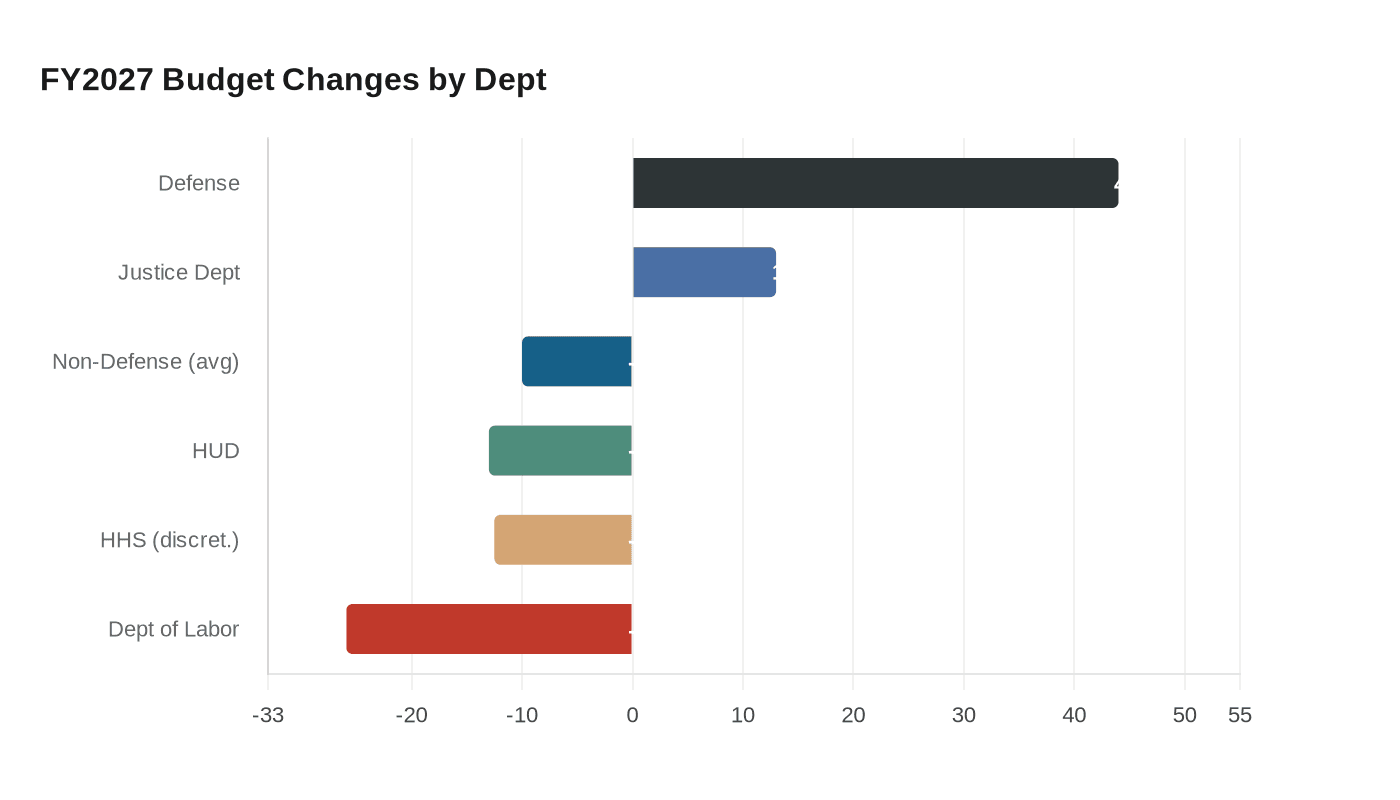
The Department of Labor faced the steepest percentage reduction of any major agency: a 25.9% cut, or $3.5 billion, leaving its total budget at $9.9 billion. Three key educational access programs would be eliminated, $354 million in grants to minority-serving institutions would be cut, and more than two dozen K-12 grant programs would be consolidated or removed, including funding for after-school programs. The Justice Department stood as one of the few domestic agencies to see a boost, receiving a 13% funding increase aligned with the administration's immigration enforcement agenda.
Congressional Democrats moved quickly to condemn the proposal. House Appropriations Committee Ranking Member Rosa DeLauro of Connecticut said, "Families and hardworking people across the country are begging for lower prices, but President Trump is ignoring them and is proposing a budget that will only make the cost-of-living crisis worse." Senate Minority Leader Chuck Schumer and Senate colleagues characterized the budget as reflecting the "wrong priorities." House Appropriations Committee Chair Tom Cole of Oklahoma, by contrast, expressed support for the request.
The scientific community raised separate alarms. Sudip Parikh, CEO of the American Association for the Advancement of Science, noted that "Congress did its job and rejected a catastrophic proposal for FY26," a pointed reference to Congress's broad rejection of Trump's similar domestic cuts last year. The Association of American Medical Colleges warned the proposal "would have far-reaching adverse effects on the future of American health care."
That prior congressional resistance is perhaps the most significant variable in whether any of these cuts survive. The FY2027 budget kicks off a months-long appropriations process, and Congress is under no obligation to adopt it as written.
Sources:
Know something we missed? Have a correction or additional information?
Submit a Tip