Trump policy uncertainty drives lenders, insurers from China-linked solar factories
Lenders and insurers are pulling back from China-linked U.S. solar plants as subsidy rules cloud more than 25 gigawatts of manufacturing capacity.
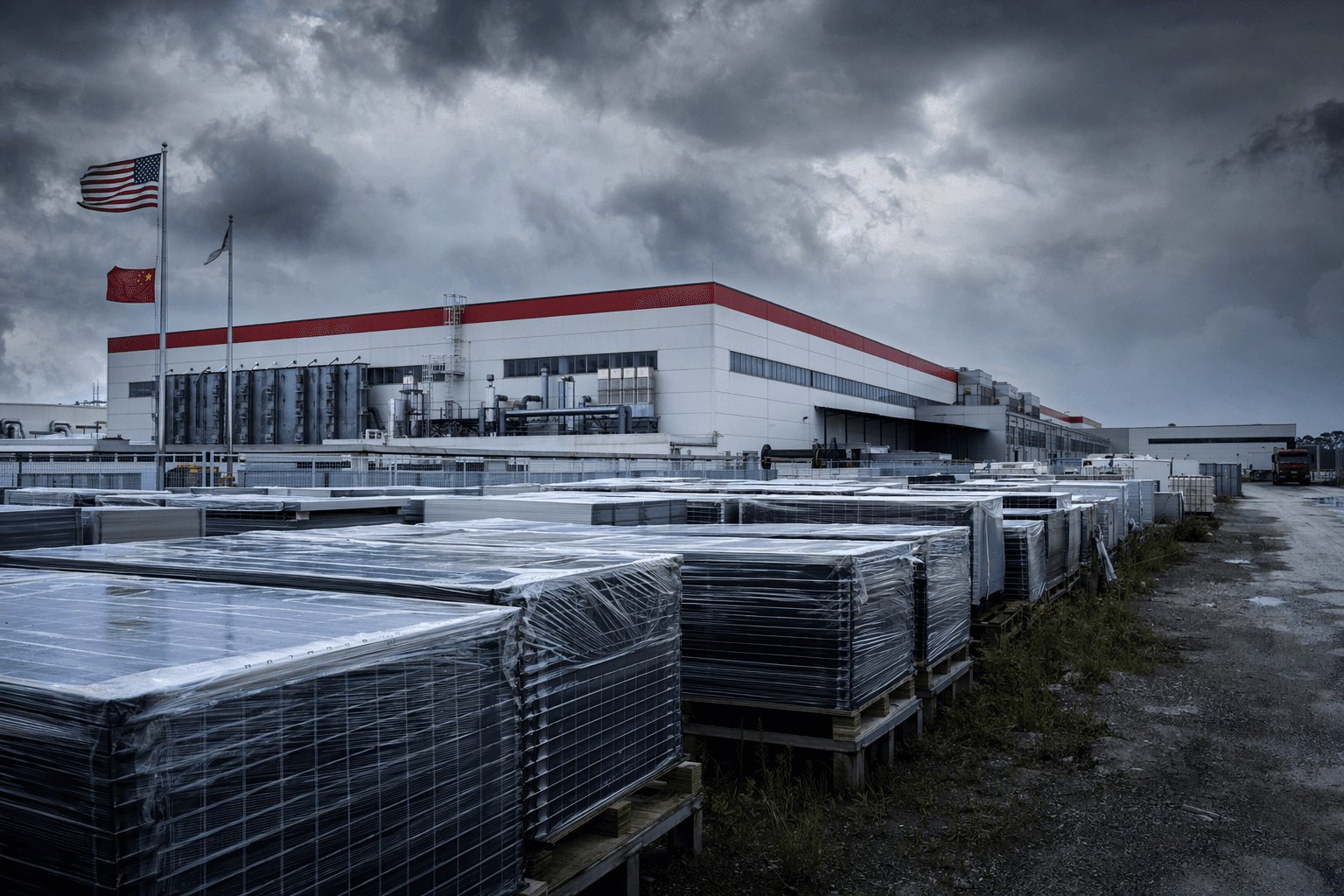
Major solar lenders, insurers and buyers are stepping back from recently built U.S. panel factories with China ties, a sign that Washington’s crackdown on foreign influence is colliding with its push to build a domestic solar manufacturing base. The uncertainty is already freezing financing and commercial relationships at plants that sit on American soil but remain exposed to questions over Chinese ownership, suppliers or earlier development links.
At least six recently built factories have been shunned because market participants fear the facilities could lose access to federal clean-energy subsidies. The exposed slice is large: factories originally built and operated by China-linked producers account for at least 25 gigawatts of the nation’s roughly 66 gigawatts of operating solar module manufacturing capacity. That means more than a third of U.S. solar panel output capacity is now vulnerable to the new compliance chill.
The pressure intensified after the Treasury Department and the Internal Revenue Service issued guidance on Feb. 12, 2026, setting out when facilities, energy storage technologies or eligible components are deemed to have received material assistance from a prohibited foreign entity and therefore become ineligible for certain tax credits. For factories that were designed to help re-shore manufacturing, the guidance has created a moving target. Banks, insurers and installers are reluctant to commit while they wait for a clearer line on what counts as disqualifying China-linked involvement.
The result reaches beyond a single tax program. If lenders will not finance a plant and insurers will not underwrite it, the factory can exist on paper and still struggle to operate at full commercial scale. That creates a direct threat to the administration’s industrial-policy goals, particularly at a moment when the United States is facing rising utility bills and surging electricity demand from data centers serving the artificial intelligence industry.
The broader enforcement backdrop explains why the sector is so cautious. U.S. Customs and Border Protection says the Uyghur Forced Labor Prevention Act bars goods made wholly or in part with forced labor from entering the country, and the Department of Homeland Security says the law is aimed at blocking imports tied to Xinjiang Uyghur Autonomous Region supply chains. A 2025 update to the UFLPA strategy added 78 entities to the enforcement list, showing how intensively Washington has been scrutinizing China-linked solar inputs.
That scrutiny predates the current financing freeze. Reuters reported in 2024 that Chinese companies were expected to have at least 20 gigawatts of annual solar panel production capacity on U.S. soil within a year, enough to supply about half the U.S. market. Now, with major market participants treating China-linked capacity as too risky to back, the anti-China push risks slowing the very domestic manufacturing expansion it was meant to support.
This article was produced by Prism’s automated news system from verified source data, official records, and press releases, then run through automated quality and moderation checks before publishing. The system is built and supervised by the people who set the standards it runs under. Read our full AI policy.
Did this article answer your question?

